The Architect of New York's Drumless Underground
Michael Bonema, known professionally as MIKE, emerged from New York's underground in the mid-2010s as both a prolific solo artist and the gravitational center of the 10k collective, a loose network of rappers and producers redefining abstraction in hip-hop. Born in New Jersey to Nigerian parents and raised partly in London before returning to the Bronx, MIKE's early exposure to displacement and cultural duality became foundational to his introspective, stream-of-consciousness approach. His music operates in the space between memory and present tense, using jazz-soaked loops, minimal percussion, and whispered delivery to create soundscapes that feel like overhearing someone's internal monologue.
What distinguishes MIKE from his peers isn't just his prolific output — he's released over a dozen projects since 2017 — but his refusal to treat underground status as a limitation. His work exists in deliberate opposition to commercial rap's structural conventions, stripping away drums entirely on many tracks and letting bass-heavy samples breathe around sparse, conversational verses. This approach, sometimes called "sLUms rap" after the collective's early name, has influenced a generation of artists exploring lo-fi production and emotional vulnerability without melodrama. MIKE's music doesn't announce its importance; it reveals itself gradually, rewarding patience with layers of meaning that accumulate across repeated listens.
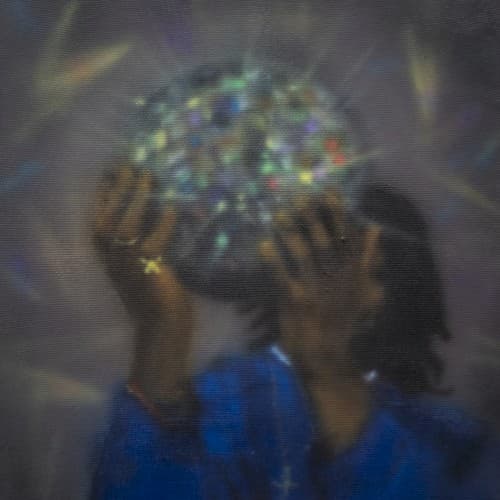
By the time "Disco!" arrived in 2021, MIKE had already established himself as a generational voice for a specific strain of New York rap that values texture over punch, implication over declaration. His connection to artists like Earl Sweatshirt brought wider attention, but his creative vision remains resolutely his own — rooted in personal narrative, African diaspora consciousness, and a production aesthetic that treats silence as an instrument.
Drumless Meditation: MIKE's Lo-Fi Production Language
MIKE's sonic signature is immediately recognizable: jazz and soul samples stretched and warped until they sound like memory itself, often stripped of traditional drum programming in favor of the natural rhythm within the loops. His production — much of which he handles himself under various aliases — favors obscure records, vinyl crackle, and bass frequencies that anchor tracks without overwhelming them. The result is music that feels simultaneously spacious and claustrophobic, like listening through walls or recalling conversations from years past. When drums do appear, they're often subdued, shuffling in the background rather than driving the beat forward.
Vocally, MIKE operates in a near-whisper, his delivery closer to spoken word than traditional rap cadence. He rarely raises his voice, letting the weight of his observations carry the emotional load. His flow is conversational and non-linear, sentences folding into each other mid-thought, jumping between past and present without transition. This creates a hypnotic effect — his verses don't follow conventional bar structures or punchline setups, instead building meaning through accumulation and repetition. Specific images recur across projects: his mother, his grandmother, New York streets, the weight of inheritance, the search for stability in unstable circumstances.
The influence of Earl Sweatshirt's 2018 reinvention is audible in MIKE's work, but the relationship flows both ways — they've pushed each other toward greater abstraction, proving that minimalism in hip-hop doesn't require sacrificing emotional depth. MIKE's production often recalls Madlib's dustiest moments or the meditative loops of early Alchemist, but filtered through a younger sensibility less concerned with tradition than with finding new ways to process grief, displacement, and Black experience in America. His music doesn't demand attention; it invites you into a headspace and trusts you'll meet it there.
From the Bronx to 10k: MIKE's Prolific Underground Ascent
MIKE's recorded output began in earnest around 2015, releasing early projects that established his core aesthetic before most listeners knew his name. His 2017 album "May God Bless Your Hustle" marked a breakthrough within underground circles, introducing the skeletal production style and introspective lyricism that would define his catalog. The project arrived as part of a wave of New York artists — including Standing on the Corner, Navy Blue, and Medhane — who were collectively reimagining what underground rap could sound like in the streaming era. This network, initially called sLUms (an acronym for "sorry, let us mow your lawn"), became 10k under MIKE's stewardship, functioning less as a formal group than as a creative ecosystem.
Between 2017 and 2020, MIKE released a staggering volume of work: "Resistance Man," "Black Soap," "Tears of Joy," "War in My Pen" — each project refining his approach while exploring different emotional territories. "War in My Pen" (2019) represented a creative peak, balancing abstract production with his most focused songwriting to date. These weren't mixtapes in the traditional sense; each felt like a fully realized statement, released with minimal promotion and allowed to find their audience organically through SoundCloud, Bandcamp, and word of mouth. His productivity became part of his identity — MIKE wasn't chasing perfection or commercial timing, he was documenting his interior life in real time.
The 2021 release of "Disco!" through 10k marked a subtle shift, arriving as his most accessible work without compromising his aesthetic principles. The album's reception — including critical acclaim that positioned MIKE alongside Earl Sweatshirt and Billy Woods in conversations about underground rap's intellectual vanguard — validated his approach while introducing him to listeners beyond the SoundCloud underground. Tracks like "Aww (Zaza)" and "Evil Eye" showcased his growth as both producer and writer, maintaining the signature lo-fi haze while allowing more melody and structural clarity to emerge. The project's thematic focus on legacy, family, and the weight of ancestral memory felt earned, built on years of work exploring those same ideas with less refinement.
Since "Disco!", MIKE has continued his relentless release schedule while also focusing on developing 10k as a label and platform for like-minded artists. His collaborations with Earl Sweatshirt have been particularly significant — the two share production credits, trade verses, and push each other toward increasingly experimental territory. MIKE's influence now extends beyond his own catalog; his production style and DIY ethos have shaped how a generation of underground artists approach music-making, proving that you don't need industry infrastructure to build a meaningful career. He's performed at festivals, gained coverage in major music publications, and maintained complete creative control, existing proof that the underground can sustain an artist willing to work within its economics.
Redefining New York Abstraction for a New Generation
MIKE's significance lies not in chart positions or viral moments but in his role as a torchbearer for underground rap's most uncompromising tendencies. At a time when New York hip-hop's mainstream identity became increasingly melodic and drill-focused, MIKE preserved a lineage connecting back to the city's experimental traditions — the abstract wordplay of early Def Jux, the jazz-rap innovations of the Native Tongues era, the raw introspection of late-90s indie rap. His music proves that New York still produces artists willing to challenge what rap can sound like, even if those challenges happen away from major label support or radio play.
The 10k collective's influence now rivals what Odd Future or Pro Era represented for their generations — a self-contained creative universe that operates by its own rules and develops its own stars. Artists like Navy Blue, Medhane, and Jadasea emerged from or alongside this network, each carrying forward aspects of the drumless, jazz-inflected aesthetic MIKE helped codify. His production work for other rappers has spread his sonic fingerprints across the underground, creating a recognizable sound that younger artists continue to reference and build upon. In this sense, MIKE functions as both artist and architect, shaping not just his own catalog but the broader ecosystem of contemporary underground rap.
What makes MIKE's work endure is its refusal to trade in easy answers or conventional hip-hop narratives. His music doesn't offer escapism or aspirational fantasy; it documents the psychological weight of existing between cultures, processing loss, and searching for meaning in ordinary moments. This honesty, combined with production that treats minimalism as expansion rather than limitation, has created a body of work that feels increasingly relevant as more listeners seek alternatives to algorithm-optimized rap. MIKE didn't invent lo-fi hip-hop or introspective lyricism, but he's among the most uncompromising practitioners of both, proving that depth and difficulty can coexist with genuine emotional connection.