Style & Context
Influences
Rock album photography, Cash Money's luxury aesthetic, gothic imagery
Location
This represents Cash Money's New Orleans empire at its commercial peak, when Wayne felt invincible enough to alienate core fans.
Visual Language
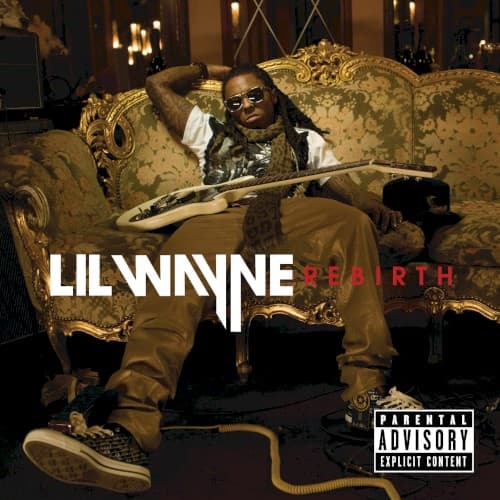
The moody lighting technique borrows from classic rock portraiture while maintaining the opulent visual language of Southern rap.
Symbols
White electric guitar
The pristine guitar symbolizes Wayne's attempt to cross genres into rock, literally held across his body like a new identity.
Ornate baroque couch
The gilded furniture represents Cash Money wealth while Wayne's casual pose suggests comfort in luxury even during reinvention.
Candlelit mansion backdrop
The medieval-style candelabras create a gothic rock atmosphere, blending hip-hop excess with alternative music's darker aesthetic.
Where Sound Meets Image
The guitar is the cover's central element because Rebirth featured Wayne singing and playing over rock instrumentation, abandoning the bars that made him famous. The candlelit opulence mirrors the album's polished production, which layered Wayne's Auto-Tuned vocals over pop-punk guitars and stadium-rock drums. The moody lighting reflects tracks like 'Drop the World' and 'On Fire,' which attempted darker, angrier tones than his previous party anthems. The formal setting contradicts the rebellious music, creating tension between Wayne's established luxury image and his rock star aspirations.
The cover became a visual shorthand for ambitious artistic misfires in hip-hop, representing the risk of alienating your core audience while chasing rock credibility. Its straightforward approach—artist plus new instrument—influenced how other rappers announced genre experiments, though few followed Wayne down the rock path after Rebirth's mixed reception. The image captured a moment when hip-hop's biggest star believed he could succeed in any genre, a confidence that defined the late 2000s rap landscape even as the album itself disappointed fans expecting the lyrical virtuosity of Tha Carter series.