Style & Context
Influences
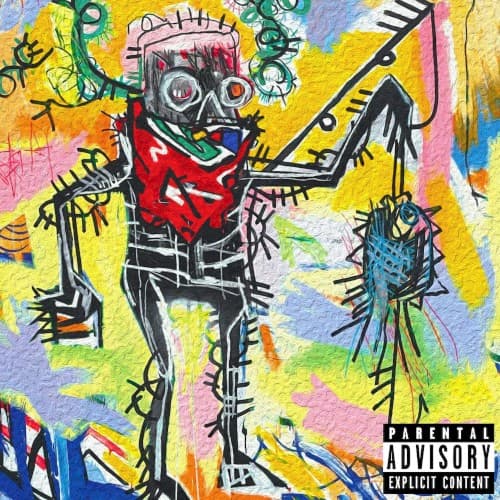
Jean-Michel Basquiat, Haitian Vodou ceremonial art, street graffiti aesthetics
Location
Mach-Hommy channels Newark's Haitian community while nodding to Buffalo's Griselda movement, bridging regional diaspora networks through visual language.
Visual Language
The deliberately crude application and layered textures reject polish, embracing urgency over refinement like Basquiat's anti-establishment visual language.
Symbols
Skeletal central figure
The exposed ribcage and skull represent Haiti's exploitation, a nation stripped bare by centuries of colonial extraction.
Red bandana covering face
The mask suggests both revolutionary identity concealment and protection against systems designed to silence Haitian voices.
Crown motif above head
This Basquiat signature reclaims royalty for Black bodies, asserting pre-colonial African kingship against Western erasure narratives.
Where Sound Meets Image
The visual chaos perfectly matches Mach-Hommy's labyrinthine wordplay and the album's disorienting sample flips of Haitian jazz and kompa. Just as the skeletal figures resist easy interpretation, tracks like 'Folie à Deux' and 'Au Revoir' demand multiple listens to decode their layers of meaning. The cover's refusal of clean composition mirrors the album's rejection of commercial rap structures, both operating as encrypted transmissions for those willing to decode them.
This cover positioned Mach-Hommy as hip-hop's most visually adventurous voice in an era of photographic literalism, proving underground rap could engage fine art without pretension. Its success encouraged other Griselda artists to experiment beyond their noir minimalism, while demonstrating that Afro-Caribbean aesthetics could claim space in East Coast rap's visual vocabulary without dilution.