The scorecard
7.4/10 · Good
- Writing25%
- 7.0
- Production25%
- 8.0
- Delivery15%
- 7.5
- Cohesion15%
- 6.5
- Originality10%
- 8.0
- Replay value10%
- 7.5
The three MCs trade absurdist non-sequiturs and pop-culture rapid fire with real wit, but the jokes are better than the ideas and a few of the stranger left turns land flat.
Drum machines, disco breaks, analog synths, dub and Latin-flavored detours are all handled with taste, and Mix Master Mike's scratching turns the turntable into a lead voice, though the clutter and sprawl sometimes override the focus.
The group's tag-team interplay is sharper than on any rival record of the year, and the vocoder-flavored hook on "Intergalactic" is memorable, though the writing rarely says anything and the earnest moments fall flat.
Twenty-two tracks wander between rap workouts, ballads and instrumental detours, and the closing stretch loses the energy the opening builds.
Reviving early-'80s electro and disco-break rap as a living style, in 1998, was a real swerve that treated old tools as forward-looking, and Mix Master Mike's turntablism added a new texture to the group's sound.
The singles and the best deep cuts reward constant revisiting, though the second half sags and the sprawl means the best version is the one you build yourself by skipping the weaker stretches.
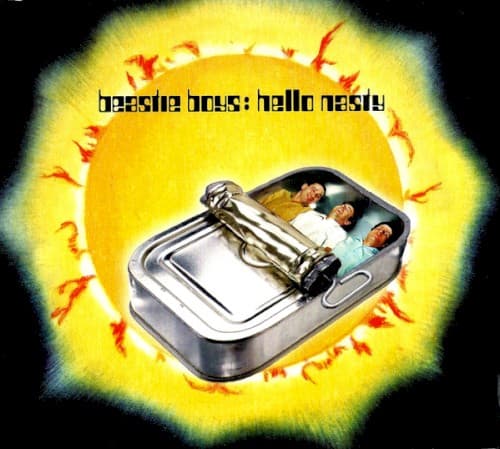
Beastie Boys Hello Nasty: Old-School Rap Rebuilt as a Toy Box
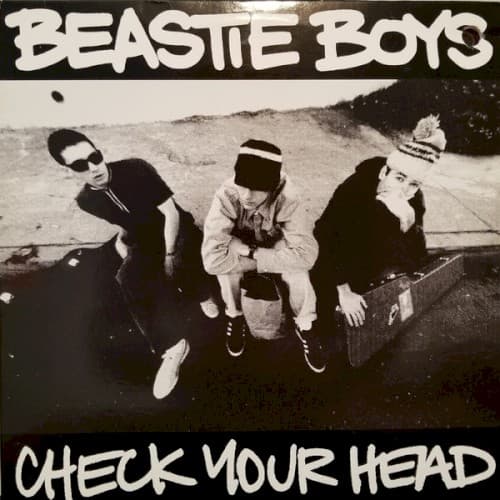
Hello Nasty is the sound of the Beastie Boys deciding that the earliest years of hip-hop were always stranger than the nostalgists remember, and then proving it with twenty-two tracks of public weirdness. Where Paul's Boutique was a sample collage and Check Your Head put instruments back in their hands, this record treats the early-'80s toolkit as a toy box: 808s, disco breaks, beatboxing, analog synthesizers and a turntablist who plays the scratch like a lead guitar. The thesis is that the group got ahead of a rap scene drifting toward polish by retreating to the culture's cheap, odd, electronic roots, and that the retreat is the most forward-looking thing they did.
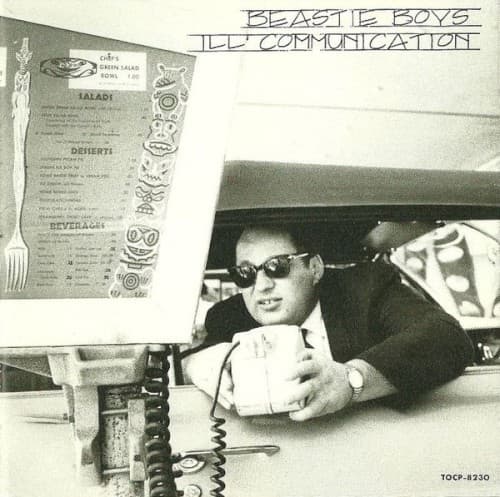
The case rests on how much fun the record sounds like it is having. The three voices still finish each other's lines, the jokes still come faster than you can file them, and the arrangements keep leaving the rap song to chase some tangent: a lounge-pop sendup, a Latin-flavored instrumental, a dub excursion with a legend at the controls. Critics at the time heard a looser, more welcoming Beastie Boys than the one that made Ill Communication, and the ear confirms it. This is the friendliest record they ever made, and it earned that friendliness by being the most musically restless.
Context helps explain the sprawl. The album arrived just over four years after Ill Communication, it added the DMC champion Mix Master Mike to the lineup, and Mike D later described a group so shut away in the studio that it lost touch with everything outside, as if living in a hole in the ground. You can hear the isolation as freedom: nobody is checking the charts, and nobody is editing.
The stakes are about length and discipline. A record this open-handed risks sounding like a clearance sale, and the closing stretch does sag. But the best of it is the funniest, most inventive rap of 1998, and the group's own opinion of it, as Ad-Rock later put it, was that this was their best record. That is too generous, yet it is not a silly claim.
Scratches, Synths and the Joke That Keeps Moving
The production is the album's real argument. Pitchfork's Evan Rytlewski heard a revisionist love letter to 1980s hip-hop, and the best parts of that letter are rhythmic: spare drum-machine programming, snapping disco breaks, beatboxed fills and the thin, bright electronics of the early Sugar Hill and Def Jam years. What separates this from a tribute act is the sheer amount of clutter the group allows into the room. A bass line gets treated like a lead vocal, a scratch answers a rhyme, and a sampled horn turns up for four bars and vanishes. Mix Master Mike deserves his place in that picture. His turntable work is not decoration laid over finished beats; it is part of how the beats are phrased, and it gives the record a sense of live performance that the era's more programmed rap rarely had.
The rapping works because of arrangement rather than because of any one verse. Each MC has a different grain, with one voice clipped and dry, one nasal and sarcastic, one broad and amused, and the production leaves room for them to cut in on one another. They write in strings of images that share a rhythm more than a meaning, and the effect is closer to a standup trio than to a lyricist's reveal. The delivery carries it. A line about nothing lands because the timing is perfect, and a chorus built on a chant, or on a robotic vocal treatment as with "Intergalactic", sticks in the head for days. The guest spots are well chosen and used lightly: a vocal turn from Miho Hatori adds a softer register, and Lee Perry brings the dub tradition in as an equal rather than a novelty.
The weaknesses are real. The writing rarely says anything, and when the group reaches for something sincere the results are earnest rather than sharp. A few jokes are weaker than the surrounding ones, and a few of the stylistic detours, like the lounge-pop pastiche of "Song for the Man", are charming for a minute and too long at three. The mix of straight rap songs and loose electronic instrumentals also means the record never settles into one groove for more than a handful of tracks, so the momentum that a hard run of songs builds gets reset again and again. On a better-edited record those instrumental passages would be the connective tissue. Here they sometimes read as the group declining to choose.
Still, the sound is distinct. Nothing else in 1998 sounded this relaxed about using old tools, and few rap records have been this willing to let a producer's curiosity override the hit-making instinct. The comedy and the music are the same thing, and that gives the album a character a more disciplined record would have lost.
Twenty-Two Tracks, One Long Party With a Slow Exit
As a sequence, Hello Nasty is front-loaded and generous to a fault. The opening run is the strongest stretch, moving quickly from disco-break electro through hard rap and party-starters, and it peaks around "Intergalactic", where the album's mix of absurdity and groove is at its most compact. After that the pacing becomes more of a playlist than an arc. Ballads, dub, Latin instrumentals and drum-and-bass flavored experiments are scattered between straight rap songs, and the shifts in tone sometimes feel arbitrary rather than designed. That is part of the charm on a first listen and part of the problem on a tenth.
The second half, which spends a long time in the dub and ballad zone, is where the length is hardest to defend. The tracks are not bad, but several are the kind of idea that works as a two-minute interlude and gets stretched into a full song. The closing stretch is the weakest part, and an AllMusic critic called the ending a little anticlimactic, which is fair. A shorter record that dropped four or five of the middle tracks would have been tighter, and a few of those cuts would have made better B-sides than album tracks.
Where the album earns its length is in variety. Every few songs a new texture arrives, and the group's willingness to sound different on each track means the record never turns into a single-note exercise. The best version of Hello Nasty is the one you build yourself, by taking the first third, a handful of later highlights and the Lee Perry collaboration, and skipping the rest. Even the full version works well as background for a long drive. Nobody sequences a record like this to be heard at attention, and the group seems to know it, which is both the generosity and the limitation. The final track, "Instant Death", is a fitting capstone only in the sense that it leaves the record on a note of mischief rather than an argument.
Third in the Catalog, First in Sheer Willingness
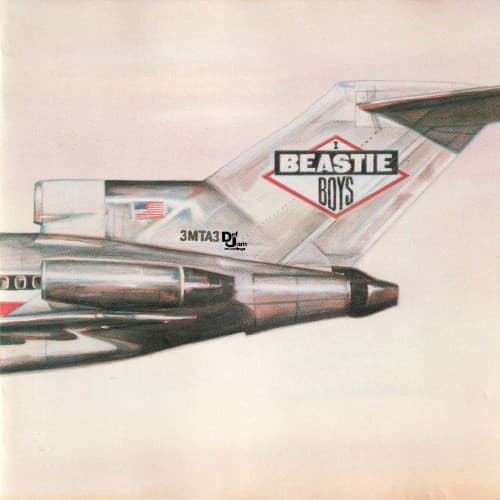
In the Beastie Boys catalog, Hello Nasty sits in the second tier behind Paul's Boutique and Licensed to Ill, and a hair behind Ill Communication. Paul's Boutique is a tighter, denser piece of work, and Licensed to Ill has an immediacy that this record never tries to match. Hello Nasty beats Ill Communication on invention and on pure good humor, but loses it on sequencing: it has the highest peaks of the late-period records and also the loosest middle. That is the deliberate ordering behind the score.
It is for listeners who like their rap playful and musical, who think a joke and a groove are the same thing, and who are curious how early-'80s electro and disco rap sounded when played by people who loved it. It will also suit anyone interested in turntablism, since Mix Master Mike's arrival changes the group's sound. It is not for those who want unified concept albums, who want lyrical density, or who dislike genre-hopping. If the ballads and dub experiments are not your thing, you will skip about a third of it, and that is a fair reaction.
As for age, the party-record side of the album has held up better than the experimental side. The singles still sound fresh and the production does not date in an obvious way, because it was already revisiting an older sound when it was made. The weaker tracks have aged the way weaker tracks always do, quietly.
For a first listen, start with "Intergalactic" for the hook and the Grammy-winning performance, then "Body Movin'" for the party side and "Dr. Lee, Phd" for the dub side. If you want the Beastie Boys at their most dense and sample-heavy, go back to Paul's Boutique, the better-built record. If you want the instrument-playing, funk-and-hardcore side of the group, Ill Communication is the sibling. Hello Nasty remains the one to play when you want to hear three friends and a turntablist treat a whole genre as their own private joke.
Track by track
Track Listing
Super Disco Breakin’
StandoutA fitting opener that sets the thesis in place: electro drums, disco-break energy and scratching, all played as a party rather than a lecture. It announces the early-'80s toolkit without apologizing for it.
The Move
SolidA short, groove-forward piece that keeps the opening run moving. Fine as a connector, forgettable on its own.
Remote Control
StandoutOne of the straight rap songs that supplies the instant gratification, with the three voices cutting in on each other. It is more about momentum than about any one line.
Song for the Man
SolidThe lounge-pop sendup, a put-down of a loser set to kitsch, and the album's clearest example of a detour that is more fun to describe than to replay. The joke is fine for a verse and then outstays itself. It shows the group's range but not its best judgment.
Just a Test
SolidAnother rap-driven cut that keeps the first half lively. Solid, without being a standout.
Body Movin’
StandoutA party track built on a rolling groove and a hook designed to move a room, and it does the job well. This is the kind of song that works because the group does not take itself seriously. It sits comfortably with the best of the album's accessible side.
Intergalactic
StandoutThe album's centerpiece and its biggest song, built on a robotic vocal treatment, a chant-ready hook and the three voices playing off each other in a sci-fi cartoon of a rhyme scheme. It won the Grammy for Best Rap Performance by a Duo or Group, and the award is deserved on delivery alone. The track is a compact version of the album's whole argument: electronic, funny, rhythmic and impossible to dislike. Start here.
Sneakin’ Out the Hospital
SolidA slower, odder cut that shows how the album uses tempo changes to break up the rap songs. It works as a change of pace without leaving a strong mark.
Putting Shame in Your Game
StandoutA hard-rapping track in the style of the album's instant-gratification songs, with the group at its most competitive. It has bite and lacks surprise.
Flowin’ Prose
StandoutA drum-and-bass shuffle woven subtly into the rhythm, which is the album at its most quietly inventive. The group does not announce the experiment; it just lets the beat move differently. It is a better illustration of what Mix Master Mike's arrival changed than the showier tracks.
And Me
SolidA relaxed, low-key track that trades energy for atmosphere. Pleasant, but it is the first sign that the first half of the album is about to run out of urgency.
3 MC’s and 1 DJ
StandoutA group-portrait cut that puts the lineup in the foreground, three rappers and a turntablist, and makes the new member's role plain. The track is a statement of method more than a song, and it is stronger as a statement than as a listen.
The Grasshopper Unit (Keep Movin')
SolidThe start of the second half, a restless track that tries to keep the energy up after a natural break. It is serviceable and slightly overshadowed by the stronger material before it.
Song for Junior
StandoutA Latin-flavored instrumental, in the vein of a Santana-and-Traffic summit, that proves the group can play rather than just sample. It is warm and well made. It is also a reminder that the album is more interested in mood than in rap.
I Don’t Know
SolidAn earnest, soft ballad featuring Miho Hatori, which gives the record a gentler register. It is sincere and pretty, and probably the clearest example of the album trading punch for feeling. Some will find it a highlight; others will skip it.
The Negotiation Limerick File
SolidA loose, playful track in the album's off-center mode. It fits the spirit more than it justifies the running time.
Electrify
SolidA rap track with enough bounce to wake up the second half. It works, though it is not among the album's most memorable cuts.
Picture This
SolidA mid-sequence track that adds texture but little new. Filler in the best sense: pleasant, brief and easy to forget.
Unite
SolidA communal, easygoing track in the style of the group's calls for solidarity. It is warm without being sharp.
Dedication
SolidA sincere, understated cut that slows the late run down further. It is well meant and mostly adds to the sense of a record winding down.
Dr. Lee, Phd
StandoutThe Lee Perry collaboration, and the best of the album's tipsy dub tracks. Rather than treating the Jamaican producer as a guest cameo, the group lets his sensibility reshape the groove, and the result is loose, strange and genuinely musical. It is the strongest argument that the second half has material worth finding.
Instant Death
SolidThe closer, which leaves the record on a note of mischief rather than a climax. It is consistent with the album's temperament, but it does not fix the sense that the ending is anticlimactic.
Frequently Asked Questions
Is Hello Nasty the best Beastie Boys album?
What awards did Hello Nasty win?
What songs should I hear first from Hello Nasty?
Who is Mix Master Mike on Hello Nasty?
Styles