The scorecard
7.9/10 · Great
- Writing25%
- 7.0
- Production25%
- 8.0
- Delivery15%
- 9.0
- Cohesion15%
- 7.5
- Originality10%
- 9.0
- Replay value10%
- 8.0
The themes of violence, drugs and death are standard for the genre, but the framing, with grief running under the boasts, gives the verses more weight than the word choices alone would.
DJ U-Neek's rumbling pianos, synthetic strings and slow bass build a dark G-funk bed that is melodic and cohesive, even if the drums are modest.
The interlocking, half-sung rapping of five voices, with Krayzie Bone on every track, is the album's defining achievement and has few equals in the genre.
One mood from start to finish is a strength in design, but seventeen tracks at similar tempos and two skits sag in the middle.
Sing-rap this fast and this tuneful, laid over West Coast funk, had few precedents in 1995.
The melodies and layered harmonies reward repeat listening, though the narrow tonal range limits how often the full album sits right.
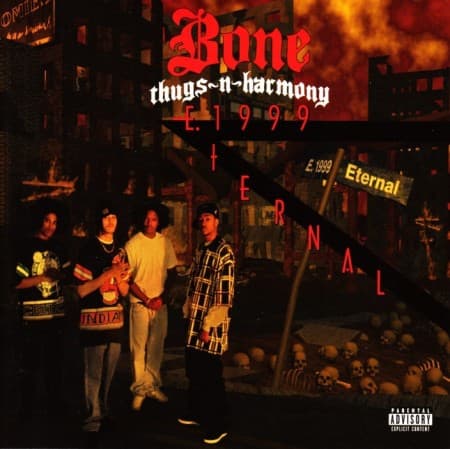
Bone Thugs-n-Harmony E. 1999 Eternal: Menace Sung Like a Hymn
The strongest case for E. 1999 Eternal is that nobody else could have made it, and the second strongest is that it still sounds like Los Angeles. Five voices from Cleveland sing-rap at double speed over slow, smoked-out keyboards, and the combination turns gangsta rap's usual coldness into something closer to a wake. That tension between a mourning sound and a murderous subject is the thesis: this is a 90s street record whose melodies do the arguing, and whose menace lands harder because it is so easy to hum.
That is a stranger claim than it sounds, because the inventory is familiar. Drugs, gunplay, paranoia and death fill the record the way they filled every West Coast gangsta album of the period. What Bone Thugs-n-Harmony changed was the delivery. The verses are fast, interlocked and half sung, and the hooks arrive as stacked harmonies that make a threat sound like a hymn. Set beside the Compton and Long Beach tradition, where menace usually came from a deadpan baritone and a bounce you could set a watch by, the contrast is stark. West Coast records of the era were rarely this tender while describing this much violence.
The context matters here only because it explains the mood. The album arrived four months after Eazy-E died, and he is credited as executive producer and album concept. The grief is not a marketing gesture, though; it is built into the keyboards and the voices, and the record would sound bereaved with or without the dedication. DJ U-Neek produced the whole thing, a Los Angeles producer working in a dark G-funk register, and the consistency of his palette is what lets several distinct voices sound like a single organism.
It is not flawless. The sound is deliberately sluggish, and across seventeen tracks the tempos blur, which leaves the vocals to separate one song from the next. The audience heard what the critics heard anyway: the album opened at number one, stayed there for a second week, and became the group's best seller. Next to the cool, rolling funk of Dr. Dre and his heirs, this is a West Coast sound turned inside out, borrowed in its bass and synth language and wholly earned in everything that sits on top of it.
Funeral Keyboards, Liquid Voices, and a Beat That Never Hurries
The production earns its reputation by being unfashionable in the right way. DJ U-Neek builds around rumbling piano chords, mellotron-style textures and synthetic strings, then lets the bass sit low and the drums move slowly. The G-funk vocabulary is plainly West Coast, but the usual party-ready swing is replaced by a funeral pace. Critics have noted that the beats are not especially striking by themselves, and that is a fair complaint about the drums: on their own they are modest, and a few songs lean on a mid-tempo plod that a lesser vocal group could not have survived. The strength is in the melodic bed, which behaves like a songwriter's arrangement. Layzie Bone is credited as a producer as well, and the whole album sits in one coherent sonic frame.
The group's delivery is the real invention, and it is easy to underrate how technical it is. Two or three voices will trade a line mid-bar, lock into a unison for the hook, then split into counter-melodies, all at a speed that would leave most rappers short of breath. The sing-song cadence reads as a Jamaican-influenced approach to toasting as much as it reads as rap, and it lets the verses carry melody without a dedicated singer. Krayzie Bone is on every track, and his fluid, almost liquid line is the thread that ties the ensemble together, while Bizzy Bone's fractured, restless intensity provides the album's most unpredictable moments. Layzie Bone and Wish Bone fill out the middle with steadier, more conventional rapping, and the blend works because each voice has a distinct texture.
Lyrically, the album works at a narrower range than its reputation suggests. The themes are the standard ones of the genre, and the writing rarely produces a surprising image or a fresh angle on them. Where it does stand out is in how it frames the subject: the violence is delivered with such lilting melody that the menace feels almost spectral, and the repeated references to death and loss take on a ghostly quality. That is a strength of tone rather than of ideas. When the verses lean on a stock threat, the music does the work that the pen does not, and a listener who reads the lyrics without hearing them would find the writing thinner than the performance implies.
The sequencing of tone is also the album's main limitation. The record maintains one mood from beginning to end, which is impressive as design and tiring as an experience. There is little release, little humor, and almost no change of tempo, so an hour in, the effect that was gripping at the start can feel like a closed room. The two skits do not help, and the explicit-only closing tracks add length rather than shape.
For all that, the album is stronger than the sum of its parts. The tunefulness never lapses, the voices stay in tune with the bass, and the hooks are placed so that even the heaviest verse resolves into something warm. It is a record that gets better when its darker references clear up on repeat listens, and the layers become more rewarding the closer you listen.
A Slow Descent Through One Long Night
The sequence is built as a slow descent. The opening stretch establishes the mood quickly: after a short, ceremonial introduction the record settles into its hazy mid-tempo groove and does not leave it for a long time. That is a smart decision in the first third, where the commitment to one tone feels like confidence, and the early songs have the best melodies on the record. The momentum is strongest between the title song and the cluster of longer posse-style cuts that follow, where the voices trade lines so quickly that the pacing feels propulsive despite the slow tempo.
The middle of the album is where the design starts to strain. Several songs run past four or five minutes at nearly identical speeds, and the reliance on the same piano-and-strings palette means that the transitions between songs are barely audible. A skit lands at the point where the album needs a change of direction and instead offers a brief pause, which is useful but not transformative. The record's best sequencing instinct is the way two songs near the end flow into each other, a segue that gives the closing stretch a sense of continuity the middle lacked.
The final run is the least certain part. The last two tracks appear only in the explicit edition, and they feel like additions rather than a conclusion: the album does not so much end as stop. At seventeen tracks and well over an hour, the length is only partly earned. A tighter version, shorn of one or two of the slower mid-album cuts, would play as a near-perfect forty-five minutes. As released, it is a record you absorb as an atmosphere rather than a narrative, and it works best in sections.
Even so, the sag is relative. Nothing on the record is bad, and the lows are simply long stretches of competent, similar work rather than failures. The peaks are high enough, and the melodic consistency strong enough, that the record rarely loses a listener who has accepted its terms.
The Most Haunted West Coast Record of 1995
No other Bone Thugs-n-Harmony album is rated on this site yet, so the ranking here is a judgment about the record's place in the genre rather than the group's catalog. It is the clear high point of their early run: the group's best-selling album, a number-one debut that held the top for two weeks, and a Grammy nominee in the first year of the Best Rap Album category, where it lost to Naughty by Nature's Poverty's Paradise. The commercial result matches the artistic one. It is the record where the group's invention and U-Neek's production line up perfectly.
Who is it for? Anyone who wants to understand how rap absorbed melody before melody became the default. Fans of G-funk who find the genre too sunny will hear its darker cousin here, and anyone who has followed the singing-rapper lineage that runs through Naughty by Nature and onward will find the root of a lot of later flows. Skip it if you need lyrical density, narrative storytelling or tempo variety; the album's ideas are thin and its moods are narrow, and a listener who judges rap primarily on pen craft will find less than the reputation promises.
It has aged well because the vocal technique is still rare. Many artists since have imitated the singsong cadence, but few have matched the way the voices fit together, and the sedated keyboards sound more distinctive now than much of the funk revivalism of the period. The weaknesses have also aged in the expected way: the length feels more like a CD-era habit than a creative choice, and some mid-album songs are interchangeable.
Start with East 1999, Eternal and Crossroad, which give you the sound, the melody and the emotional center in turn. Then, to hear the same West Coast foundation with a very different temperament, try Dr. Dre and his funk-driven catalog for contrast; for a Midwestern rival in melodic delivery, the Naughty by Nature album that beat this one at the Grammys is the obvious comparison. The record's lasting power is that a group of five rappers from Cleveland made the most haunted-sounding West Coast album of its year, and nobody has been able to copy the way it hums.
Track by track
Track Listing
Da Introduction
SolidA short, ceremonial opener that sets the funereal tone before any rapping starts. It works as scene-setting and nothing more, but it tells you exactly what kind of record this is.
East 1999
StandoutThe title song is the album's thesis in miniature, and one of its clearest showcases for the group's interlocking style. Voices pass lines back and forth so quickly that it is hard to tell where one rapper ends, then lock into a stacked hook that turns the neighborhood boast into something almost devotional. U-Neek keeps the keyboards low and the drums patient, so the vocals get the whole front of the mix. It sets a template the rest of the album follows, and because it arrives early, the template feels fresh rather than repeated. Not every verse is a landmark, but the ensemble work is the point, and the record rarely sounds more confident or more itself than it does here.
Eternal
StandoutThe title cut leans harder into the album's elegiac side, with the melody carrying more weight than the bars. The harmonies sound like a eulogy, which fits the dedication to Eazy-E, and the production lets the sadness sit without pushing it. It is a slower, quieter peak than the opener, and it shows that the group could build emotion from tone alone. The lyrics are less specific than the arrangement, which is the one thing holding it back from the top tier.
Crept and We Came
SolidA menacing, mid-tempo posse song where the verses trade quickly and the beat stays out of the way. It is solid and typical of the album's middle, strong in delivery and modest in invention.
Down ’71 (The Getaway)
StandoutOne of the album's longer narrative-leaning songs, and U-Neek is credited as producer. The voices move over a slow, rolling bed with a sense of motion that the other mid-tempo cuts lack. The storytelling is more cinematic in intent than in detail, but the pacing is good and the hook sticks. A standout for the way it uses the group's speed to suggest flight rather than just aggression.
Mr. Bill Collector
SolidA solid cut with a slightly looser groove, and the vocal interplay carries it. The subject is everyday pressure rather than outright violence, which gives the album a rare moment of relatability. It runs a little long for what it has to say.
Budsmokers Only
StandoutA shorter, smoky mood piece produced by U-Neek, and one of the cleanest examples of the album's G-funk lineage. The haze in the keyboards matches the subject, and the hook is easy to remember. It is lightweight but well made, and it breaks up the heavier songs around it.
Crossroad
StandoutThe emotional center of the record and its most widely known song, and the dedication to Eazy-E is felt in every bar. The group sings more than it raps, with a chorus that reads as a prayer, and the verses mourn lost friends in plain, direct language rather than elaborate imagery. The arrangement is spare, with sustained keyboards and a slow beat that leaves the voices exposed, and that restraint is what gives it power. It is the one track where the melodic gift and the grief meet without any filler between them. Even listeners who find the rest of the album monotonous tend to make an exception for this one, and the difference is audible in how little it relies on menace.
Me Killa
SolidA skit of under a minute. It adds a little atmosphere and nothing else.
Land of tha Heartless
StandoutA compact, aggressive song with some of the sharper delivery on the album. The shorter runtime keeps it focused, and the voices are tighter and meaner than on the longer cuts. The ominous keys do the heavy lifting.
No Shorts, No Losses
SolidA long, steady posse cut that shows the limits of the formula. The verses are well performed, but the beat barely changes across nearly five minutes, and the energy flattens in the second half. Competent, but the kind of song that blurs into its neighbors.
1st of tha Month
StandoutA highlight, produced by U-Neek, and a rare moment of lightness. It frames the arrival of the month as a communal ritual, and the bouncy feel makes it the most inviting song on the record. The voices are loose rather than strained, the hook is built for singing along, and the production leaves space for personality. Without it, the second half would feel considerably heavier. It also demonstrates that the group could be warm without losing the signature sound, which makes it more important to the album's balance than its subject suggests.
Buddah Lovaz
SolidA hazy, drifting song that leads directly into the next track. The mood is consistent with the rest, but the melody is more diffuse and the hook less assertive. Fine as atmosphere, minor as a song.
Die Die Die
StandoutA short, hard-edged song produced by U-Neek that flows out of the previous cut. The urgency is welcome after the drifting stretch, and the compressed length keeps it sharp. One of the better uses of the album's menace.
Mr. Ouija 2
WeakA short skit that continues the previous track's thread. Brief atmosphere, no real content, and filler by design.
Mo’ Murda
SolidOne of the two tracks found only on the explicit edition, and at nearly six minutes it is a heavy way to close the album. The vocals are strong, but the beat does little that earlier songs did not, and the length feels indulgent.
Shotz to tha Double Glock
WeakThe closer is an explicit-edition posse cut with a roster of guests, including Tony Tone, Tombstone, Mo! Hart, Boogie Nikke, Sin & Sage. The crowd of voices gives it a loose, street-corner energy, but the group's chemistry is diluted and the song stops rather than concludes. A weak ending to a strong record.
Frequently Asked Questions
Is E. 1999 Eternal Bone Thugs-n-Harmony's best album?
Who produced E. 1999 Eternal?
What are the best songs on E. 1999 Eternal?
Did E. 1999 Eternal win a Grammy?
Styles