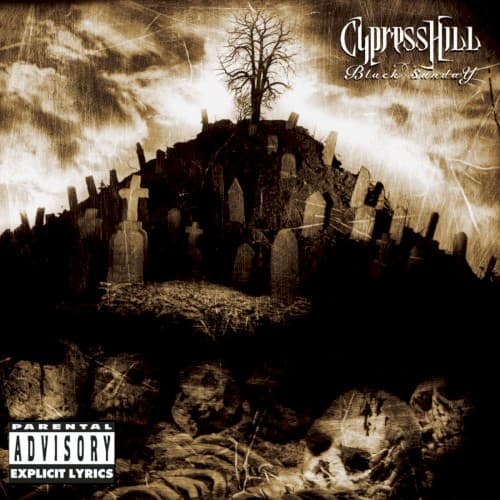
The scorecard
8.2/10 · Great
- Writing25%
- 7.0
- Production25%
- 9.0
- Delivery15%
- 8.5
- Cohesion15%
- 8.0
- Originality10%
- 8.5
- Replay value10%
- 8.5
The gun and weed material is vivid and consistent in tone, but it narrows to a few subjects and leans on repetition over development.
DJ Muggs builds sparse, bass-heavy, loop-based tracks with menace and space, and Insane in the Brain turns a tiny groove into a crossover hit.
B-Real's pinched, nasal voice against Sen Dog's low, barking one is instantly recognizable and gives every hook a built-in contrast.
Fourteen tracks with several short interludes and sketches keep the pace tight, though the gunplay songs begin to blur in the second half.
No other rap act in 1993 sounded like this: Latin-inflected, weed-centered and dark, without borrowing the G-funk sound dominating the West Coast.
Short running times and strong hooks make it easy to return to, even if the lyrics offer fewer layers than the beats.
Cypress Hill Black Sunday — Menace Built from Almost Nothing
Black Sunday proves that a rap album can be menacing without being busy. DJ Muggs strips his beats down to a loop, a drum pattern and a bass line, and then leaves enormous gaps, so every sound in them carries weight. Into that space step B-Real, whose high, pinched voice sounds like a warning, and Sen Dog, whose barked lows hit like a hand on the table. The effect is a record that feels threatening and playful in the same breath, and that quality, rather than any single verse, is why it holds up.
The thesis is simple: Black Sunday is a producer's album first and a rapper's album second, and it is one of the strongest of its decade because the production is so confident. The group's second record followed a debut that was already a hit, and it did something unusual for a sequel by sharpening the sound rather than widening it. The fact sheet says it debuted at number one on the Billboard 200 with 261,000 copies in its first week, which was the highest SoundScan figure for a hip-hop group at that time, and that the group briefly had two albums in the top ten at once. Those numbers matter because the music behind them is neither polished nor pop-minded. It is spare, dark and a little strange, and a lot of people bought it anyway.
What makes that impressive is the contrast with the dominant West Coast sound of 1993, which was warm, melodic and funk-driven. Cypress Hill went the other way, toward dust, tension and a Latin-inflected street identity that no peer had. The weakness is also clear from the start: the lyrical range is narrow, and the writing leans on a small set of themes, mostly weed and guns, that the record repeats more than it develops. The album gets away with that because the beats and voices are so distinctive, but a listener looking for storytelling depth will find less here than in the best of its peers.
Muggs, Space and the Two-Voice Trick
The core of Black Sunday is the relationship between a minimal beat and two very different voices. DJ Muggs is credited with turntables, arrangements, programming, mixing and executive production, and the album sounds like the work of one person with a clear idea. The drums hit hard but not fast, the bass is thick and dry, and the samples are used as short, looping hooks rather than as full musical backdrops. T-Ray is credited as producer on one track, and the rest of the record carries Muggs's stamp, which gives it a consistency that many rap albums of the era lacked.
That consistency is the album's greatest strength. Where Dr. Dre's G-funk sound, then at its peak on the West Coast, filled the frame with synth leads and live-sounding bass, Muggs leaves the frame mostly empty and lets tension do the work. The comparison is useful because it shows what Cypress Hill earned and what they borrowed. They borrowed West Coast gangsta themes and swagger; they earned a sound that is almost the opposite of the sunny, rolling groove down the coast. The result sounds closer to a horror soundtrack with a bounce than to a party record, and it is the main reason the album did not date in the way trend-chasing records did.
On the microphone, B-Real and Sen Dog work as a pair of contrasting textures. B-Real's nasal, almost cartoonish tone gives the hooks their bite and makes even a simple line stick, while Sen Dog's lower, rougher delivery grounds the verses and adds menace. Their chemistry is why the record works at slow and medium tempos, and why the hooks land. The delivery reads as distinctive rather than technical; neither rapper is a dazzling lyricist, but both understand how to place a line against a loop.
The weakness sits in the writing. The subject matter is tight to the point of repetition: celebrations of smoking and threats of violence cover most of the record, and a listener who plays it end to end will notice the same ideas turn up in slightly different clothes. There is humor and a sense of character, but there is little development, and the second half in particular leans on attitude over new angles. The album works because the sound sells those ideas, not because the verses add much new.
Still, the combination of minimal beats, contrasting voices and a Latin-inflected identity is what made the group a rare crossover act that never sounded like it was trying to cross over. Black Sunday is bold about what it leaves out, and that restraint is the source of nearly all its power.
Fourteen Short Tracks and a Pace That Rarely Drags
Black Sunday is sequenced like a tight set. Nothing runs long: the longest cut is under four and a half minutes, and several tracks come in around three. That keeps the minimal sound from wearing out, because the album moves on before any single groove becomes tiresome. The running order opens with its most direct statement of identity, then lands its biggest hit in the third slot, so the casual listener is hooked early and the committed listener has plenty to explore.
The flow depends on contrast. Upbeat, hook-heavy songs alternate with darker, heavier ones, and a handful of interludes and skits break the tension without killing the mood. The short pieces are well judged, since they act as palate cleansers rather than filler, and one of them lasts under a minute. That economy is a real strength in a decade when many rap albums ran far past their ideas.
The first half is the stronger one. The opening run has the album's best hooks and the clearest sense of purpose, and Insane in the Brain, the first single, sits where it can do the most good. The second half does not collapse, but it is more repetitive, and the gunplay-themed songs begin to resemble each other in tempo and tone. By the late stretch the beats are still strong but the surprise is gone, and the pacing depends on the shorter tracks to keep it moving.
The closing run lands softly rather than with a final peak. It ends on a brisk, short track instead of a big statement, which suits the album's no-excess philosophy but leaves a slight sense of anticlimax. Even so, at fourteen tracks and a modest runtime, the length is earned. The album never overstays its welcome, and its sequencing choices, especially the early placement of its hit and the use of short breathers, show a sense of pace that many bigger and more ambitious records never find. The main sag is thematic rather than structural: the songs are well placed, but several say the same thing.
A Dark Classic That Holds Its Ground at Number One
Black Sunday is a great album and a landmark of early-nineties West Coast rap, even though it is not a writer's demonstrate. Because no other Cypress Hill albums are rated on the site yet, its place in the catalog has to be judged on its own terms: it is the group's commercial peak, the record that took a strange, dark, Latin-tinged sound to the top of the Billboard 200, and the one that turned a cult act into a mainstream presence. Its production and originality are the highest marks, and the narrow writing is the reason it is a great record and not an all-time one.
It is for anyone who loves beat-driven rap, anyone curious about the alternatives to G-funk, and listeners who like their hip-hop dark, funny and compact. It is also a good starting point for the group, because it contains their best-known song and their most focused sound. Skip it if you want dense lyricism, personal storytelling or emotional range; the themes are narrow, and the album is more about atmosphere than about stories.
It has aged well. The minimal production has not dated the way brighter, more ornamented records have, and the voices of B-Real and Sen Dog remain instantly identifiable. Much of what has worn thin is the repetition of subject matter, but that matters less on a record this short.
For a first listen, start with Insane in the Brain for the hit, I Ain't Goin' Out Like That for the Grammy-nominated single produced by T-Ray, and Hand on the Glock for the re-recorded version of an earlier song. Then move to the group's Cypress Hill catalog and hear how the debut compares, since it shares the same parents but lacks the sharpened focus. For a contrast with the other major West Coast sound of the time, put on Dr. Dre and notice how much of Black Sunday is built from absence rather than fullness. It is the sound of a group who understood that silence between the drum hits could be the loudest thing on the record.
Track by track
Track Listing
I Wanna Get High
StandoutThe opener lays out the group's identity right away: a slow, heavy loop, B-Real's high voice and Sen Dog's low bark, and a subject that anchors the record. It is a mood-setter more than a showpiece, and the beat does most of the work. Solid and focused.
I Ain’t Goin’ Out Like That
StandoutThe Grammy-nominated single, and the one track credited to T-Ray as producer. It stands apart from the Muggs tracks without breaking the album's tone, with a strong, chant-ready hook and a defiant stance that gives the record a second kind of hit. B-Real and Sen Dog trade lines with real energy, and the arrangement is dense enough to feel fuller than most of the album while staying menacing. One of the clear high points and a good place to start for new listeners.
Insane in the Brain
StandoutThe crossover hit and the album's defining song. A tiny, bouncing loop and a chant-like hook carry the whole track, and B-Real's voice turns a simple idea into something that sticks after one play. It shows how little the group needed to make something unforgettable, and the minimalism is the point. Easily the first track to play, and the clearest demonstration of what Muggs does with space.
When the Shit Goes Down
StandoutA darker, heavier cut that shifts the mood from party to threat. The beat is stark and the delivery is harder, and it works as the album's first real turn toward violence. Effective, though it sets up a theme the record revisits repeatedly.
Lick a Shot
SolidA tense, loop-driven song where the bass does most of the talking. The verses lean on the group's usual gun imagery, so the lyrics are the least interesting part, but the groove is strong enough to carry it.
Cock the Hammer
SolidRunning over four minutes, this is one of the longer tracks, and it uses the extra time for a slower, more ominous build. The imagery is again about weapons and threat, and the atmosphere is good, though it stays close to what the previous two songs have already established.
Lock Down (interlude)
SolidA short interlude of about a minute and a quarter that breaks the tension and resets the pace. Functional, brief and not filler in a harmful way.
3 Lil’ Putos
StandoutThe track where the group's Latin identity is most visible, with a looser, more playful feel than the gunplay songs around it. It adds variety and personality to the middle of the record, and the humor helps. A welcome change of texture.
Legalize It
SolidAt forty-six seconds, this is a sketch rather than a song, a quick statement of the group's favorite cause. It is short enough to avoid wearing out and works as a bridge to the next track.
Hits From the Bong
StandoutA compact, hook-driven piece that returns to the weed themes with a lazier, more hazy groove. It is well performed and in keeping with the album's identity, though it does not add much new beyond the opening track's ideas. Solid and easy to replay.
What Go Around Come Around, Kid
SolidA mid-tempo cut with a moral-of-the-story angle that gives the second half a slightly different shape. The beat is steady and the verses are workmanlike, so it feels like a stronger-than-average album track rather than a highlight.
A to the K
SolidThe track the clean version of the album removes, per the fact sheet, which tells you how the group handled content at the edge. It is a hard, aggressive cut with a heavy beat, and it fits the record's tone though it is another entry in the weapons theme. Effective but familiar.
Hand on the Glock
StandoutA re-recorded version of Hand on the Pump from the debut, according to the fact sheet, and the revision tightens the sound to match the harder focus of this album. It is a good example of the group refining its own material, and the beat has a real swagger. One of the stronger back-half tracks.
Break ’em Off Some
SolidA brisk, short closer that ends the album without a grand statement. The groove is lively and the performances are loose, which suits the record's no-excess approach, though after the run of heavier songs it feels more like an exit than a finale.
Frequently Asked Questions
Is Cypress Hill Black Sunday a good album?
How well did Black Sunday sell?
What are the best songs on Black Sunday?
Styles