The scorecard
7.2/10 · Good
- Writing25%
- 6.5
- Production25%
- 8.0
- Delivery15%
- 7.0
- Cohesion15%
- 7.0
- Originality10%
- 8.0
- Replay value10%
- 7.0
The writing relies on repeated phrases and fragmentary imagery, so a track like "Government Plates" conveys paranoia as a mood but gives almost no specific scene or idea.
Zach Hill's drumming and the clipped synthesizers turn short loops into dense, controlled aggression, and "Birds" shows the group can build a hook out of an edited guitar figure.
MC Ride's barked, chanted refrains work as percussion on "I’m Overflow", though the approach offers less range than the group's wordier earlier work.
At about thirty-six minutes with no skits the album keeps its momentum, but the middle run blurs together and the six-minute closer outstays its material.
Few rap albums of 2013 pushed distortion, chant hooks and drum-led repetition this far, and it sharpens the group's machine-like side beyond its earlier releases.
The abrasive sound has held up since release and rewards short sessions, but the repetitive hooks give less to uncover on later listens than a denser lyrical record would.
Death Grips Government Plates: When the Drums Take Over the Mic
Government Plates is the album where Death Grips treat the voice as one instrument among several, and the record is better for it, provided you accept the trade. Stefan Burnett, performing as MC Ride, is present on every track, but he works in repeated phrases, shouted fragments and abstract noises that sit inside the machinery instead of on top of it. The group's third album asks you to follow the drumming, the distortion and the physical pressure of the mix, and it rewards that attention with some of the most tightly engineered aggression in rap from its year.
That is the thesis: this is a drummer's and producer's album that happens to have a rapper in it, and its best moments come when the group commits to texture over narrative. It is also why the record divides people. Critics who wanted the long, ugly streams of language from the earlier releases noticed the thinner vocal presence, and they have a point. Government Plates trades density of writing for density of sound, and a listener who measures rap by lyrical content will find the cupboard bare in places.
Set against the West Coast tradition, the choice is striking. Gangsta rap from N.W.A. through Ice Cube's early solo albums built menace out of narrative, a first-person voice telling you exactly what it would do, and G-funk later wrapped that menace in smooth synthesizer melody. Death Grips keep the menace and discard both the story and the polish. What is earned here is physical impact: kick drums and distorted synthesizers land like a collision, and the hooks are chanted instead of sung. What is borrowed is the confrontational stance itself, which rap has carried since its hardest early records and which here arrives with the narrative removed.
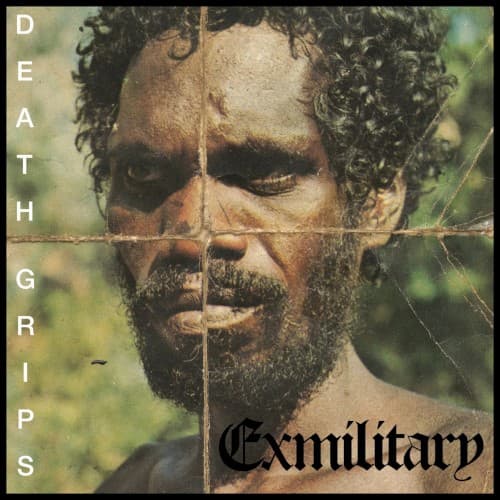
The album came after No Love Deep Web, with The Money Store before that, so this is a band already settled into its extremes. Government Plates does not widen them. It sharpens one of them, the machine-like one, and keeps it moving at a pace that rarely lets up across eleven songs and about thirty-six minutes.
Chant, Clip and Compress: How the Machine Is Built
The sound of Government Plates is built on repetition and compression. Drum patterns lock into short loops that mutate by small degrees, synthesizers are pushed until they clip into something closer to noise than melody, and the vocal is mixed like another percussive layer. Zach Hill's drumming gives the loops a human kick that purely programmed industrial rap lacks: the rhythms stumble, rush and recover instead of sitting on a grid. The fact sheet credits the writing, recording and production to the group as a whole, and the unity of the palette bears that out. The songs feel like they come from one room and one argument.
Delivery is where the album is most distinctive. Ride's approach here leans on chant, bark and pitch-shifted fragments, with hooks that work as slogans. It is a different muscle from the rapid, wordy attack of the group's earlier tapes, and it sits closer to the shouted refrains of hardcore punk and early rap crews than to the lyrical dexterity prized on a Kendrick Lamar or Freddie Gibbs record. On "Anne Bonny" and "I’m Overflow" the voice lands as a rhythmic punch rather than a statement, and the effect is hypnotic more than informative.
Against the West Coast canon, the writing is the obvious gap. The region's great records, from Dr. Dre's The Chronic to Kendrick Lamar's good kid, m.A.A.d city, earn their menace through detail: places, people, consequences. Government Plates offers an atmosphere of threat with almost no specifics, and its imagery stays fragmentary and abstract. That is a deliberate aesthetic, but it also caps the album's emotional range. Anger without a target becomes texture, and texture is what you remember afterward, not any single line.
The concrete weakness is sameness of tone. Because nearly every track pairs a hard loop with a barked refrain, the middle of the record runs together, and a few songs, "Bootleg (Don’t Need Your Help)" among them, pass by as variations on a template rather than as ideas in their own right. Variety does arrive in the stranger and more melodic moments, but less often than it should for an album with this much raw energy. Several hooks also depend on sheer repetition to land, which works at volume in a room and thins out by the fourth listen.
The production's best quality is control. The aggression is shaped, with songs that build, thin out and slam back in, which keeps the volume from becoming a flat wall. That discipline, more than any individual sound, separates this record from the many imitators who treat distortion as a substitute for arrangement. It is also what makes the album easier to enjoy in short bursts than in a single sitting at low attention.
Thirty-Six Minutes Without a Cooling-Off Period
As a sequence, Government Plates is short, front-loaded with ideas and then dependent on momentum. The first stretch sets the rules quickly: the songs are brief, mostly under three and a half minutes, and they arrive without ceremony or skits. There is no intro to settle into and no cooling-off period, so the opening feels like being pushed through a door. That economy is a real strength. At about thirty-six minutes, the album runs exactly as long as this kind of abrasion stays exciting rather than tiring.
The pacing is less even in the middle. A run of similarly built songs blurs the shape of the record, and attention drifts toward the mix and away from the individual tracks. The single, "Birds", stands out partly because it breaks the pattern. At four and a half minutes it is one of the longest songs on the album, and it is built around an edited guitar figure that the fact sheet credits to actor Robert Pattinson. The melodic hook gives the ear something to hold. Its placement in the fifth slot is smart, arriving just as the first run of attacks threatens to settle into routine.
The closer is the sequencing risk. At more than six minutes it is nearly three times the length of the shortest songs, and it stretches the album's ideas to the point of testing patience. As a closing statement it is bold, and it leaves the record on defiance rather than resolution, but the extra length is not fully earned by what happens inside it. A tighter edit would have let the ending land harder.
Taken whole, the length is earned by tempo rather than by variety. The album never overstays because it hardly stops, and that reflex of brevity is the best sequencing decision on the record. Still, a better-shaped middle, with one more change of register before the ending, would have turned a strong run of songs into a stronger album.
A Strong Argument for Rhythm Over Rhyme
Government Plates reads as the most machine-driven of the early Death Grips run, and as a record it is good rather than essential. The Money Store and No Love Deep Web share its nihilism, and what separates this one is how far it pushes the vocals into the background. It earned strong notices at the time, a Metacritic average of 75 from 18 critic scores and a Best New Music tag from Pitchfork, but the praise was mostly for attitude and impact rather than writing, which matches what the record delivers. With no other Death Grips album rated here yet, its rank is provisional, and the scores below reflect that: high marks for production and originality, a middling one for writing.
It is for listeners who judge rap by rhythm, noise and impact, and for anyone who likes industrial or punk-adjacent music and wants to hear rap stripped of conventional verses. Skip it if you want storytelling, wordplay or the regional detail that made West Coast classics durable. There is little here to quote and less to unpack, and anyone who loved the group's denser rhyming should start with The Money Store instead.
The record has aged well because it never chased a trend. The harsh electronics of 2013 still sound abrasive, and the release itself, a surprise free download with a music video for every song, looks like an early template for abrupt, self-controlled album drops. Its mark on later experimental rap, from the collage-like albums of JPEGMAFIA onward, is easy to hear even if no direct line can be drawn.
Start with "Birds", for the guitar hook and the clearest shape, then "Anne Bonny" and "I’m Overflow" for the group at full chant. For what to hear next, No Love Deep Web offers the same vulgar, militant nihilism that Slant's critic described across all three albums, while The Money Store is the better choice if you want more rapping per minute. Government Plates proves that a chant and a drum loop can hold a listener for thirty-six minutes, and it also shows what that approach cannot do, which is leave one sentence in your head the next morning.
Track by track
Track Listing
You Might Think He Loves You for Your Money but I Know What He Really Loves You for It’s Your Brand New Leopard Skin Pillbox Hat
StandoutAn opener with an absurdly long title and a very short fuse: it runs just over two and a half minutes and throws a hard loop and a shouted refrain at the listener with no warm-up. It sets the terms for the record, hooks as chants and drums as the main event. It was later used in a 2014 shoe commercial, which says something about how easily its energy translates outside the album.
Anne Bonny
StandoutOne of the cleanest examples of the album's chant method. The refrain is built for repetition, the drum pattern pulls forward, and the voice acts like a percussion layer. It is enjoyable more than deep, but it shows why the record works at volume, and it is a good second track for pace.
Two Heavens
StandoutThe track that reaches hardest for melody, with synthesizer lines that give the vocal something closer to a tune to ride. It breaks up the grind without softening the mood, and it is a welcome change of color in the first half. The hook is among the more memorable on the record, even though it never fully leaves the album's mechanical frame.
This Is Violence Now (Don’t Get Me Wrong)
SolidShort, tense and built on pressure instead of a big hook. The delivery is clipped and rhythmic, and the arrangement keeps tightening until the track ends. It is solid and does its job in the sequence, though it is more about momentum than about anything that stays with you afterward.
Birds
StandoutThe key track and the album's most accessible one. The edited guitar figure, credited in the fact sheet to Robert Pattinson, gives the song a recognizable melodic spine, and the group chops it into a stuttering loop that behaves like a drum part as much as a riff. At four and a half minutes it has the room to build, and the vocal sits snugly inside the groove, repeating phrases until they feel like part of the machinery. It shows the group can write a hook without giving up its noise, and it is the best place to send a first-time listener. The only complaint is that nothing else on the album reaches quite the same balance of shape and menace.
Feels Like a Wheel
SolidBrief and lurching, with a rhythm that seems to roll forward and catch. It works as a transition inside the run of attacks rather than a destination, and its refrain is more atmosphere than statement. Solid but not essential.
I’m Overflow
StandoutA key song for how it uses the vocal as texture. Ride's delivery is repeated and strained, sitting in the mix like another distorted instrument, and the beat has a heavy, bruising weight that suits the title. It is hypnotic rather than informative, and that is the album's whole approach in miniature. The drums do the storytelling, pushing and releasing, while the voice supplies the tension. It lacks the melodic hook of the best tracks but makes up for it in sheer physical force, and it is the clearest example of the group choosing rhythm over language.
Big House
SolidA compact track that leans on its grinding groove and clipped refrain. It is solid, but it blends into the stretch around it, and the idea does not develop enough to stand out from neighboring songs. Good in sequence, forgettable alone.
Government Plates
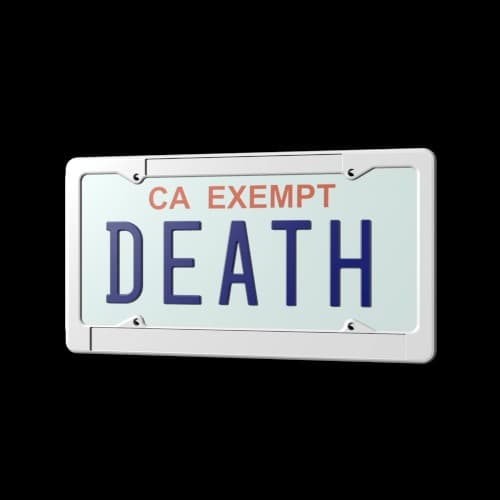
StandoutThe title track is a key piece of the album's identity: a pounding, compressed beat with a vocal that functions as a rhythmic shout. Its two and a half minutes are well used, with the drum figure driving everything and the distortion placed to hit hard on the downbeats. The writing offers a mood of paranoia and surveillance more than any specific scene, which fits the cover's license plate image but gives the song little to quote or retell. It is a strong, efficient piece that captures why the record is better felt than analyzed, though it does not add a new idea beyond what the earlier songs have already established.
Bootleg (Don’t Need Your Help)
WeakThe shortest track and one of the thinner ones. It is a quick burst of noise and attitude that sounds like a variation on the formula rather than a fresh idea. It keeps the momentum up and nothing more, so it comes close to filler.
Whatever I Want (Fuck Who’s Watching)
SolidThe closer and the album's longest track at more than six minutes, nearly three times the length of its shortest. It is a defiant ending that stretches the group's repetition to its limit, with the beat and vocal circling a fixed idea while the production shifts around them. The ambition is clear and the stance suits the record, but the length strains the material, and the song does not offer enough development to justify the extra minutes. Fans of the group's willingness to test an audience will find it compelling, while others will see a track that would have been stronger at half the length. It ends the album on attitude instead of resolution.
Frequently Asked Questions
Is Death Grips Government Plates a good album?
What are the best songs on Government Plates?
How does Government Plates compare to The Money Store and No Love Deep Web?
How long is Government Plates?
Styles