The scorecard
5.4/10 · Weak
- Writing25%
- 5.5
- Production25%
- 5.5
- Delivery15%
- 6.0
- Cohesion15%
- 5.0
- Originality10%
- 4.5
- Replay value10%
- 5.0
The boasts and novelty songs rarely rise above posture, and the crude one-joke tracks add nothing.
DJ Yella's rolling bass and the Naughty By Nature cuts have bounce, but the sound leans on G-funk ideas Dre had already perfected.
Eazy sounds loose and lively, and the Dresta, B.G. Knocc Out and MC Ren pairings give the posse tracks real chemistry.
Assembled from unrelated sessions, the sequence swings between moods and sags through a run of crude filler in the middle.
It borrows the bass weight and synthesizer whine of the post-Chronic sound and says little Eazy had not said before.
A handful of posse cuts and the Roger Troutman closer reward return visits, while the rest is easy to skip.
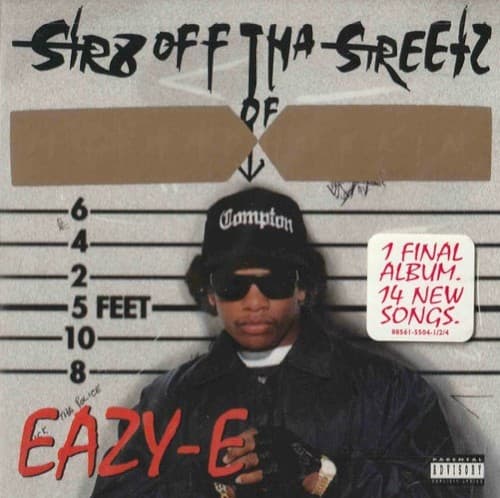
Eazy-E Str8 off tha Streetz of Muthaphukkin Compton: A Salvage Job That Plays Like a Family Reunion
Eazy-E spent the early nineties watching the West Coast sound he helped invent get rebuilt without him. Dr. Dre's The Chronic arrived in December 1992, popularized G-funk and aimed shots at him, and that was enough to make Eazy shelve the double album he had been piling up. Str8 off tha Streetz of Muthaphukkin Compton is what survived. Eazy died in March 1995, and the record that followed was stitched together by DJ Yella from leftovers, fragments and tracks borrowed from other abandoned projects. The argument here is that this is neither a lost statement nor a cash-in corpse. It is a salvage job, and it works best when it stops pretending to be an album and behaves like a Ruthless Records family reunion.
That framing matters because the record keeps hinting at a bigger story than it can deliver. A number of its songs began life as sessions for the unreleased Temporary Insanity, and a few more came from a compilation that never appeared. What holds the pieces together is Eazy's voice, thin, nasal and unmistakable, plus a rotation of Compton regulars who give it weight: B.G. Knocc Out, Dresta, MC Ren and, at the very end, Roger Troutman.
Against the West Coast tradition, the album sits in an awkward spot. It is too late to be the raw gangsta rap of Eazy-Duz-It, and it is too derivative to be a G-funk record on Dr. Dre's terms. What it can claim is a loose, rowdy, unusually unguarded Eazy, and that is a smaller prize than the title and the chart debut suggest.
Eazy sounds energized here, which is the real surprise, but energy is not the same as direction. The record borrows its bass weight and its synthesizer whine from a style Dre perfected, and it earns its few high points mostly through guests and outside producers rather than through a singular idea. Expect a record worth sampling track by track, not one worth sitting through.
Many Hands, Thin Ideas, and One Unmistakable Voice
The first thing to understand about how this record works is that there is no single production voice. DJ Yella handles the bulk of the work, and his beats lean on rolling bass and thin, whining synthesizer lines that nod toward the G-funk template without ever matching its warmth or its layering. Then the sound lurches. Bobcat and Eazy himself produce a few tracks, Naughty By Nature supply two, and Tony G produces the longest cut. Each of those hands brings a different texture, and because the album was assembled rather than sequenced, the textures never talk to each other. A track built on bounce can be followed directly by one built on gloom with no transition.
The writing is where the record is most exposed. Eazy was never a dense lyricist, and his appeal was always attitude, a sneer riding a beat. Here the attitude is intact, but the material is thin: boasts about sex, drink and street credibility, a few score-settling lines, and a handful of crude novelty songs. Critic Stephen Thomas Erlewine's complaint that the music treads familiar gangsta territory and trades in meaningless boasts is harsh, but it describes a real problem. There is very little on this album that Eazy had not already said better on his earlier solo work or with N.W.A. Even the songs about loss and betrayal rarely get past a statement of mood.
Delivery is the stronger half of the equation. Eazy sounds looser and more playful than he did on his last full-length, and he is willing to let the guests carry verses. The pairings with Dresta and B.G. Knocc Out give the posse tracks a lived-in, neighborhood feel, and MC Ren's presence adds a few seconds of N.W.A. chemistry that the album needs. David Browne's description of this as Eazy's most musically varied record is fair, and variety is a virtue in a sample-heavy genre. But variety is also a sign of a record without a center.
The concrete weakness is the filler. Two of the album's cruder tracks are brief, one-joke songs that exist to fill space and add nothing but a sense of how much material was missing. The cobbled origin shows at the seams in other ways too: levels shift, moods switch without warning, and the closing stretch gets by on guest appeal more than on content.
What the album does not do is sound dated in a way that hurts it. Its bass-heavy, sparse arrangements age better than many mid-nineties attempts at crossover polish. Still, the sound is borrowed far more than it is earned, and the rapping rarely pushes past what the beats ask of it.
A Mixtape in an Album's Clothes: Where the Momentum Holds and Where It Drains
As a sequence, the album has the shape of a mixtape that happens to have a track list. It opens with a short intro and then moves straight into a posse track, which is a smart start: the guest voices arrive early, and the album establishes that it is as much about the Ruthless family as about Eazy alone. The first third has real momentum because the beats are chosen for bounce, and the pacing between the singles is quick enough to hide how little connective tissue exists.
The sag arrives in the middle. A run of crude, one-dimensional songs lands back to back, and the weight of that stretch is felt because none of the tracks has the hook or the narrative to justify its place. The short running times help, since the worst of them are over in a couple of minutes, but the effect is still a loss of direction. It is here that the cobbled-together origin is most audible; the album sounds like what it is, a set of unrelated sessions pushed into an order.
The recovery is partial. The back third restores some energy through its guest features and the longer, more atmospheric tracks, and the album closes on a tribute that gives the whole record an emotional frame it would otherwise lack. That frame feels earned mostly because of what we know about the circumstances, not because the sequencing prepared it.
At just over fifty minutes, the length is a mixed case. Fourteen tracks is a manageable number, and the record never drags as badly as an overstuffed double album would. But a tighter ten-song version, built from the posse cuts and the stronger outside productions, would be a better argument for the album than the one the full version makes. The sequence works as a collection and fails as a statement, which is exactly what its history predicts.
The Epilogue of a Compton Founder, Worth a Visit and Not a Residence
In Eazy-E's catalog this record is the epilogue, not the chapter. The first album remains the one that defines his voice, and nothing here replaces it. This one ranks below it because the writing is thinner and the sound is derivative, but it ranks above a pure leftovers dump because Eazy's performance is lively and the best guest moments are genuinely good. Its rating is a middling one, and the case for that rating is straightforward: enjoyable passages, an unfocused whole.
Who should listen? Anyone who follows the N.W.A. story and wants to hear where Eazy's career ended should hear this, as should listeners curious about the mid-nineties moment when the West Coast was moving from raw gangsta rap to G-funk and a Ruthless artist tried to keep pace. Fans of Compton posse records will find several tracks to keep. Anyone new to Eazy-E, or looking for a defining West Coast album, should skip it and start with his debut.
As for age, the album has settled better than the critical consensus at release suggested. Its context now carries more weight than its content, and the closing tribute, once you know the story, is more affecting than any single verse. The cruder novelty tracks have not aged at all, and they are the reason a casual listener should program the album rather than play it straight through.
Start with the posse single built around malt liquor and the long closing tribute with Roger Troutman, then add the song that reunites Eazy with MC Ren. Those three give a fair sense of what the record can do.
For a next step, go back to Eazy-Duz-It to hear the voice at full strength, or move to Dr. Dre's solo work to hear the polished version of the sound this album could only imitate. The record is best remembered as a final, rowdy sign-off from a man who had already lost the argument about where West Coast rap was headed.
Track by track
Track Listing
First Power
SolidA short opener that serves as a cold open and little else. It sets the tone with a few bars of Eazy attitude and leaves before it develops. Filler, but short enough to be forgiven.
Ole School Shit
StandoutA posse track with Dresta, B.G. Knocc Out and Sylk-E. Fyne, produced by DJ Yella, and a good example of what the album does well: it lets the guests carry the room while Eazy sets the tone. The bass is thick and the pace unhurried, giving the record an early sense of neighborhood chemistry. The hook is loose, the verses are workmanlike, and the whole thing feels more like a cypher than a song, which suits it. It is a better opener than the actual opener.
Sorry Louie
SolidProduced by Bobcat with Eazy, it is a mid-tempo song with a slightly more gloomy tone than its neighbors. Eazy sounds relaxed, and the beat gives him room, but the writing never gets past a posture.
Just tah Let U Know
StandoutOne of the singles, and produced by Eazy himself. It is the clearest sign that he still had instincts for hooks and pacing: the beat is lean, the vocal is confident, and the song has a point of view rather than a mood. The album's most direct-sounding moment and a reminder that his best work was always about voice and timing, not density. It holds up as one of the better cuts, even if the sound is closer to its time than to anything lasting.
Sippin’ on a 40
StandoutA single with B.G. Knocc Out and Dresta, produced by DJ Yella, and the record's best case for the G-funk-adjacent sound. The bass is thick and slow, the hook is easy, and the three voices trade lines with a lazy, convincing chemistry. The subject is the usual one, but the tone is warm instead of threatening, and that makes it the most replayable song here. It is derivative of what Dre was doing, but derivative done well.
Nutz on Ya Chin
SolidProduced by Naughty By Nature and one of the more crude entries. The beat has a bounce that is different from the rest of the album, but the lyrical premise is a joke that wears thin by the second verse.
Tha Muthaphukkin’ Real
StandoutA single featuring MC Ren, with DJ Yella and Ren sharing production credit. The reunion of two N.W.A. members is the draw, and it delivers a few moments of real chemistry: Ren's drier, harder voice contrasts nicely with Eazy's higher register. The beat is heavy and a little mechanical, and the song does not build to much, but as a signal of where Eazy's loyalties were, it is the album's most meaningful collaboration. Worth hearing for the voices alone, whatever the writing.
Lickin’, Suckin’, Phukkin’
WeakA short, crude novelty track with nothing to say beyond its title. Filler that exists to fill time.
Hit the Hooker
WeakAnother Naughty By Nature production, and another crude, one-note song. The beat is serviceable, the subject matter is shallow, and it is over quickly. Skip it.
My Baby’z Mama
SolidProduced by Bobcat, and a more personal subject than most of the record, which gives Eazy a slightly different register. It is a mid-tempo cut with an easy groove, though the writing stays on the surface and the hook does not stay with you.
Creep ’n’ Crawl
StandoutA single produced by DJ Yella, and one of the stronger examples of the album's low, creeping bass. The tempo is slow and menacing, and Eazy's delivery matches it with a sly, understated tone. It lacks a big hook but makes up for it with atmosphere, and it is one of the few songs that feel designed rather than assembled. A solid late-album highlight.
Wut Would You Do
SolidWith Dirty Red and produced by Tony G, this is the longest track on the record, and the length is a problem. The beat is competent and the guest adds variety, but the song stretches a thin idea across nearly six minutes and loses momentum in the second half.
Gangsta Beat 4 tha Street
StandoutA posse cut with Dresta, B.G. Knocc Out and Menajahtwa, produced by DJ Yella. It is a return to the neighborhood-cypher format of the early tracks, with decent bass and a stable groove. Nothing surprising, but it is a pleasant, rowdy track and a reminder of the record's best quality: the sense of a crew in the room.
Eternal E
StandoutThe closer, with Roger Troutman, produced by Eazy-E, Troutman and DJ Yella. Troutman's talk-box voice gives the song a warmth and a melancholy that the rest of the album avoids, and it plays as an elegy even when the lyrics are not explicitly one. Given the circumstances of its release it carries real emotional weight, and it is the one moment where the record's posthumous status feels like part of the music instead of a footnote. The best track and the right way to end.
Frequently Asked Questions
Is Eazy-E's Str8 off tha Streetz of Muthaphukkin Compton good?
Was Str8 off tha Streetz of Muthaphukkin Compton released after Eazy-E died?
Who produced Eazy-E's Str8 off tha Streetz of Muthaphukkin Compton?
Styles