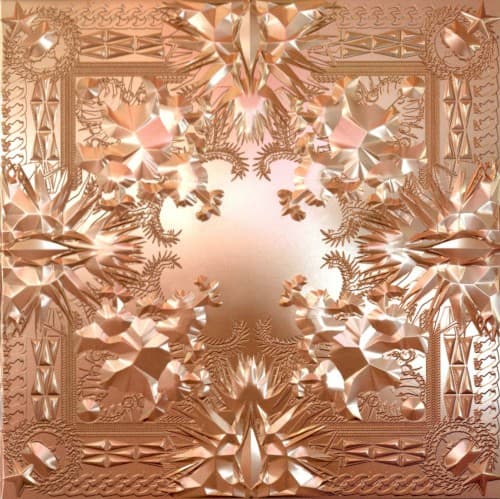
The scorecard
7.2/10 · Good
- Writing25%
- 6.5
- Production25%
- 8.5
- Delivery15%
- 7.0
- Cohesion15%
- 6.0
- Originality10%
- 7.5
- Replay value10%
- 7.5
The constant materialism and luxury brand references wear thin by the second half, though both rappers deliver technically sharp verses with strong internal rhyme and vivid imagery when focused.
Kanye West and his production team build dense, unconventional beats with orchestral heft and prog-rock flourishes, from the rock-centric opener to the dubstep-inflected Who Gon Stop Me, sustaining invention across twelve very different tracks.
Jay-Z's imperial flow and Kanye's more ragged cadence create a clear contrast, though the dynamic rapping cannot fully compensate for guest verses doing most of the melodic heavy lifting.
The album shifts abruptly between moods and production styles with no clear arc, includes obvious filler like Lift Off and That's My Bitch, and at forty-two minutes feels more like a collection than a coherent statement.
The unlikely pairing and the scale of the production distinguish it from other 2011 releases, even though the prog-rap maximalism is borrowed directly from My Beautiful Dark Twisted Fantasy and the lyrical themes are standard for both artists.
The production detail rewards repeat listens even when the writing does not, with Niggas in Paris, Otis and No Church in the Wild holding up a decade later as the album's durable core.
Jay-Z and Kanye West Watch the Throne — The Gilded Cage They Built Together
Watch the Throne is a victory lap that never stops to ask what the race was for. Jay-Z and Kanye West recorded this album in hotel suites across three continents, argued for days about which songs belonged, and ultimately delivered a document of two men at the peak of their commercial power with almost nothing left to prove and very little new to say about it. The thesis here is simple: wealth and fame are both the reward and the burden, and the album spends forty-two minutes examining that tension without ever resolving it. What makes the record worth the effort is not the ideas but the execution, specifically the production, which extends the dense orchestral maximalism of My Beautiful Dark Twisted Fantasy into a more varied and sometimes harsher sonic palette.
The writing is technically sharp but thematically narrow, and the album sags whenever it mistakes luxury brand names for insight. This is the sound of two rappers who had already conquered the genre deciding to build a monument to the conquest itself, and the monument is more impressive than the message it carries.
The stakes are lower than either artist wants to admit: this is not a reinvention or a new direction, but a high-budget exercise in showing what happens when two of the biggest names in rap have unlimited resources and no one telling them no. The result is uneven, often brilliant in execution, and only occasionally interested in being more than a flex.
Prog-Rap Maximalism With No Room for Subtlety
The production on Watch the Throne is its strongest asset and the main reason the album holds attention. Kanye West leads the work with Mike Dean, and the sound is a continuation of the orchestral density and prog-rock ambition he established on My Beautiful Dark Twisted Fantasy, though applied here with more variety and less focus. No Church in the Wild opens the album with a gnarled guitar sample and filmic strings, setting a moody and expansive tone that the rest of the record does not sustain. Niggas in Paris, produced by Hit-Boy with West's direction, is built on staccato orchestral stabs and fizzing industrial noise over a menacing beat, and it remains the album's most durable track because the production is both aggressive and inventive.
Otis chops up Otis Redding's Try a Little Tenderness into a rhythm track, reducing Redding's voice to a melodic riff in a way that recalls The College Dropout era but with more technical precision. Who Gon Stop Me samples dubstep producer Flux Pavilion and drags the sound into harsh, distorted territory that feels like an experiment West wanted to try regardless of whether it fit the album. The Neptunes produce Gotta Have It with chopped James Brown samples and Eastern flute melodies, and RZA co-produces New Day, which interpolates Nina Simone over a reflective beat. The range of producers and influences keeps the album from sounding monotonous, though it also means the record has no clear sonic identity beyond expensive and maximal.
The mix is dense and the arrangements are busy, which works on the stronger tracks and makes the weaker ones feel cluttered.
The writing is technically proficient but lyrically one-note. Both rappers deliver sharp internal rhyme schemes and vivid imagery, and Jay-Z in particular sounds effortless in his flow, bridging lines with the same imperial command he has used for a decade. Kanye is rougher and more erratic, and the contrast between the two voices is the main dynamic tension on the record.
The problem is that nearly every song is about the same thing: wealth, power, material excess, and the loneliness or paranoia that comes with it. The first few tracks make the case convincingly, but by the back half the boasts have worn thin and the album has nothing new to add. Murder to Excellence attempts social commentary by contrasting black-on-black violence with black success, but the execution is clumsy and the song never earns the gravity it reaches for. New Day is the one track where both rappers address something beyond themselves, imagining advice to future sons about fame, and it is the rare moment where the writing matches the ambition of the production.
Elsewhere the lyrics are competent but uninspired, filled with references to luxury brands, expensive cars, and European vacation spots that function as proof of status rather than ideas. The album is technically impressive but thematically shallow, and the shallowness becomes a problem because the production keeps promising depth.
At least two tracks are outright filler. Lift Off is a pop song with Beyoncé singing a motivational hook over baroque strings and synthesizers, and it sounds like a leftover from a different project. That's My Bitch is cluttered with guest vocalists and a choppy James Brown sample that never coheres into a track worth the three minutes it takes. Both could have been cut without loss.
A Sequence Built for Singles, Not an Album
Watch the Throne does not work as a front-to-back listen because it was never designed as one. The album is a collection of expensive standalone tracks with no clear arc or pacing, and the sequencing feels arbitrary. The opening stretch sets a moody and serious tone, then immediately undercuts the mood with pop bombast and motivational slogans.
The middle stretch is the album's peak, three short tracks in a row that play to both rappers' strengths and never overstay their welcome.
The back half sags under its own weight, and by the time the album reaches its closing run, the momentum is gone. The record is forty-two minutes long and still includes at least two tracks that serve no purpose, which suggests the artists could not distinguish between their best and weakest material or did not care to. The album ends with a downbeat closer that does not resolve anything or provide a satisfying conclusion, and the sense is that the project simply stopped rather than finished. The deluxe edition adds four bonus tracks, and the fact that some of the stronger material ended up as bonus tracks reinforces the impression that the album was assembled without a clear editorial vision.
A Monument to Success That Forgets Why Success Matters
Watch the Throne is a reveal for expensive production and technical rapping skill, and on those terms it delivers. The best tracks here are worth owning, and the production across the album is ambitious and detailed enough to reward close listening. The problem is that the album has almost nothing to say beyond the fact that Jay-Z and Kanye West are rich and powerful, and by the second half that message has been delivered so many times that it stops meaning anything.
This is not an album for someone looking for storytelling, introspection, or ideas. It is an album for listeners who want to hear two of the genre's biggest names operating at a technical peak over unconventional and maximalist production. The writing is the weak point, and the lack of cohesion means the album works better as a playlist than as a statement.
It has aged reasonably well because the production was ahead of its time and because Niggas in Paris became a cultural moment, but it is not an essential entry in either artist's catalog and it is not the best place to start for new listeners. If you want to hear what this album does well, start with Niggas in Paris, Otis, and No Church in the Wild, then decide whether the rest is worth the effort. If you want to hear either artist at their best, go to Reasonable Doubt or The Blueprint for Jay-Z, or My Beautiful Dark Twisted Fantasy for Kanye.
Watch the Throne is a document of two rappers who had already reached the top and decided to spend a year proving it, and the proof is technically impressive but emotionally hollow. It is a monument built for its own sake, and like most monuments it is more imposing than it is meaningful.
Track by track
Track Listing
No Church in the Wild
StandoutThe album's strongest opener and one of its best tracks, built on a gnarled guitar sample and cinematic strings that set a mood the rest of the record never matches. Frank Ocean and The-Dream provide the melodic backbone while both rappers deliver verses about loyalty, power, and religion, with Jay-Z questioning what gods mean to non-believers and Kanye musing on lies and Socrates. The production, led by 88-Keys and Kanye, is dark and expansive, and the song closes with a segment of Italian avant-prog band Njervudarov's Tristessa, a flourish that recurs throughout the album. The writing here is more interested in ideas than most of the record, and the execution is confident enough to carry the weight. This is the track that makes the strongest case for what the album could have been if it had committed to this tone.
Lift Off
WeakA motivational pop song with Beyoncé singing over baroque strings, martial drums, and synthesizers, and it feels like a leftover from a different project. The production is bombastic in a way that undercuts the seriousness of the opener, and the lyrics are vague slogans about taking it to the moon and the stars. Beyoncé does what she can with the hook, but the song has no real reason to exist and it disrupts the album's flow immediately after the opening track. Pure filler.
Niggas in Paris
StandoutThe album's most durable track and the one that became a cultural moment, built on staccato orchestral stabs, fizzing industrial noise, and a menacing beat by Hit-Boy. The production is both aggressive and inventive, with an unusual sample of dialogue from the film Blades of Glory adding a surreal touch. Both rappers frame their rags-to-riches story over the beat, and the verses are technically sharp even if the subject matter is familiar. The song works because the production is relentless and the energy never dips, and it holds up a decade later because the beat was genuinely ahead of its time. This is the track that justifies the album's existence and the one most listeners will remember.
Otis
StandoutA showcase for Kanye's chipmunk-soul production style applied to Otis Redding's Try a Little Tenderness, chopping Redding's vocals into a rhythm track and letting both rappers deliver braggadocious verses over the top. The sample is manipulated so thoroughly that Redding's voice becomes a melodic riff rather than a feature, and the production recalls The College Dropout era with more technical polish. Both rappers sound energized and the track is short enough to avoid overstaying its welcome. The writing is pure boasting with no deeper ideas, but the execution is sharp and the Redding sample gives the track a warmth that most of the album lacks. One of the album's clear highlights.
Gotta Have It
SolidProduced by The Neptunes with Kanye, built on chopped James Brown vocal samples, Eastern flute melodies, and an aggressive bass line. Both rappers trade verses over the vocal riff, referencing contemporary rap trends and delivering technically proficient bars with no real substance. The production is busy and the track is short, just over two minutes, which keeps it from becoming tiresome. Solid but unremarkable, and it works mainly because it does not linger.
New Day
StandoutThe album's one moment of introspection, with both rappers addressing hypothetical future sons about the burdens of fame and wealth. RZA co-produces with Kanye, interpolating Nina Simone's Feeling Good over a reflective beat, and the track references Raekwon's Incarcerated Scarfaces in a nod to the lineage both rappers are trying to protect. Jay-Z imagines steering his son away from the mistakes he made, and Kanye reflects on his public image and the costs of his choices. The writing here is more personal and specific than almost anything else on the record, and the production gives the verses room to breathe. This is the rare track where the album's stated themes of power and burden feel earned rather than asserted.
That’s My Bitch
WeakA cluttered track with guest vocalists Elly Jackson, Connie Mitchell, and Justin Vernon providing the hook, built on chopped James Brown samples and an Apache interpolation. The production by Kanye, Q-Tip, and Jeff Bhasker is busy and never coheres, and the track feels like an experiment that did not work. Both rappers deliver competent verses but the song has no clear focus and the three-minute runtime feels longer than it is. Filler.
Welcome to the Jungle
SolidProduced by Swizz Beatz, who also provides background vocals, and the track is built on aggressive drums and a harsh, confrontational beat. Both rappers deliver technically sharp verses about dominance and power, and the production is intense enough to hold attention, but the song does not add anything new to the album's themes and it feels like a lesser version of what Niggas in Paris does better. Solid but not essential.
Who Gon Stop Me
SolidAn experiment in bringing dubstep into rap, sampling Flux Pavilion's I Can't Stop and building a harsh, distorted beat that feels like Kanye testing an idea regardless of whether it fits the album. The production by Sak Pase, Kanye, and Mike Dean is abrasive and the verses are combative, with both rappers asking who can challenge them. The track is interesting as a sonic experiment but it disrupts the album's flow and the execution is not strong enough to justify the risk. Mr Hudson and Swizz Beatz provide additional vocals but they do not add much. A fascinating failure.
Murder to Excellence
WeakThe album's attempt at social commentary, contrasting black-on-black violence with black success and wealth, and the execution is clumsy. Produced by Swizz Beatz and S1, the track samples The Indiggo Twins and Quincy Jones, and the beat is moody and deliberate. The first half addresses gun violence in Chicago and other cities, and the second half shifts to celebrating black achievement, but the transition is jarring and the song never earns the gravity it reaches for. The writing tries to be weighty but ends up feeling forced, and the five-minute runtime is too long for what the track accomplishes. The intention is admirable but the result is one of the album's weakest moments.
Made in America
StandoutFeaturing Frank Ocean on the hook, built on a reflective beat by Sak Pase, Mike Dean, and Om'Mas Keith, and the track is about immigrant stories, the American dream, and the costs of success. Ocean's vocals provide the emotional center and both rappers deliver verses about their rise and what it means to succeed in a country that still treats them as second-class. The production is understated compared to the rest of the album, and the writing is more thoughtful than most of the record, though it still leans on familiar themes. A solid closer for the standard edition, though it does not provide a strong conclusion or resolution.
Why I Love You
SolidThe actual closer for the standard edition, featuring Mr Hudson on the hook and sampling Cassius over a downbeat, melancholic beat. The track is about betrayal and paranoia, with both rappers addressing people who turned on them after they achieved success. The production by Kanye and Mike Dean is moody and the verses are more vulnerable than most of the album, but the song does not provide a satisfying conclusion and it ends the record on a downbeat note that feels unresolved. A weak closer that suggests the album simply stopped rather than finished.