Juice WRLD's Freestyle Mastery and Emo Rap Revolution
Jarad Anthony Higgins, known professionally as Juice WRLD, compressed a career's worth of sonic innovation into less than three years of active recording before his death at 21 in December 2019. His ability to freestyle entire songs over beats he'd never heard — sometimes for an hour straight without pause — wasn't just a parlor trick but the foundation of his creative process. This improvisational approach gave his music an urgent, confessional quality that resonated with a generation navigating anxiety, heartbreak, and prescription drug dependency.
Emerging from Chicago's South Side in 2018, Juice WRLD didn't slot neatly into the drill sound dominating his city's rap landscape. Instead, he absorbed emo and pop-punk influences alongside trap production, creating melodic rap that felt equally indebted to Future's drugged-out Auto-Tune experiments and Fall Out Boy's emotional intensity. His breakthrough single "Lucid Dreams" — built around a Sting sample and fixated on romantic betrayal — demonstrated how seamlessly he could marry sung melodies with hip-hop's rhythmic foundation. The track's massive commercial success proved that vulnerability could chart just as high as bravado.
What separated Juice WRLD from the crowded SoundCloud rap scene was his technical fluency. He possessed an encyclopedic knowledge of rhyme schemes and could reference everything from classic rock to contemporary trap within the same verse. This musical omnivore approach, combined with his willingness to expose his struggles with codeine addiction and mental health, created an intimacy that felt dangerously real. His fans didn't just enjoy his music — they saw their own pain reflected in it.
Melodic Improvisation: Juice WRLD's Signature Vocal Approach
Juice WRLD's vocal delivery existed in the space between rapping and singing, never fully committing to either. He used Auto-Tune not as pitch correction but as an instrument itself, bending notes and extending syllables until words became pure emotion. His melodies often moved in unexpected directions, avoiding the predictable cadences of standard pop-rap. This unpredictability stemmed directly from his freestyle methodology — when you're inventing songs in real-time, conventional song structure becomes secondary to raw expression.
Production-wise, Juice WRLD gravitated toward Nick Mira's guitar-driven beats, which provided spacious canvases for his melodic experimentation. Mira's work on Goodbye & Good Riddance established the template: looping acoustic or electric guitar phrases, minimal percussion, plenty of negative space for vocals to breathe. The production felt stripped-down compared to the maximalist trap dominating 2018, creating an almost bedroom-pop intimacy. Tracks like "All Girls Are the Same" let Juice's voice carry the emotional weight without competing against cluttered instrumentals.
His lyrical content obsessively circled themes of heartbreak, substance abuse, and mortality with an almost prophetic quality. He frequently referenced his own potential early death, treating drug dependency not as celebration but as inevitable fate. This darkness was offset by his technical playfulness — internal rhyme schemes that revealed careful craft even within supposedly spontaneous freestyles, pop culture references that demonstrated his broad musical palette, wordplay that showcased genuine wit. The contrast between his melodic accessibility and his lyrical heaviness created cognitive dissonance that made his music addictive and unsettling in equal measure.
From SoundCloud Sensation to Posthumous Icon: Juice WRLD's Brief, Intense Rise
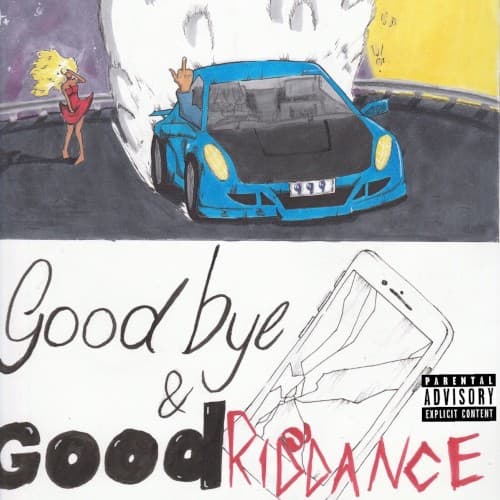
Juice WRLD's commercial trajectory moved with unusual speed. After building a modest SoundCloud following in 2017, he released "Lucid Dreams" in May 2018 as part of his debut studio album Goodbye & Good Riddance. The track climbed to number two on the Billboard Hot 100, establishing him as a mainstream force within months of his first proper release. The album itself showcased his emotional range across 15 tracks, though its consistency wavered — the production's sameness occasionally undermined the songs' individual impact. Still, it crystallized his aesthetic: heartbreak anthems delivered with melodic hooks and raw emotional exposure.
The success of Goodbye & Good Riddance led to an intense recording pace. Juice WRLD reportedly recorded hundreds of unreleased songs, treating the studio like a daily diary rather than a project-based endeavor. This prolific output reflected both his freestyle-driven creative process and the demands of sudden fame. By March 2019, he released Death Race for Love, a more ambitious 22-track effort that debuted at number one. The album expanded his sonic palette slightly, incorporating harder trap beats alongside his signature guitar-led production, but maintained his thematic fixations on pharmaceutical dependency and doomed romance.
His collaborative network extended beyond his core producer Nick Mira to include Metro Boomin, whose darker, more menacing production pushed Juice into grimier sonic territory. He recorded prolifically with other artists from his generation, including collaborations that paired his melodic approach with the harder edges of artists like Future and Young Thug. These partnerships highlighted his versatility — he could match energy with trap's aggressive side while maintaining his emo-inflected sensibility.
Juice WRLD's live performances leaned heavily on his freestyling ability, often extending songs with improvised verses that demonstrated his technical skill in real-time. Videos of these extended freestyles circulated widely, building his reputation as a genuine talent rather than a studio-manufactured product. This authenticity mattered to his core audience, who valued the unfiltered access his music seemed to provide.
His death in December 2019 from an accidental overdose at Chicago's Midway Airport cut short what seemed like an ascending career arc. The circumstances — seizure induced by oxycodone and codeine — grimly validated the substance-abuse narratives running through his entire discography. His passing immediately shifted the conversation around his music from commercial product to cultural artifact, with his lyrics about early death recontextualized as tragic foreshadowing.
Juice WRLD's Lasting Impact on Melodic Rap and Mental Health Discourse
Juice WRLD's influence crystalized a shift in hip-hop's emotional vocabulary. Where previous generations might have coded vulnerability through metaphor, he made mental health struggles and addiction explicit subject matter without apology. This directness opened lanes for artists like Lil Uzi Vert and Kid Cudi to explore similar terrain with increasing mainstream acceptance. The emo rap subgenre he helped popularize — already emerging through artists like Lil Peep — became commercially viable in ways that seemed impossible before his chart success.
His freestyle methodology influenced how younger artists approach songwriting. The idea that technical skill and emotional authenticity could coexist without one undermining the other became part of his legacy. Numerous artists have cited his freestyling ability as inspirational, though few possess the same combination of melodic intuition and lyrical facility. His prolific recording habits also established new expectations around posthumous releases, with his estate continuing to issue albums drawn from his vast unreleased catalog — a practice that raises questions about artistic intent versus commercial exploitation.
The cultural conversation around Juice WRLD's death paralleled discussions following Mac Miller's overdose a year earlier, forcing the music industry to confront how it markets and profits from artists openly struggling with addiction. His music became both memorial and cautionary tale, with fans treating his catalog as both comfort and warning. The tension between celebrating his artistic achievements and acknowledging the self-destructive patterns documented in his work remains unresolved, making his legacy more complex than simple martyrdom or commercial nostalgia.