The scorecard
8.1/10 · Great
- Writing25%
- 8.5
- Production25%
- 8.0
- Delivery15%
- 8.0
- Cohesion15%
- 7.5
- Originality10%
- 8.5
- Replay value10%
- 8.0
André and Big Boi move past playa postures into introspection and existential questions without losing their storytelling grip, especially on Elevators and Babylon.
Organized Noize and the duo's first self-productions deliver spacey dub echoes and gospel touches that serve the concept even when the beats turn skeletal.
Both MCs sharpen their flows into more complex patterns and Big Boi finds new pockets in the slower tempos, though the laid-back pace occasionally mutes their energy.
The outer-space concept holds across the album despite some sag in the middle with guest appearances and the tacked-on remix.
In 1996 nobody else in the South was making beats this minimal and spacious or rapping about extraterrestrials and aging; it pointed OutKast toward the eccentricity that defined them.
Elevators and the title track anchor the album while the slower experimental material rewards patience on repeat listens.
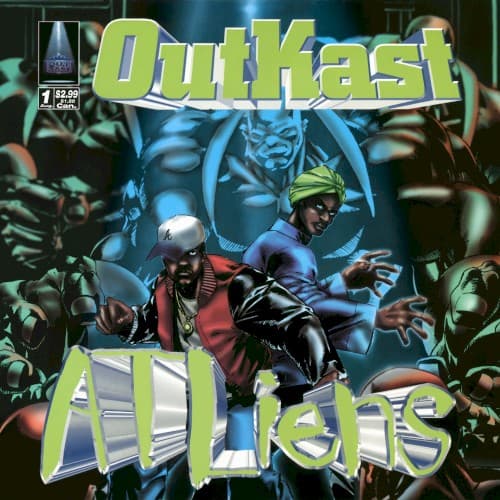
OutKast ATLiens — When Atlanta Started Sounding Like Outer Space
After the Source Awards booing and the skeptics who thought the South only had bass music, OutKast could have doubled down on the trunk-rattle and the playa shit that made Southernplayalisticadillacmuzik platinum. Instead they came back with the strangest answer possible: dub echoes, no samples, beats that breathe instead of knock, and raps about elevators as metaphors and forbidden childhood attractions. ATLiens is OutKast deciding they would rather be weird than right, and in 1996 that was the only way to prove the South had something to say.
The album works because it commits fully to the alien concept without turning it into a gimmick. The spaciness is in the production—echoes that stretch across every beat, basslines that pulse like sonar, reverb that makes Atlanta sound like it is underwater. Organized Noize and the duo's first self-productions strip out the funk and the live instrumentation that made the debut warm and replace it with cold air and negative space. The writing follows: André stops smoking and starts questioning everything, Big Boi becomes a father and both of them abandon the partying characters for something more inward. The result is not as immediately satisfying as what came before or after, but it is the album where OutKast became ambitious enough to matter beyond the region. It sits in the middle of their run, the necessary bridge between the fun and the genius, and it holds up as the moment they stopped trying to fit in.
Dub Bass and Gospel Echoes in the Dirty South
The production on ATLiens is deliberately spare, built on deep bass, hard drums, and empty space where most rap records in 1996 were stuffing the mix. Organized Noize handles two-thirds of the album and brings dub and reggae techniques—echo, reverb, delay—into Southern rap without making it sound like a fusion experiment. The beats feel like they are happening in a large room with the lights off. Gospel creeps in through organ riffs and churchy vocal touches, especially on the intro You May Die, which sets the tone with its somber hymn feel. The duo's own productions, credited to Earthtone III alongside Mr. DJ, are even more minimal: Jazzy Belle is built on a chopped sample and a drum pattern with almost nothing else, and Elevators uses telephone tones and a restrained bassline that leaves room for the flows.
The problem is that the restraint sometimes tips into undercooked. Tracks like Millennium and Decatur Psalm feel like sketches, beats that need another layer or a stronger hook to justify their length. Mr. DJ's scratching on Wheelz of Steel is technically furious but the track itself does not build to much. E.T. has no drums at all, which is bold but also makes it feel like an interlude stretched to three minutes. The back half of the album drags because too many songs settle into the same mid-tempo pocket without enough variation in texture or energy. Organized Noize's usual knack for melody is muted here in favor of atmosphere, and while that serves the concept it leaves some beats feeling more interesting to describe than to actually ride.
The writing is where the album steps forward. André and Big Boi both sharpen their technical skills, packing more syllables into bars and twisting their flows into tighter pockets. The subject matter is more reflective than the debut: the title track has André explaining his new drug-free life over a hypnotic loop, Babylon unpacks his religious upbringing and sexual guilt, and 13th Floor/Growing Old is a meditation on aging that ends the album on a somber note. Jazzy Belle addresses how the duo's view of women has matured, moving past the objectification of the first album into something more considered. Big Boi brings in his experience as a new father and both MCs sound like they are thinking harder about what they want to say. The guests—Witchdoctor, Goodie Mob members, Cool Breeze—mostly stay out of the way, though the posse cuts in the middle blur together.
The problem is that the laid-back delivery, while more technically complex, sacrifices some of the raw energy that made the debut hit. The flows are cerebral and the voices are calm, which works on Elevators and ATLiens but makes stretches of the album feel monotonous. The balance between ambition and accessibility tilts too far toward the former in places, and the album asks for more patience than it always earns.
The Long Ride Up and the Sag in the Middle
The album is front-loaded with its best material and then tests your commitment in the middle before recovering at the end. The opening run through the first four tracks is the strongest sequence, establishing both mood and ambition before delivering the clearest single. After that the pacing sags. The middle stretch feels like OutKast working through ideas rather than delivering finished songs. The guest appearances pile up and the beats settle into a sameness that the writing does not always overcome.
The album is fifteen tracks and 56 minutes, which is about ten minutes too long. The bonus remix at the end breaks the album's flow after the penultimate track provides a natural, somber conclusion. The sequencing makes sense thematically—the progression from street tales to introspection to existential questions follows a logic—but the execution drags in the middle third. One drumless interlude offers a break in continuity, but it feels more like an experiment than a payoff. The album works best when you skip the posse cuts and the remixes and focus on the core OutKast material, which is not how a great album should function.
The Transitional Record That Proved the Ambition
ATLiens is the third-best OutKast album, behind Aquemini and Stankonia but ahead of the debut and everything that came after. It is the bridge between the fun regional record and the artistic statement, the moment where OutKast chose to be strange and cerebral instead of safe. The production is too sparse in places and the album is too long, but the ambition and the weirdness are what made the next two albums possible. It proved that Southern rap could be experimental and introspective, that dub and gospel belonged in the same frame as trunk-rattle and that OutKast was not interested in repeating themselves.
This is for listeners who want to hear the South start to think bigger, who value ambition over consistency, and who are willing to sit with slower tempos and more abstract concepts. Skip it if you want OutKast at their most energetic or their most melodic—Stankonia and Aquemini do both better. The best way in is Elevators, ATLiens, and Jazzy Belle, which capture the album's strengths without its sprawl. From there the title track on Aquemini picks up the spacey production and sharpens it, and Stankonia takes the experimental impulse and pairs it with better hooks. ATLiens is the album that made those records possible, the one where OutKast stopped worrying about what the East and West Coast thought and started building their own sound. It is not their peak, but it is the climb that mattered.
Track by track
Track Listing
You May Die (intro)
SolidA one-minute gospel-tinged intro that sets the album's somber, otherworldly tone with churchy vocals from Joi and others. It works as mood-setting but offers nothing beyond atmosphere.
Two Dope Boyz (in a Cadillac)
StandoutThe closest thing to the debut's energy, with André and Big Boi trading short, punchy verses over a minimalist beat. It keeps one foot in the playa persona before the album leaves it behind entirely. The hook is simple but it sticks.
ATLiens
StandoutThe mission statement: André raps about quitting drugs and Big Boi anchors the duo's Southern pride over a hypnotic, echoing beat they produced themselves. The chorus is a chant, the verses are dense with internal rhymes, and the whole track feels like a transmission from somewhere else. It announces the album's direction clearly and commits to it without apology. One of the duo's most focused early tracks.
Wheelz of Steel
SolidMr. DJ's scratching is technically impressive and furious, but the track itself does not build into much beyond a showcase for his turntable work. The beat is skeletal and the verses feel like they are waiting for a hook that never arrives. Interesting as an experiment, forgettable as a song.
Jazzy Belle
StandoutOutKast's first full self-production, built on a chopped T La Rock sample and almost nothing else. The minimalism works because the writing is sharp: both MCs address their evolving view of women with specificity and self-awareness, moving past the objectification of the debut into something more thoughtful. The beat's restraint lets the flows breathe, and the hook is understated but effective. A clear step forward in ambition and craft.
Elevators (Me & You)
StandoutThe album's peak and its most complete song: a meditation on fame, partnership, and the ups and downs of success, built on telephone tones, dub bass, and a melody that feels both eerie and comforting. André's final verse about the fake childhood friend is vivid storytelling, Big Boi's delivery finds new pockets in the slow tempo, and the hook is simple enough to be a mantra. The Super Mario Bros sound effects in the original mix are a playful touch that does not undercut the song's weight. It holds up as one of OutKast's best singles and the clearest argument for the album's spacey aesthetic.
Ova da Wudz
WeakWitchdoctor's guest verse is competent but the track itself is one of the album's weaker self-productions, with a beat that feels thin and a hook that does not land. It blurs into the middle stretch without leaving much impression.
Babylon
StandoutAndré unpacks his religious upbringing and childhood sexual guilt over a Vangelis sample and a brooding beat. The writing is introspective and specific, addressing forbidden attractions and the contradictions of being raised in the church. The production is heavy and the subject matter is heavier, which makes it one of the album's more successful slow burns. Not a track that grabs you immediately but it deepens with listens.
Wailin’
SolidA two-minute posse cut with Cee-Lo that feels more like a transition than a fully realized song. The beat is solid but brief, and the track ends before it builds any momentum.
Mainstream
SolidA five-minute posse cut with T-Mo and Khujo that questions commercial rap and mainstream expectations. The concept is solid but the execution drags: the beat is repetitive, the guest verses are fine but not essential, and the length is not earned. It feels like an album track that should have been tightened or cut.
Decatur Psalm
WeakAnother posse cut with Big Gipp and Cool Breeze that addresses Southern pride and street life. The Commodores sample is warm but the track itself is sluggish, and the guest verses do not elevate the material. By this point in the album the mid-tempo beats and the crew appearances start to feel like filler.
Millennium
WeakA brief, skeletal track with ShaJuanna Edghill on vocals that feels more like a sketch than a finished song. The production is minimal to the point of being undercooked, and the track does not justify its three minutes.
E.T. (Extraterrestrial)
SolidThe most experimental track on the album: no drums, just a floating bassline and Witchdoctor on the guest verse. It is bold in concept but the execution feels more like an interlude stretched to three minutes. Interesting as a departure from the album's structure but not something that demands repeat listens.
13th Floor/Growing Old
StandoutThe album's proper closer: Big Rube's spoken word intro, Debra Killings' somber soul vocals, and a Prince-influenced piano riff anchor a meditation on aging and Southern rap's legitimacy. It is slow and deliberate, the kind of track that works as a final statement but not as something you return to often. The somber tone provides closure to the album's introspective arc, and the nearly seven-minute runtime is mostly earned by the song's emotional weight.
Elevators (ONP 86 mix)
SolidA remix that swaps the Super Mario sound effects for a Parliament sample and a slightly different arrangement. It is a solid alternate take for fans but it breaks the album's flow after 13th Floor already provided a natural ending. Should have been a B-side.
Frequently Asked Questions
Is OutKast ATLiens better than Southernplayalisticadillacmuzik?
What are the best songs on ATLiens?
Who produced ATLiens?
How does ATLiens compare to Aquemini?
Genres
Styles