The scorecard
6.3/10 · Mixed
- Writing25%
- 6.0
- Production25%
- 6.5
- Delivery15%
- 7.0
- Cohesion15%
- 6.0
- Originality10%
- 5.5
- Replay value10%
- 6.5
Villain and Traumatized turn guilt and fear into direct, unglamorous confession, but verses elsewhere repeat the same threat and the same wound without adding detail.
Beats from DJ Swift, Drumma Boy and Wheezy with TM88 give the record a Southern bounce and melodic gloom, though several tracks reuse the same minor-key piano-and-808 template.
His raw, cracking pitch on Outside Today and Diamond Teeth Samurai turns plain lines into urgent ones, and the hook-rapping flow rarely sounds routine.
Thirteen songs in the same register with a long middle stretch of interchangeable mood pieces, so Preach to Worth It blurs together.
Pairing Louisiana street testimony with sung, emo-leaning melodies was distinctive for a debut, even if the album does not stretch the idea far.
The singles and a handful of confessional tracks hold up well, while the guest-heavy and mid-tempo cuts are easy to skip.
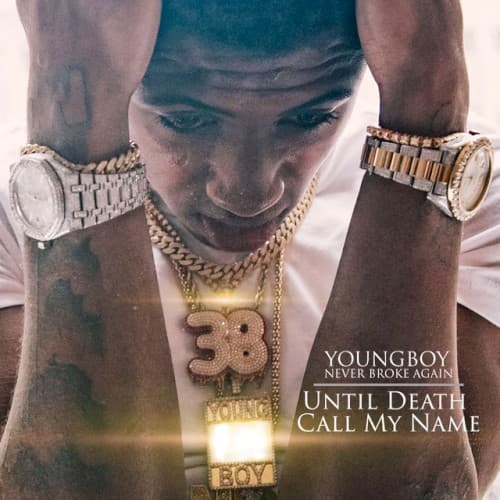
YoungBoy Never Broke Again Until Death Call My Name: A Southern Debut That Sings Its Sins
Until Death Call My Name is a Southern street record that keeps trying to apologize. The most striking thing about the debut from YoungBoy Never Broke Again is not the threat in the verses, which is standard issue for the genre, but how often the voice breaks into something closer to a prayer. A hook arrives in a ragged, bent melody, a line about violence ends on a flinch, and a beat that should bounce in a trunk instead sinks into a minor-key ache. My argument is that this tension is the entire record, and that it is a stronger asset than any single song.
That makes the debut more interesting than its reception suggested. The fact sheet notes mediocre reviews, with critics like the one at HipHopDX calling it an album with issues that still beams with promise, and that verdict is fair. What the critics were reading as unevenness is partly the album doing something that Southern rap had always done at its best: letting a single voice carry mood where the production offers only scaffolding. In the line of Louisiana rappers who treat melody as a weapon, YoungBoy is closer to the strain of Lil Wayne than to the clipped Atlanta trap that was setting the pace in 2018, and the album even leans on that lineage by interpolating a Lil Wayne, Juvenile and B.G. song on one of its singles.
Commercially it did well enough to matter: a first top-ten debut at number seven, with 43,000 units in its first week, and a later platinum certification. Creatively it is a record of two halves that never quite meet. The first third is as sharp as anything he released that year, the back half drifts, and the collaborations with Future and Birdman fit the sound without lifting it. Taken as a whole, Until Death Call My Name is a promising, damaged and frequently gripping debut that wastes a few songs and a lot of ideas.
Minor Keys, Heavy 808s, and a Voice That Cracks on Purpose
The production list is long, with DJ Swift, Bighead, DMacTooBangin, Drumma Boy, Dubba-AA, Wheezy, TM88, Kenny Beats and others each handling a track or two. That could have produced a mess, and the album avoids one because almost everyone builds in the same register: sustained minor chords, a heavy 808 that rolls instead of snaps, and drums that leave room for the vocal. The sound is Southern in its weight and slow pull, yet melodic in a way that tilts toward the emo-trap that was spreading through the South at the time. Producers like Drumma Boy bring a Memphis-rooted low end to We Poppin, while Wheezy and TM88 on Public Figure bring a leaner Atlanta bounce. The differences are small, and that sameness is both the album's glue and its main limitation.
Where the production works best, it leaves a gap for the voice. YoungBoy does not rap in a lock-step pocket. He pushes lines slightly ahead of the beat, drags a syllable until the pitch bends, and then clips a phrase short. That cadence is why Outside Today and Diamond Teeth Samurai work as singles: the drums set a mood and he shapes the bounce on top of it. The interpolation of a famous New Orleans anthem on Diamond Teeth Samurai is not a gimmick; the album uses it to claim a lineage, and the youngest voice on the record handles it without sounding like a copy.
The writing is blunt and specific about consequence, which gives the record its weight. Songs return to danger, loss and an expectation of an early death, the theme Pitchfork's reviewer described as anticipating an early grave. At its best, in Villain and Traumatized, the writing is a confession that does not ask to be admired. That honesty is the reason the threats read as fear rather than posture.
The weakness is repetition. Many verses restate the same grievance or the same boast with slightly different wording, and a number of hooks are interchangeable. Across thirteen tracks the same wound is shown from the same angle, so the later songs add volume but not insight. The guest spots do not help much; the Birdman feature gives We Poppin a classic Southern shape but little urgency, and Future's presence on Right or Wrong is more a stamp of approval than an exchange.
The quality that holds everything together is the singing. Without it, this would be a competent set of trap songs. With it, even the average tracks have a ragged emotional edge that is hard to fake.
Thirteen Songs in One Long Southern Night
The sequencing opens strong and then loosens. The first run has the best balance of mood and hook, and it sets a pace that the album cannot quite maintain. After the two singles land back to back, the record settles into a slower, more reflective stretch where every song feels like a variation on the one before. The ear starts to wait for the next shift in tempo, and it arrives late.
The middle is where the album sags. Three consecutive songs run over ten minutes together, and while none is a failure, none shifts the pace either. A casual listener will feel the same minor key and the same hook shape repeated until the details blur. Thirteen tracks and about forty minutes is a modest length by streaming standards, but it feels longer than it is because of that sameness, and a tighter ten-song cut would have been more convincing.
The lift comes back late. Traumatized and a harder, Atlanta-built cut just after it bring shorter, sharper songs with more urgency, and the closing track is brief enough to leave a clean impression. The shape is a classic Southern album arc: heavy start, long mid-tempo haze, and a final push that reminds you why the voice works. The sequence does not build toward a climax so much as wear down and recover, which suits the lyrical theme but is not ideal for repeat listening.
Overall the length is only partly earned. The strongest dozen minutes would stand up beside any debut of the period, but the surrounding material dilutes them. The album is better enjoyed in segments than in one sitting, with the first third and the last third doing the heavy lifting.
A Promising Debut That Knew Its Voice Before It Knew Its Shape
As a first album, Until Death Call My Name is a strong statement of voice and an incomplete statement of craft. No other YoungBoy albums are rated here yet, so the ranking is relative to the genre rather than the catalog: it scores 6.3, a good record with real strengths and noticeable weaknesses. That places it above a typical streaming-era debut stuffed with filler and below the records that define the era. The voice is the reason; the sequencing is the reason it does not score higher.
This album is for listeners who want Southern rap that leans toward melody and confession over punchlines, and for anyone interested in how the emotional register of trap shifted in the late 2010s. It will also appeal to fans of the Louisiana tradition who are curious about how it sounds filtered through a generation raised on streaming. Skip it if you want varied tempos, tight verses from guests, or a front-to-back arc, because the middle stretch will test patience.
How it has aged is better than expected. The singles still sound urgent, and the confessional tracks have acquired more weight as the artist's catalog has grown. The weaker songs have aged worse, because they rely on formulas that have since become common. Start with Outside Today for the clearest picture of the voice, Diamond Teeth Samurai for the Southern lineage, and Villain for the writing at its most exposed.
For the next step, go to the Southern lineage that this album borrows from, beginning with Lil Wayne for the melodic-menace tradition behind the interpolation, and then to Future for another approach to turning hurt into a hook. The record's best minutes show a young rapper who already knows how to make pain sound musical, and its flaws are the flaws of someone who has not yet learned when to stop.
Track by track
Track Listing
Overdose
StandoutA sombre opener produced by Bighead that establishes the album's dark, melodic center. The voice is pitched slightly sour and the hook leans on repetition, which suits the mood. It sets the template for the first third.
Preach
SolidA long, slow track from DJ Swift with a gospel-adjacent title and a heavy, steady beat. The delivery is controlled and the song never builds past its first idea, so it reads as a mood piece. Fine, but it does not stand out from what surrounds it.
Diamond Teeth Samurai
StandoutThe second single, which debuted at number 59 on the Billboard Hot 100, and the album's clearest connection to Southern rap history through its interpolation of a Lil Wayne, Juvenile and B.G. song. DJ Swift's beat keeps the bounce while the vocal bends around it, and the hook sticks because it never tries to sound polished. It is the best place to hear how he turns a familiar melody into something personal, and it keeps the energy high without losing the ache underneath.
Outside Today
StandoutThe lead single, which peaked at number 31 on the Hot 100, is the album's calling card. DMacTooBangin keeps the beat lean, which puts the voice front and center, and the hook leans on strain instead of polish. It is short, memorable and a clear sign of why he broke through. The writing is simple, but the delivery turns simplicity into momentum, and it remains the strongest argument for the record as a whole.
Astronaut Kid
SolidCashMoneyAP and AlexvnderWolf supply a floating, spacey beat that suits the title. The melody is pleasant but the verses stay on a single note, so it drifts instead of landing.
We Poppin
SolidDrumma Boy brings a Memphis-bred low end, and Birdman's guest appearance links the record to an older New Orleans label tradition. The song is the longest on the album and the energy does not justify the runtime. It sounds like a nod to a Southern lineage more than a standout.
Solar Eclipse
SolidDubba-AA and 1040 build a dark, wide beat with plenty of room. The vocal is committed, though the lyrics circle familiar themes of distrust and survival, and it is another mid-album track that blends into its neighbors.
Villain
StandoutThe track Pitchfork's reviewer singled out for its embrace of inner demons, and the album's most direct piece of writing. Ben Billions and Schife Karbeen keep the production dark but sparse, so the confession carries the weight. He frames himself as the threat without celebrating it, and the delivery, tired and honest, sells the idea better than any boast could. It is the key to the whole project, because it explains why the melodies sound like prayers.
Traumatized
StandoutKenny Beats and Judge deliver a leaner, faster beat, and at just over two minutes the song is one of the album's most efficient. The writing deals with fear and aftermath, and the shorter form keeps it from repeating itself. A welcome change of pace in the back half.
Worth It
SolidA three-producer track that sounds like a typical mid-album slot: melodic, mid-tempo and competent. Nothing is wrong, but nothing demands a replay.
Right or Wrong
SolidThe Future feature, with DJ Montay and Big Korey behind the board. The two voices share a melodic sensibility and the pairing makes sense on paper, but the song is long and relaxed where it needs tension. A nice detail, not a highlight.
Public Figure
StandoutWheezy and TM88 bring a harder, more percussive Atlanta feel, and the shift in texture is welcome after the long soft middle. The song is short, direct and one of the better late-album tracks. It shows what the album might have sounded like with a tighter hand on the sequencing.
Rags to Riches
SolidA brief closer from CashMoneyAP and AlexvnderWolf that ends the album at under two minutes. It is a modest, melodic sign-off that fits the theme but works more as an outro than a statement.