The Blueprint for Soul-Sampling Excellence
Pete Rock & C.L. Smooth emerged from Mount Vernon, New York in 1991 as one of hip-hop's most musically sophisticated duos, crafting a sound that bridged the gap between jazz tradition and boom-bap innovation. Their partnership represented a perfect division of labor: Pete Rock behind the boards excavating soul and jazz samples with archaeological precision, C.L. Smooth delivering introspective verses with a conversational ease that felt effortless yet deliberate. Where many early-90s acts leaned into aggressive posturing or party aesthetics, this duo carved out space for contemplation without sacrificing street credibility.
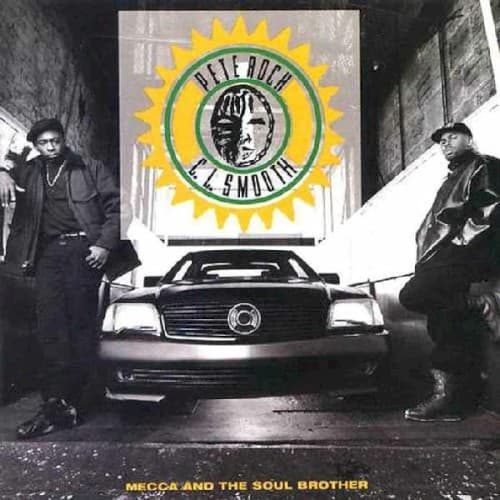
Their commercial peak lasted only a few years, but the music produced during that window — particularly their 1992 masterwork Mecca and the Soul Brother — established production and lyrical benchmarks that producers and MCs still chase three decades later. The duo's approach wasn't about flash or technical gymnastics. It was about feel, pocket, and the kind of organic musicality that makes you forget you're listening to programmed drums and sampled horns. They made hip-hop that sounded like it had always existed, pulling from the past to create something definitively of their moment.
Their influence extends far beyond their relatively modest catalog. Pete Rock's fingerprints appear across the last thirty years of East Coast production, while C.L. Smooth's unhurried delivery anticipated the laid-back confidence that would become central to conscious rap's evolution. They proved that boom-bap could be beautiful, that jazz samples could feel urgent, and that introspection didn't require sacrificing groove.
Horn Loops, Soul Breaks, and Conversational Precision
Pete Rock's production signature is immediately identifiable: warm bass, crisp snares positioned slightly behind the beat for maximum swing, and horn samples that breathe rather than stab. He didn't chop samples into unrecognizable fragments the way some peers did. Instead, he let musical phrases develop, allowing melodies to resolve naturally while drums provided rhythmic counterpoint. His use of the SP-1200 and later the MPC gave his beats that slightly loose, human quality — quantization was a tool, not a mandate. Listen to how the horns unfold across "They Reminisce Over You (T.R.O.Y.)" or the way bass and keys interlock on "Straighten It Out" — this is production that understands space and restraint.
C.L. Smooth's flow operated on a different frequency than most golden-age MCs. Where contemporaries favored rapid-fire multisyllabics or staccato punch-ins, he worked with longer phrases and relaxed cadences that prioritized clarity and emotional resonance. His voice carried natural authority without aggression, a quality that made his street narratives and personal reflections land with equal weight. He never sounded like he was straining to keep pace with the beat; instead, he surfed the pocket Pete Rock created, finding unexpected rhythmic entry points that gave verses an almost conversational quality.
The duo's sonic palette drew heavily from jazz, soul, and funk records that predated hip-hop's birth, but they filtered these influences through a distinctly early-90s sensibility. The result was music that felt timeless rather than retro — respectful of tradition without being museum pieces. Their approach to arrangement favored musicality over minimalism, layering elements without cluttering the mix, creating soundscapes dense enough to reward repeated listening while remaining immediately accessible.
From EP Breakthrough to Premature Dissolution
The partnership began organically, with Pete Rock hosting a show on WBLS radio in New York and C.L. Smooth contributing verses to early demos. Their 1991 EP All Souled Out introduced their chemistry to a wider audience, with tracks like "The Basement" showcasing Pete's sample-flipping expertise and C.L.'s narrative capability. The project positioned them within the Native Tongues-adjacent sphere of conscious, jazz-influenced hip-hop without fully committing to that movement's more Afrocentric aesthetics. They occupied their own lane from the start.
Mecca and the Soul Brother arrived in June 1992 and immediately established itself as a creative peak for both artists. The album balanced radio-friendly material like "They Reminisce Over You (T.R.O.Y.)" — a tribute to their deceased friend, Heavy D's dancer Trouble T-Roy — with deeper album cuts that demonstrated range and ambition. Pete Rock's production across these tracks felt like a masterclass in sampling technique, pulling from Tom Scott, James Brown, and obscure funk 45s with equal facility. C.L. Smooth responded with some of his most focused writing, tackling everything from street politics to personal loss with measured intelligence. The album didn't chase trends; it set them, influencing how producers approached soul sampling and how conscious MCs balanced message with accessibility.
Their 1994 follow-up The Main Ingredient showed artistic growth in some respects — more polished production, tighter song structures — but arrived at a moment when hip-hop's center of gravity was shifting. West Coast G-funk dominated commercially, while East Coast acts like Wu-Tang Clan and Nas were pushing grittier, more aggressive sounds. Pete Rock & C.L. Smooth's jazz-inflected introspection felt slightly out of step with the moment, despite tracks like "Take You There" and "Sun Won't Come Out" demonstrating their formula still worked. The album sold respectably but failed to expand their audience significantly.
By the mid-90s, creative tensions and business disagreements began fracturing the partnership. Pete Rock's growing reputation as an in-demand producer — crafting beats for Nas, The Notorious B.I.G., and others — pulled him toward solo work and broader collaborations. C.L. Smooth pursued solo opportunities as well, though he never achieved the same commercial or critical success independently. The split wasn't acrimonious in the public eye, but it was definitive. Occasional reunion rumors circulated over the decades, and they've performed together sporadically at shows and festivals, but no full-length reunion project has materialized despite fan demand.
The Sample Template Every Producer Studies
Pete Rock's production influence rivals any beatmaker from hip-hop's golden age. His approach to horn samples, his drum programming philosophy, his understanding of musical space — these elements became foundational for an entire generation of producers. Artists from 9th Wonder to Alchemist to J Dilla studied his technique, particularly his ability to make loops breathe and his instinct for when to add elements versus when to let the sample speak. The sound he pioneered with C.L. Smooth became synonymous with intelligent, soulful East Coast production, a counterbalance to the harder-edged aesthetics of Mobb Deep or the abstract experimentation of early Wu-Tang.
C.L. Smooth's legacy is quieter but no less significant. His conversational flow and thoughtful content presaged the introspective approach later artists like Common, Talib Kweli, and Mos Def would refine throughout the late 90s and early 2000s. He demonstrated that consciousness didn't require preaching, that you could address serious topics without sacrificing listenability or groove. His influence appears in how MCs approach pocket and phrasing more than in direct stylistic imitation — an effect felt rather than quoted.
Mecca and the Soul Brother remains a touchstone for anyone exploring hip-hop's relationship with jazz and soul. It sits comfortably alongside A Tribe Called Quest's The Low End Theory and Gang Starr's work as proof that sampling could elevate rather than diminish source material, that hip-hop could honor its musical ancestors while pushing the culture forward. The album's endurance speaks to its craftsmanship — these tracks haven't aged because they were never chasing the present. They exist in their own pocket of time, equally relevant in 1992 and today, a testament to the duo's understanding that great music transcends its moment.