Style & Context
Influences
Madlib album aesthetics, nature documentary framing, street photography
Location
Gary, Indiana's post-industrial landscape haunts the image even though the photo shows greener spaces and relative peace.
Visual Language
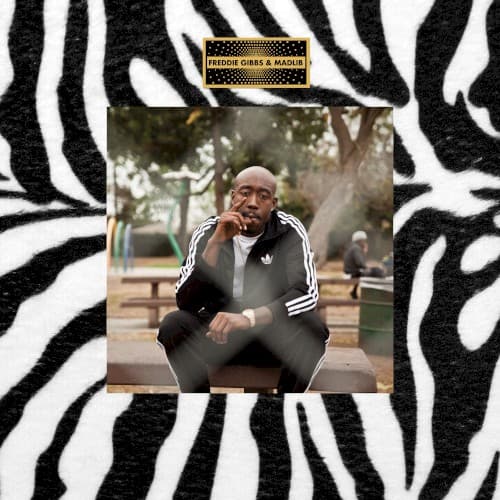
The composition mimics a safari photograph turned inward, documenting street life with anthropological distance and intimacy simultaneously.
Symbols
Zebra-print border
The wild pattern frames Gibbs as both predator and prey in the street economy he narrates.
Adidas tracksuit
The three stripes connect to hip-hop's foundational era while signaling Gibbs' working-class roots and authenticity.
Park setting backdrop
Public space where children play becomes a stage for contemplating the violence Gibbs survived and witnessed.
Where Sound Meets Image
The frame-within-frame design mirrors how Madlib's loop-heavy production creates sonic containers for Gibbs' autobiography. Tracks like 'Thuggin' and 'Shitsville' describe Gary's drug economy over dreamy jazz loops—the same tension this cover visualizes. The zebra stripes suggest the black-and-white moral universe Gibbs navigates, where survival requires adaptation like animal camouflage. The outdoor setting with trees and playground equipment connects to songs about childhood stolen by street life, particularly 'Broken,' where Gibbs reflects on cycles of violence and fatherhood.
This cover helped establish Madlib's visual language for the Piñata series—mixing stark photography with bold graphic borders that create psychological distance. The design influenced how independent hip-hop marketed itself in the streaming era: no Photoshop excess, just raw portraiture and one strong design choice. The approach signaled substance over style, letting music speak first.