Style & Context
Influences
Gregory Crewdson, family album aesthetics, surrealist portraiture
Location
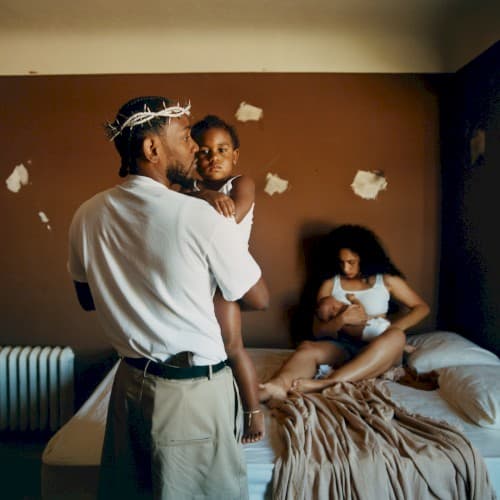
This deliberately avoids hood signifiers, placing Kendrick in the universal space of family struggle and healing.
Visual Language
The square format and staged surrealism create psychological tension, making the viewer feel like an intruder in someone's therapy.
Symbols
Crown of thorns
Kendrick positions himself as a martyr figure, bearing the pain of generational trauma and public expectation.
Cotton clouds indoors
Thoughts and trauma literally escape the mind's confines, manifesting as physical objects in domestic space.
White tank tops
The matching undershirts strip the scene to its most vulnerable, suggesting uniform exposure in therapy.
Where Sound Meets Image
The dual nature—Kendrick facing away while his partner faces us—mirrors the album's structure as both sides of a conversation about accountability and healing. The clouds represent the therapeutic unpacking happening across tracks like 'Father Time' and 'Mother I Sober,' where buried memories surface. The thorns connect to 'Savior,' where Kendrick rejects messianic expectations. This isn't a triumphant image because the album isn't triumphant—it's uncomfortable work, shown here as a man literally standing between his past (the partner, generational cycles) and future (his daughter, breaking patterns). The staginess reflects how we perform even in private, a theme threading through the album's examination of masculinity and vulnerability.
This cover influenced rap's shift toward therapeutic vulnerability as marketable aesthetic. The family-as-album-art trend it accelerated appears in countless 2023-24 releases. By centering Black domesticity without glamorizing it, Kendrick created a template for depicting complexity—not struggle porn or aspirational wealth, but the messy middle where healing happens. The surreal elements gave permission for more experimental visual approaches in mainstream rap, moving beyond street realism or luxury flexing into psychological landscapes.