Scorecard: 8.3/10 · Great
How we score- Writing(25%)
- 8.5
Lyrics swing from absurdist gardening metaphors to anti-materialist satire with a specificity and wit that no one else was attempting in 1989, though the conversational delivery sometimes lags behind the production's ambition.
- Production(25%)
- 9.0
Prince Paul's collage method—doo-wop, psychedelic rock, French lessons, children's records—built something genuinely new from the debris, though the unconventional structures occasionally sprawl past their functional limits.
- Delivery(15%)
- 7.5
Pos, Trugoy and Mase trade lines with a conversational ease that serves the humor and ideas, even if the looser flow sometimes can't match the production's technical reach.
- Cohesion(15%)
- 7.0
The quiz show skits eat up time on a 67-minute album where the pacing sags in the middle, though the D.A.I.S.Y. Age motif does provide thematic glue across 24 tracks.
- Originality(10%)
- 9.5
Invented progressive hip-hop in a single album: the first record to treat sampling as psychedelia, the first to make skits structural, the first to prove rap could be playful and intelligent without apology.
- Replay value(10%)
- 8.0
The singles remain indestructible and the sample collages still surprise, though the skits and shorter interludes lose their novelty and the middle third drags after a few passes.
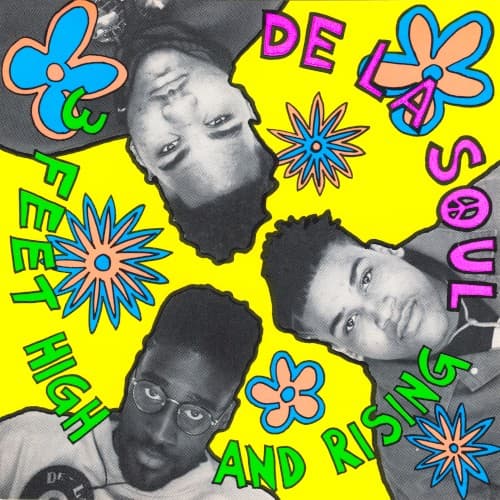
De La Soul 3 Feet High and Rising — The Record That Made the Boom Bap Weird
When 3 Feet High and Rising arrived in early 1989, it was the wrong album at the wrong time, which made it exactly right. Public Enemy had militarized rap production the year before, N.W.A. was about to codify the West Coast gangsta blueprint, and here came three kids from Long Island with a cover covered in hand-drawn flowers, rapping about dandruff and lawn care over samples from French-language instructional records. The album won the Village Voice critics poll by a landslide and went platinum, proving that hip-hop had room for something other than revolution and reportage, that you could be thoughtful without being didactic and playful without being lightweight. The thesis: intelligence and absurdity are not opposites, and sampling is a compositional language, not a shortcut.
De La Soul and producer Prince Paul built 3 Feet High and Rising as a deliberate rejection of the emerging materialist tropes in rap. Where others were stacking gold chains and claiming corners, Pos, Trugoy and Mase invented the D.A.I.S.Y. Age—Da Inner Sound, Y'all—a sunnier ethos that lampooned the genre's growing self-seriousness without abandoning its craft. The music backed it up: Paul's production pulled from doo-wop, psychedelic rock, Steely Dan, Hall and Oates, children's music, anything that could be broken and reassembled into something new. Robert Christgau called it radically unlike any rap anyone had heard, and he was right. Thirty-six years later, it still sounds like the moment sampling became surrealism, a sound that the Beastie Boys would expand with Paul's Boutique later that same year.
Sampledelia and the Casio That Built the Future
Prince Paul's production on 3 Feet High and Rising turned the sample-heavy style of late-eighties hip-hop into something stranger and more ambitious. Instead of loop-based funk breaks, Paul built collages: The Magic Number stitches together a children's counting song with a loping bassline, Eye Know flips a Steely Dan yacht-rock chorus into a love song that sounds like it was recorded in a kaleidoscope, and Potholes in My Lawn uses gardening as a metaphor for protecting your creative space over a beat that feels like it is falling sideways. The group used a Casio RZ-1 drum machine and an Eventide Harmonizer to manipulate and layer their samples, a low-budget setup that forced invention. The result is the first psychedelic hip-hop record, music that treats the sample as raw material for new structures rather than a reference to be recognized.
The writing avoids both the confrontational edge of gangsta rap and the earnest messaging of conscious rap, landing instead in a zone of bizarre specificity. Jenifa Taught Me turns a breakup into a surrealist revenge fantasy, Me Myself and I mocks materialism without sermonizing, and the album's recurring animal imagery—talking dogs, borrowed voices, Dr. Dolittle absurdism—gives the wordplay a cartoonish flexibility. Pos, Trugoy and Mase trade lines in a conversational flow that prioritizes clarity and humor over technical flash. The delivery is looser than what the Juice Crew or Rakim were doing, which serves the comedy and keeps the tone light, but it also means the rapping sometimes lags behind the ambition of the production. Guest spots from Q-Tip and the Jungle Brothers on Buddy add energy, but the core trio carries the album on wit and ideas rather than pure technical skill.
The unconventional song structures and the quiz show skits that recur throughout the album are where the vision gets messy. The skits—game show banter hosted by Prince Paul as a fictional host—are credited with inventing the hip-hop skit as a format, and they do provide thematic glue for 24 tracks, but they also eat up time on an album that is already 67 minutes long. Cool Breeze on the Rocks, a 48-second collage of samples where the word rock appears, is a clever flex that had to be gutted for the 2023 streaming release due to clearance issues; the replacement version is 18 seconds of tape-winding noise. Interludes like Transmitting Live from Mars and De La Orgee are amusing once, then skippable. The pacing sags in the middle third, and the album would have been stronger at 50 minutes.
The Long Play and the Four That Escaped It
At 24 tracks and 67 minutes, 3 Feet High and Rising was too long for vinyl and it feels too long now. The opening stretch builds momentum, but the middle section loses focus. The skits and short interludes pile up, and the sequencing does not do enough to separate the statement tracks from the experiments. The peaks are high—the anti-materialist argument gets its cleanest distillation, the group sounds loosest and most fun in places, the weirdest and most lyrically dense moments reward close attention—but the album asks the listener to sit through several disposable minute-long sketches to get there.
The singles earned their radio play. The Magic Number became a cultural reference point, and Me Myself and I went to number one on the R&B charts. The deeper cuts show the range of the concept without hitting as hard. The album rewards patient listening, but it does not make patience easy. A tighter tracklist would have sharpened the argument.
The Sgt. Pepper Comparison Was Not Wrong
3 Feet High and Rising is the most important alternative hip-hop album ever made, the record that proved rap could be progressive without being preachy and experimental without being unlistenable. It invented the template that the Native Tongues, the Pharcyde, Outkast, and every other group that refused the gangsta-or-conscious binary would follow. It is also the only platinum album in De La Soul's catalog, and the fact that it was kept off streaming until 2023 due to sample clearance issues is a fitting coda for a record that treated copyright as a creative commons. The production still sounds ahead of its time, the writing is sharper than most of what followed, and the vision is complete.
This is not the album to start with if you want to understand what De La Soul became—later records like De La Soul Is Dead are leaner and more focused—but it is the one that explains why they mattered. The best case for it is also the best case against it: this is a 67-minute art statement that could have been a 50-minute classic. Start with The Magic Number, Eye Know, Me Myself and I, and Potholes in My Lawn, then decide if the skits and interludes are charming or exhausting. If you want to hear where alternative hip-hop came from, there is no other option. If you want to understand why Prince Paul is in the conversation with the RZA and DJ Premier as a foundational producer, this is the evidence. It sprawls, it sags in the middle, and it is still unlike anything else.
Track Listing
Intro
●A 101-second overture that establishes the quiz show framing device and the D.A.I.S.Y. Age concept with spoken-word samples and choppy editing. Sets the tone but adds no musical value.
The Magic Number
▲The cleanest synthesis of the album's thesis: a children's counting rhyme flipped into a mission statement about the power of three, with a bassline that bounces and a hook that became a cultural reference. The writing is playful without being slight, the production is immediately memorable, and the track does everything it needs to do in three minutes. This is the one that made the album undeniable, and it still works as both a single and as the argument in miniature. Used in the end credits of Spider-Man: No Way Home in 2021 as a reference to the three Peter Parkers, which proves its reach beyond hip-hop.
Change in Speak
▼A two-and-a-half-minute skit about miscommunication and slang, more spoken-word performance than rap. The production is sparse and the concept wears thin quickly. Filler.
Cool Breeze on the Rocks
●Originally a 48-second collage of dozens of samples containing the word rock, replaced on streaming with an 18-second tape-winding sound due to clearance issues. The original was a clever production flex that had no deeper purpose; the replacement is a joke about what got lost.
Can U Keep a Secret
●A minute-and-a-half interlude built around a whispered hook and a minimal beat. Functions as a palate cleanser but does not develop into anything.
Jenifa Taught Me (Derwin’s Revenge)
▲A breakup turned into a surrealist revenge fantasy, with Pos recounting romantic disaster in absurdist detail. The production is off-kilter, the storytelling is specific, and the track uses humor to deal with heartbreak without trivializing it. One of the album's best examples of how the group's bizarre subject matter serves real emotion.
Ghetto Thang
▲The album's most direct engagement with the emerging gangsta rap conventions it otherwise avoids, a track that acknowledges the reality of the streets while refusing to glamorize or preach about it. The production is darker than most of the album, and the rapping is more focused. Holds its ground.
Transmitting Live From Mars
▼A minute-long skit about extraterrestrial transmission. Amusing once, then dead weight.
Eye Know
▲The best demonstration of how Prince Paul's sampledelia works in practice: a Steely Dan yacht-rock sample chopped into a love song that sounds like it is being broadcast from inside a lava lamp. The rapping is warm and conversational, the production is dizzyingly colorful, and the track proves that sincerity and weirdness are not mutually exclusive. One of the four singles and one of the four tracks that justify the album's reputation. Still sounds wondrous.
Take It Off
●A brief interlude about stripping away pretense, with a skeletal beat and minimal rapping. The concept is clear but the execution is too thin to land.
A Little Bit of Soap
●A 57-second doo-wop sample with almost no rapping, more of a mood piece than a song. Charming in the moment, forgettable after.
Tread Water
●A solid mid-album track about staying afloat in the industry, with a steady groove and competent rapping. The metaphor is straightforward and the production is less adventurous than the peaks. Does its job without making a case for itself.
Potholes in My Lawn
▲The weirdest and most lyrically dense track on the album, using gardening as an extended metaphor for protecting your creative space from biters and fakers. The production is sideways and unsettling, the wordplay is packed with internal rhymes and absurdist imagery, and the track refuses to explain itself. This is the deepest cut into what makes the album's approach work: intelligence, humor, and a willingness to be oblique. One of the four essential tracks.
Say No Go
●A cautionary track about drug use built over a Hall and Oates sample, earnest without being preachy. The production is bright and the message is clear, but the track does not add much that the album has not already said better elsewhere.
Do as De La Does
●A two-minute interlude about following your own path rather than imitating trends. The sentiment is on-brand but the execution is thin.
Plug Tunin’ (Last Chance to Comprehend)
●A four-minute track that functions as a thesis statement about unplugging from expectation and tuning into your own frequency. The production is layered and the rapping is confident, but the track meanders and does not justify its length. Solid without being essential.
De La Orgee
▼A minute-long interlude of chopped vocal samples and minimal percussion. Filler.
Buddy
▲The loosest and most fun track on the album, a posse cut with Q-Tip and the Jungle Brothers over a bright, bouncy beat. The guest verses add energy, the group chemistry is easy, and the track works as both a showcase for the Native Tongues collective and as a moment where the album stops being conceptual and just raps. One of the four singles and one of the album's clear highlights.
Description
▼A minute-and-a-half skit about self-definition. The concept is slight and the track adds nothing.
Me Myself and I
▲The cleanest distillation of the album's anti-materialist argument, a track that mocks gold chains and luxury posturing without preaching or sounding bitter. The production is bright and minimal, the hook is immediately memorable, and the rapping is sharp and specific. Went to number one on the R&B charts and remains the most accessible entry point to what the album is trying to do. One of the four singles and one of the four tracks that define the album.
This Is a Recording 4 Living in a Fulltime Era (L.I.F.E.)
●A three-minute track about navigating the absurdity of modern life, with a mid-tempo beat and solid rapping. The track is well-constructed but does not stand out in a crowded tracklist.
I Can Do Anything (Delacratic)
●A 41-second burst of confidence and wordplay. Too short to develop but too brief to drag.
D.A.I.S.Y. Age
●The album's closing thesis statement, a nearly five-minute track that explains the Da Inner Sound, Y'all concept in full. The production is warm and the rapping is thoughtful, but the track feels like it is summarizing rather than building toward a climax. A necessary bookend that does not quite earn its length.
Plug Tunin’ (original 12″ version)
▼A nearly four-minute alternate version of the earlier Plug Tunin track, included only on CD releases. Redundant and unnecessary for anyone who is not a completist.