The Native Tongues Pioneers Who Redefined Hip-Hop's Creative Boundaries
De La Soul arrived in 1989 with a kaleidoscopic vision that shattered hip-hop's existing templates. The Long Island trio—Posdnuos (Kelvin Mercer), Trugoy the Dove (David Jolicoeur), and Maseo (Vincent Mason)—emerged from Amityville with a sound that felt like stumbling into a record store after hours, surrounded by crates of French pop, psychedelic rock, and forgotten funk 45s. Their debut 3 Feet High and Rising didn't just sample different genres; it reimagined what hip-hop could be when freed from the constraints of prevailing trends. Where their peers were locked in territorial battles or chasing street credibility, De La Soul built whimsical game show skits and stitched together sonic collages that referenced everything from Steely Dan to The Turtles.
The trio became foundational architects of the Native Tongues collective alongside A Tribe Called Quest, Jungle Brothers, and Queen Latifah. This loose confederation rejected the hard-edged posturing that dominated late-eighties rap, instead championing Afrocentric consciousness, creative experimentation, and playful intellectualism. De La Soul's influence extended beyond their own catalog—they helped legitimize alternative approaches to hip-hop at a moment when the genre risked calcifying into rigid formulas. Their career spans over three decades, marked by constant reinvention, fiercely independent artistry, and a principled stance on ownership that kept their catalog off streaming platforms for years.
Sampling as Storytelling: The Sonic Collage Technique That Became Their Signature
De La Soul's production approach, particularly in their early work with producer Prince Paul, treated the sampler like a narrative device. Rather than looping a single break or bass line, they layered disparate fragments—a harpsichord from a French film score over a James Brown grunt over a children's educational record—creating textured soundscapes that rewarded repeat listening. The technique reached its apex on 3 Feet High and Rising, where tracks like "Eye Know" borrowed from Steely Dan and Otis Redding simultaneously, creating something that felt both familiar and completely alien. This wasn't just crate-digging; it was archaeological excavation, unearthing forgotten sounds and repurposing them into hip-hop's expanding vocabulary.
Vocally, the trio operated as a three-headed organism. Posdnuos delivered intricate internal rhyme schemes with a conversational ease that made complex wordplay sound effortless. Trugoy brought a slightly nasal, sardonic tone that cut through the psychedelic production with sharp observational humor. Maseo's contributions were sparser but strategically placed, often providing the punchline or perspective shift that recontextualized entire verses. Their flow wasn't aggressive or percussive in the manner of their East Coast contemporaries; instead, they favored a relaxed, almost improvisational delivery that suggested freestyle ciphers more than studio precision. This vocal chemistry became even more essential as their production evolved beyond Prince Paul's involvement, with the group taking greater control over their beats and moving toward live instrumentation, jazz fusion elements, and darker sonic palettes on albums like Stakes Is High.
From Daisy Age Misconceptions to Creative Independence: Tracing De La Soul's Evolution
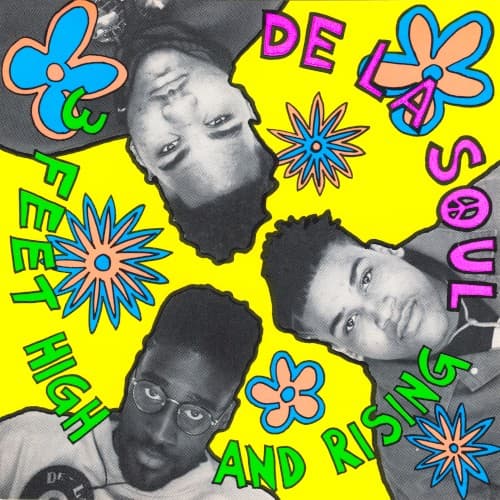
The commercial and critical success of 3 Feet High and Rising in 1989 immediately created a problem De La Soul spent years trying to escape. The media branded them "Daisy Age" rappers—flower-power hippies in a genre built on urban grit. The colorful album artwork, the skits featuring game show host segments, and the playful sampling gave critics an easy narrative that flattened the trio's actual complexity. Their 1991 follow-up De La Soul Is Dead was a deliberate repudiation, opening with the sound of a car crash destroying a garden and featuring a cover with a broken daisy pot. The album's production was darker, the skits more cynical, and tracks like "Millie Pulled a Pistol on Santa" tackled child abuse with unflinching seriousness. It was a necessary artistic statement, even if it confused fans expecting more whimsy.
Buhloone Mindstate (1993) pushed even further into experimental territory, embracing jazz abstraction and stream-of-consciousness lyricism that alienated some listeners while cementing the group's reputation among heads. Stakes Is High (1996) arrived after the trio's relationship with Prince Paul had dissolved, forcing them to self-produce alongside collaborators like J Dilla. The album felt like a manifesto against hip-hop's commercial turn, with the title track becoming an anthem for purists who felt the culture was losing its way. Commercially, it underperformed, but artistically it represented De La Soul at their most defiant and uncompromising.
The 2000s brought a creative renaissance. Art Official Intelligence: Mosaic Thump (2000) was conceived as the first part of a trilogy, featuring collaborations with Busta Rhymes, Redman, and Chaka Khan. AOI: Bionix (2001) leaned harder into electronic and synth-driven production, while The Grind Date (2004) showcased tighter, more aggressive rhyming over stripped-down beats. These albums didn't achieve massive commercial success, but they demonstrated a group still evolving, still refusing to repeat themselves. And the Anonymous Nobody (2016) arrived after an eight-year recording hiatus, funded by a Kickstarter campaign that raised over $600,000—proof that their fanbase remained deeply invested even without mainstream visibility.
Their most significant battle was fought off-record. De La Soul spent decades locked in disputes over their masters, which prevented their catalog from appearing on streaming platforms until 2023, two months after Trugoy's death. This principled stand on artist ownership came at enormous financial cost but aligned with their career-long commitment to creative and commercial independence. They turned down major label offers, avoided commercial compromises, and prioritized artistic integrity over hit singles—a strategy that limited their pop culture presence but preserved their legacy as uncompromising artists.
The Ripple Effect: How De La Soul's Creative Freedom Shaped Modern Hip-Hop
De La Soul's influence operates on multiple levels. Sonically, they proved that hip-hop could absorb any genre without losing its essential character. Their sampling philosophy directly inspired producers like Madlib, J Dilla, and Kanye West, who treat the sample as compositional element rather than mere loop. The Neptunes, 9th Wonder, and countless others cite De La Soul's textural layering as foundational to their own approaches. When Kanye West built The College Dropout around chipmunk soul and eclectic samples, he was walking a path De La Soul had cleared fifteen years earlier.
The Native Tongues movement they helped anchor created space for artists who didn't fit hip-hop's dominant narratives. Without De La Soul's commercial viability in 1989, it's harder to imagine the mainstream accepting acts like The Pharcyde, Outkast, or later alternative voices like Tyler, the Creator and Brockhampton. They demonstrated that you could be intellectually curious, aesthetically adventurous, and commercially successful—at least for a moment—without posturing or pandering. Their willingness to abandon winning formulas influenced everyone from Common to Mac Miller, artists who prioritized growth over brand consistency.
Their battle for catalog ownership became a rallying point for younger artists navigating predatory label deals. When they finally regained control and brought their music to streaming platforms in 2023, it felt like a victory for artist rights broadly, even if it came too late for Trugoy to witness. De La Soul never chased trends, never softened their vision for radio play, and never compromised their artistic principles for commercial expediency. That integrity, more than any single album or track, is their most enduring legacy—a blueprint for how to sustain a career on your own terms, even when the industry demands otherwise.