Scorecard: 8.5/10 · Essential
How we score- Writing(25%)
- 8.5
Four distinct voices trade clever first-person stories with wit and specificity, from the drunken mishaps on "Oh Shit" to the schoolboy crush narratives on "Passin' Me By", though the comedy sometimes sacrifices thematic depth.
- Production(25%)
- 9.0
J-Swift's lush jazz-funk production samples Quincy Jones, Sly Stone and James Brown into warm, layered soundscapes with live instrumentation, making every beat inventive and textured without stepping on the rapping.
- Delivery(15%)
- 8.0
Four emcees with distinct flows and energies create a playful street-corner vibe where verses feel like conversation, though the goofiness occasionally undercuts the gravity of tracks like "Officer".
- Cohesion(15%)
- 7.5
The skits and interludes break up the sequencing more than they help it, and the album wanders between comedy and sincerity without a strong arc, but the tone stays consistent enough to feel like a cohesive world.
- Originality(10%)
- 9.0
Arrived in 1992 as a completely different West Coast vision from the dominant gangsta and G-funk sound, establishing an alternative LA scene that mixed Daisy Age playfulness with jazz production years before it became common.
- Replay value(10%)
- 8.5
The production stays fresh and the writing holds detail on repeat listens, though some skits wear thin; thirty years later it remains the blueprint for humorous, jazz-tinged West Coast rap.
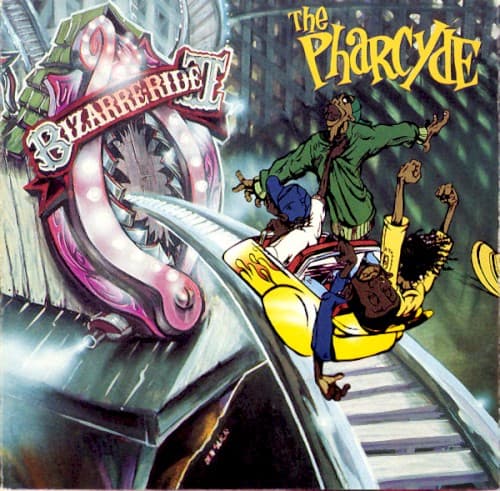
The Pharcyde Bizarre Ride II the Pharcyde — The Joke That Built a Scene
Released in November 1992, when the West Coast meant gangsta posturing and lowrider funk, Bizarre Ride II the Pharcyde arrived like a prank call from a different Los Angeles altogether. While Dre perfected the G-funk template and Death Row defined the coast's commercial sound, four former dancers from South Central turned the script into a party: jazz loops, self-deprecating storytelling, and four voices bouncing off each other like a barbershop argument. The album flopped commercially at first, peaking at number 75 on the Billboard 200, but it carved out space for an entirely different West Coast tradition, one that valued wit and musicality over bravado. The thesis is straightforward: Bizarre Ride works because it refuses the genre's dominant modes without abandoning what makes rap compelling, building a record around humor and vulnerability that still sounds more inventive than most of what followed it.
The stakes in 1992 were real. The West had spent years answering East Coast jazz rap with street reportage and speaker-rattling bass, and here came The Pharcyde with Quincy Jones samples and verses about masturbation and unrequited crushes. J-Swift's production pulls from the same jazz and funk sources that powered A Tribe Called Quest and De La Soul, but the execution is warmer and more layered, with live instrumentation filling out the samples. The rapping is just as crucial: Slimkid3, Imani, Fatlip and Bootie Brown each bring a different flow and energy, creating a conversational dynamic that turns even throwaway moments into something textured. The album is not perfect; the skits run long, the sequencing sags in the middle, and the group sometimes mistakes goofiness for substance. But what it accomplishes matters more than what it fumbles, because it proved the West Coast could support more than one sound.
Four Voices Over Live Jazz Loops
J-Swift produced fifteen of the sixteen tracks here, and the consistency of his vision holds the album together even when the rapping veers into sketch comedy. He works with a deep sample palette: James Brown, Sly and the Family Stone, Donald Byrd, Roy Ayers, Marvin Gaye. What separates this from other sample-heavy productions of the era is how much live instrumentation Swift layers in, playing piano, bass and rhodes himself while JMD handled drum arrangements. The result is production that breathes, with warmth and texture that feels closer to live performance than the stark, hard-hitting loops dominating West Coast rap in 1992. Tracks like "Passin' Me By" sample Quincy Jones but fill the space with additional keys and bass that make the beat feel lush rather than looped. "Soul Flower (remix)" builds a full arrangement around its sample, turning the track into something closer to jazz-funk than typical boom-bap.
The writing operates on wit and specificity rather than weight. This is not protest rap or street journalism; it is four guys telling embarrassing stories with enough detail to make them funny. On "Oh Shit", Slimkid, Imani and Fatlip trade verses about drunken mistakes and awkward sexual encounters, each one more absurd than the last. "4 Better or 4 Worse" includes an entire verse from Fatlip about prank calling, rattling off surreal threats while a confused woman threatens to call the police.
"On the DL" finds Slimkid, Buckwheat and Imani airing secrets they would rather keep quiet, mixing humor with genuine unease. The album's best-known track, "Passin' Me By", shifts the tone entirely: four verses about unrequited schoolboy crushes, specific enough to feel personal, melancholy enough to cut through the comedy. It became the group's biggest hit because it balanced the playfulness with something real.
The weakness is that the album never decides how seriously to take itself. "Officer" addresses racial profiling with four solid verses, but it sits between skits and stoner anthems without much context, so the moment feels orphaned. The skits themselves, particularly "It's Jigaboo Time" and "Quinton's on the Way", run longer than they earn, breaking the album's momentum for punchlines that do not land. And while the four emcees each have distinct voices, the group's commitment to goofiness sometimes flattens tracks that could use more gravity. When the album leans into storytelling and clever wordplay it excels; when it leans into pure absurdity it feels like wasted space.
A Record That Wanders But Never Loses the Thread
The sequencing on Bizarre Ride does not build toward anything; it meanders through moods and topics without much concern for arc or peaks. The album opens strong with the instrumental interlude leading into the first full track, establishing the tone immediately: humor, specificity, jazz-funk production. From there it drifts between full tracks, skits and interludes without a clear sense of which moments deserve emphasis. The emotional center arrives two-thirds through the tracklist, but nothing before it builds toward that shift in tone, and nothing after it capitalizes on it.
The closing solo track picks up where the emotional center left off, moving past heartbreak toward resilience, but the two moments are separated by a skit that kills the momentum. The album runs fifty-seven minutes across sixteen tracks, and the length is not earned. The skits add nearly five minutes of dead air, and several full tracks feel like ideas stretched past their natural length. The album would be tighter and more effective at forty-five minutes, cutting the skits and trimming the weaker full tracks. What keeps it from collapsing under its own length is the production, which stays inventive and textured even on the throwaway moments, and the chemistry between the four emcees, which makes even the lesser tracks feel like part of a conversation rather than filler.
The West Coast Record That Chose a Different Path
Bizarre Ride II the Pharcyde ranks among the most important West Coast albums of the nineties not because it sold or dominated but because it proved the region could support more than one sound. It arrived in 1992, the same year as The Chronic, and offered a completely different vision: jazz loops instead of Parliament funk, self-deprecating humor instead of swagger, four voices in conversation instead of one dominant presence. The album established a lineage that runs through Hieroglyphics, Jurassic 5 and the entire alternative LA scene that followed, showing that the West Coast had room for wit and musicality alongside its gangsta narratives. As a debut it is uneven, with skits that drag and a lack of sequencing discipline, but the highs are high enough to justify the reputation. J-Swift's production remains some of the most textured and inventive work of the era, and the four emcees create a dynamic that no other group has replicated.
This is an album for listeners who value creativity and craft over polish, and for anyone interested in the roads not taken by mainstream West Coast rap. Start with "Passin' Me By", "Oh Shit" and "Otha Fish" to hear the range: melancholy storytelling, absurd humor, and resilience. Skip it if you need thematic cohesion or cannot tolerate skits. The album has aged well, largely because it never chased trends; what sounded alternative in 1992 still sounds alternative now.
If you are working through the Pharcyde catalog, this is the starting point and the peak, the record where the group's vision was clearest before internal conflicts derailed them. For similar production and sensibility, try A Tribe Called Quest's The Low End Theory or De La Soul's 3 Feet High and Rising, both of which share the jazzy, playful DNA. For West Coast alternatives from the same era, Souls of Mischief's 93 'til Infinity carries the same spirit with tighter execution. Bizarre Ride is the better record for its ambition and its willingness to sound like nothing else on the coast, even if that ambition occasionally exceeds its grasp.
Track Listing
4 Better or 4 Worse (interlude)
▲Instrumental scene-setter with warm keys and a shuffling rhythm that establishes the album's jazz-funk palette in under a minute.
Oh Shit
▲The album's proper opening and one of its strongest tracks. Slimkid, Imani and Fatlip trade verses about drunken mistakes, awkward hookups and bizarre sexual encounters, each story more absurd and specific than the last. The production loops a soulful sample over live bass and keys, creating space for the three voices to work off each other. The writing here is sharp and self-aware, mining embarrassment for humor without tipping into mean-spiritedness. It sets the tone for the entire record: clever, conversational, and unafraid to look foolish.
It’s Jigaboo Time (skit)
▼A minute and a half of voices riffing on minstrel imagery that aims for satire but mostly just stops the album cold.
4 Better or 4 Worse
▲The title track builds on the interlude with a full arrangement, giving Slimkid, Imani and Fatlip room to stretch. Fatlip's prank-calling verse is the centerpiece, a surreal monologue of escalating threats delivered with deadpan commitment. The production keeps the jazz loop warm and layered, but the track runs over five minutes and starts to drag before it ends. Still, the specificity of the writing and the tightness of the flows make it a solid entry.
I’m That Type of Nigga
●All four emcees plus guest Buckwheat take turns describing their personalities and quirks, each verse a self-portrait in miniature. The chemistry between the five voices is the selling point here; the track works as a showcase for how different each flow and perspective is. The production stays understated, letting the rapping drive the track. Not a standout but a useful introduction to the group's dynamic.
If I Were President (skit)
●A one-minute skit where the group imagines policy changes, some funny, some pointless. Harmless filler.
Soul Flower (remix)
▲Originally released on a Brand New Heavies compilation, the remix here benefits from J-Swift's fuller production. Bootie Brown, Imani, Slimkid and Fatlip each take a verse over a lush, soulful beat built around live instrumentation and a warm sample. The writing is less absurd than the early tracks, aiming for lyrical dexterity over storytelling, and all four emcees deliver. The production is some of the album's richest, with layered keys and bass that make the track feel almost orchestral. A highlight.
On the DL
▲Slimkid, Buckwheat and Imani air secrets they would rather keep private, mixing humor with genuine discomfort. The topics range from masturbation to murder, handled with enough wit to keep the track from tipping into shock value. The production stays mellow and jazzy, giving the confessional verses room to breathe. One of the album's more interesting narrative experiments, even if it does not land every punchline.
Pack the Pipe (interlude)
●A brief instrumental break that serves as an intro to the full version later on the tracklist.
Officer
▲The album's only direct engagement with police brutality and racial profiling. Fatlip, Bootie Brown, Imani and Slimkid each recount encounters with cops, and the verses are specific and pointed, describing harassment and humiliation in plain terms. The production stays understated, a mellow loop that does not compete with the subject matter. The weakness is that the track arrives without context, sandwiched between skits and stoner anthems, so the tonal shift feels jarring. Still, the writing is strong and the group treats the topic seriously, which makes the track one of the album's most substantive moments even if the sequencing undermines it.
Ya Mama
▲The group's debut single and the track that landed them a record deal. Fatlip, Bootie Brown, Imani and Slimkid trade dozens-style insults aimed at each other's mothers, each verse trying to top the last in absurdity and wit. The production is spare and punchy, letting the rapping dominate. The track is pure comedic exercise, no deeper meaning, but the wordplay is sharp and the energy is high. It works as a showcase for the group's chemistry and sense of humor, even if it is ultimately disposable.
Passing Me By
▲The album's centerpiece and its biggest hit, peaking at number 52 on the Billboard Hot 100. Bootie Brown, Slimkid, Imani and Fatlip each deliver a verse about unrequited schoolboy crushes, specific enough to feel personal: a girl in high school, a crush on a friend's girlfriend, longing from a distance. The production samples Quincy Jones and builds a lush, melancholy arrangement around it, with live bass and keys that make the track feel warm despite the sadness. The writing balances humor and vulnerability perfectly, and the four verses together create a portrait of adolescent longing that feels universal without losing specificity. The track became a classic for good reason; it is the moment where the album's playfulness and sincerity converge into something genuinely moving.
Otha Fish
▲A Slimkid solo track that serves as a response to "Passin' Me By", moving past heartbreak toward resilience and optimism. The production, handled by L.A. Jay and Slimkid instead of J-Swift, is smoother and more polished, with a soulful loop and layered instrumentation. Slimkid's verse is confident and forward-looking, arguing that there are other opportunities and other people worth pursuing. The track works as a thematic conclusion to the album's emotional arc, even if the sequencing buries it under skits. One of the stronger closers in nineties rap.
Quinton’s on the Way (skit)
▼Over two minutes of a rambling phone conversation that adds nothing to the album and kills the momentum between "Otha Fish" and the final tracks.
Pack the Pipe
●A stoner anthem with verses from Slimkid, Bootie Brown, Fatlip, Imani and guest Quinton, each describing their relationship with weed. The production is hazy and laid-back, matching the subject matter, and the group delivers the verses with enough humor to keep the track from feeling like pure indulgence. It runs over five minutes, though, and the joke wears thin before the end. Solid for what it is but not essential.
Return of the B‐Boy
●A throwback track that nods to old-school hip-hop with all four emcees trading verses over a funky, uptempo beat. The production is tighter and more energetic than most of the album, and the group leans into braggadocio and lyrical dexterity. It works as a palette cleanser after the slower, heavier tracks, but it feels like an obligatory nod to tradition rather than something the album needed. Competent but ultimately inessential.