The scorecard
6.7/10 · Good
- Writing25%
- 5.5
- Production25%
- 7.5
- Delivery15%
- 7.0
- Cohesion15%
- 7.0
- Originality10%
- 6.5
- Replay value10%
- 7.0
Verses stay at the level of mood and swagger, with few specific images, thin wordplay and hooks that lean on repeated phrases, as on Glock and Last Laugh.
Guitar-flavored arrangements, tasteful sample use on Bandit and Attitude, and a consistent mix make the sound cohesive despite a very long producer list, though the engineering is stronger than the innovation.
Layered harmonies and flexible cadences keep the vocal performance engaging, but well-chosen guests like Future on Purple Rain carry more weight than they should when the lead performance thins out.
The first volume is tight and varied, and the guest-heavy third volume recovers momentum, though the last quarter stretches songs past their natural length and the middle contains interchangeable tracks.
The turn toward guitars and shorter songs is a refinement of existing melodic rap rather than a new idea, though it represents a real shift for Toliver against his own catalog.
Bandit, Attitude and Deep in the Water will hold up, while much of the second half is likely to be shuffled past as time goes on; this is a projection for a recent release.
Don Toliver Hardstone Psycho: A Gorgeous Sound Looking for Something to Say
Hardstone Psycho is built for a listener who skips at the thirty-second mark, and the strange thing is that it mostly survives the test. Sixteen songs run about fifty-two minutes, yet the first four finish in just over eleven, and the opener and its follow-up hand you electric guitar and a lead vocalist who sounds like he is enjoying himself within seconds. Don Toliver has understood that a streaming-era record does not get a patient first act, so he gives it a loud one. The thesis of this review is simple: the album is a triumph of arrangement and a stalemate of ideas, the best-sounding project of his career that also asks the least of him as a writer.
That tension is the whole story. The fact sheet notes that the record is split into five named volumes, from Thunder Road to Stonehenge, and the sequencing does feel like a rollout designed around moods rather than a narrative. Toliver treats his voice as a lead instrument, bending and doubling it until a sneer and a croon become the same gesture. When the beat gives him something to push against, the results are thrilling. When it does not, the lyrics fall back on swagger and romantic shorthand, and the songs lean entirely on texture to stay interesting.
Critics noticed the same split: HotNewHipHop called it his most exhilarating album while flagging the songwriting, and RapReviews praised the polish while finding the lyrics comparatively weak.
I land in the same place but would put the stakes differently. The rock coloring is not a costume. It changes how his melodies sit, makes the drums feel looser, and gives him room to sing in a rougher register than the glossy R&B that defined his earlier work. That is a real formal gain. What it does not do is give him anything new to say, and a record this carefully dressed makes that absence easier to hear. The question the album leaves open is whether sound alone can carry a project of this length, and the answer, mostly, is yes, with a few songs where it clearly cannot.
Guitars, Harmonies and a Verse Sheet With Nothing on It
The production is the album's engine, and it is credited to an unusually large cast. Metro Boomin and Zaytoven are listed on one song, Cash Cobain on another, with Bugz Ronin, Wheezy, Buddy Ross, Oz and a long list of co-writers spread across the rest. A credit sheet that crowded usually produces a compilation feel, but here the engineering keeps the room consistent: the mixing is handled by Derek Anderson on most tracks, and the low end, the vocal reverb and the way guitars are placed behind the drums stay recognizably the same from song to song. Spikes is credited with guitar on the opening pair, and the rock influence is audible in the way chords ring out instead of being looped as a sample. Samples are handled with taste rather than nostalgia bait. A Tame Impala sample and a Snoop Dogg, Pharrell and Charlie Wilson sample are both bent into Toliver's key instead of left sounding like quotations.
Delivery is where he earns his reputation. Toliver stacks harmonies so densely that a hook can read as chorale, then drops into a clipped, nasal rap cadence for verses. He rides pockets rather than hunting for punchlines, and he tends to place the melodic peak of a phrase one beat later than you expect, which gives the songs a woozy lean. Guests are used as contrast rather than competition: Future brings a weathered grind, Travis Scott brings an effects-soaked echo of Toliver's own style, Kodak Black brings a clipped bark, and Charlie Wilson supplies a smoother grain on the sampled slow jam. The casting is smart even when the guest verses themselves are ordinary.
The writing is the problem, and it is a concrete one rather than a vague complaint. Most verses stay at the level of mood board: designer excess, loyal and disloyal partners, nights that blur. There is almost no specificity, no scene you could describe back to a friend, and very few lines that survive without the beat under them. Wordplay is thin and many hooks are built on a repeated word or phrase rather than an idea. Songs like the album-closing title track make the contrast clear, because the instrumentation promises a bigger statement than the verses deliver.
Originality is a split decision. Against his own back catalog, the turn toward guitars and shorter songs is a genuine move, and against peers who simply recycle trap templates it stands out. Against the wider rock-tinged melodic rap that already exists, it is a well-executed variation rather than an invention. The result is an album that is easy to enjoy and hard to argue with, which is exactly its limitation.
Five Volumes, One Strong Opening and a Slow Fade
As a sequence, Hardstone Psycho is front-loaded and then deliberately steadied. The first volume is the sharpest stretch: short, loud, and varied enough in tone that no two songs feel like the same idea at different tempos. The second volume keeps the pace but starts to show repetition, since several tracks share a mid-tempo, wide-reverb pocket that makes it harder to tell where one ends and the next begins. By the third volume the album recovers, helped by a guest-heavy run that changes the vocal texture often enough to keep attention, and the pacing there is the best on the record.
The problem arrives late. The final volume is the longest by running time, and the songs stretch to just over four minutes in places where the earlier material proved that two and a half would have been enough. A Travis Scott feature like Inside does what Travis Scott features always do in this orbit, which is extend the mood without altering it. That is not a failure, but it does mean the last quarter feels less like a climax than a cooling-down period, and the closer does not restore the urgency the opening established.
Length is not fully earned. Sixteen tracks at roughly fifty-two minutes is not excessive by current standards, yet the middle of the album contains at least two songs that could be removed without anyone noticing the gap. The deluxe additions arrive afterward and extend the runtime further, which tells you how much the project was shaped for playlists and add-to-queue behavior as much as for an uninterrupted listen. For a casual listener this is a feature: you can start anywhere and be inside the sound in seconds. For someone who wants a record to build and release tension, it is a limit. The best way to hear it is in the first twenty minutes, then in sampled chunks from the third volume, with the closing stretch treated as optional.
The album works because it understands attention. It does not always reward it.
The Best-Sounding Don Toliver Record Is Not His Best Writing
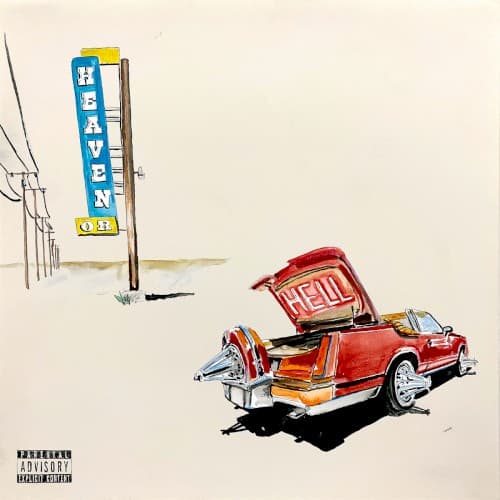
Within Don Toliver's catalog, Hardstone Psycho sits just below Heaven or Hell, the 7.2 that currently anchors his page on this site. This record is the more confident piece of sound design and the more consistent set of arrangements, and it is the first time his taste in production feels like a point of view rather than a mood he is borrowing. The earlier album still edges it on the strength of its hooks and the stickiness of its best songs, and because the writing here has not improved, the newer record gains its ground purely on sonics and on the pacing of its first half.
It is for listeners who judge rap by atmosphere and vocal texture. If you came to Toliver for the way his voice is processed, layered and bent into hooks, this is the cleanest version of that appeal, and the guitar-flavored beats give it a freshness the trap-and-R&B template had lost. It is also a good entry point for anyone curious about how the melodic-rap mainstream sounds when it tries to sound a little more rock. People who need lyrical detail, a story across the tracklist, or verses that reward close reading should skip it, because those things are not on offer and the album does not pretend otherwise.
How it ages depends on what you value. The production choices are tied to a particular moment in melodic rap, so some of the arrangements may sound dated in a few years, but the vocal performances and the best melodies should hold up better than the filler around them. Replay value is solid for the first half and weaker for the last, which is a pattern worth noting for a record that was designed for the shuffle button.
Start with Bandit for the cleanest blend of sample and melody, Attitude for the strongest feature and the smoothest groove, and Deep in the Water for a more spacious, hazy side of the sound. For a next step, try Heaven or Hell if you want the earlier, hookier version of his formula, or Love Sick if you want the glossier R&B end of the same voice. This record is a strong playlist and a modest album, and the ranking above reflects that distinction.
Track by track
Track Listing
KRYPTONITE
StandoutThe opener sets the terms: guitar from Spikes, extra vocals from FKA Twigs, and a hook that gets its lift from layered harmonies rather than a drum fill. The production is dense but never muddy, and Toliver sounds relaxed enough to let the arrangement carry the track. It does not say much, but it announces the rock-leaning palette efficiently, and at just over three minutes it respects your time. A strong start that works as a statement of intent.
TORE UP
StandoutA short, aggressive burst that also features Spikes on guitar and runs just over two minutes. It is more about energy than melody, and Toliver treats it as a bounce rather than a song, which suits the length. There is not much to remember afterward, but the immediacy is the point.
BROTHER STONE
SolidKodak Black's rasp is a useful contrast to Toliver's smoother tone, and the pairing makes for a more street-facing moment than the rest of the opening volume. The beat is competent and the guest verse does its job, though the hook is more functional than memorable. A solid track that mainly proves the casting works.
ATTITUDE
StandoutWith Charlie Wilson and Cash Cobain, and a sample built on the Snoop Dogg, Pharrell and Wilson song Beautiful, this is the album's smoothest moment. The groove is warm and conversational, Wilson's presence adds a veteran grain, and Cobain's keyboard work gives the beat a lived-in bounce. It is a deliberate single, and a good one, because the sample is reshaped rather than just looped. One of the best tracks for a first-time listener.
BANDIT
StandoutBuilt on a Tame Impala sample, this is the lead single and the clearest case for the album's thesis. The drums are light, the sample leaves a lot of air in the mix, and Toliver sings with a restrained confidence that fits the haze. The writing is slight, but the melody is instantly legible and the production is pretty without becoming sleepy. Together with Attitude, it is the song most likely to convert a skeptic.
GLOCK
SolidAt nearly four minutes, this is the first track that feels a little long. The beat has menace and the vocal treatment is effective, but the verses repeat a single attitude without developing it, so the second half adds little to the first. Fine as a mood piece, less so as a standalone song.
ICE AGE
SolidTravis Scott appears here, and the song plays like a two-person wash of reverb and vocal effects. The beat is atmospheric and the hook is catchy, but the verses blur together, and without clear contrast between the two voices the track can feel like a single long hook. Decent, and replaceable.
4X4
SolidA mid-tempo, bass-heavy cut that moves well in a car and not much anywhere else. The production credits are crowded, yet the track sounds lean, and Toliver's flow is more rhythmic than melodic here. It is solid filler in the best sense, enjoyable while it plays and gone when it stops.
PURPLE RAIN
StandoutFuture and Metro Boomin join in on the album's heaviest team-up, with Metro and Zaytoven sharing production. The beat is darker and more traditionally trap than most of the record, and Future's verse is a good tonal foil for Toliver's brighter sound. It also marks the point where the record opens up to the wider rap audience. The most obviously star-powered moment, and it is a strong one even if the hook is less distinctive than the beat.
NEW DROP
SolidProduced by Wheezy among others, this is a looser, more playful track with a bouncy pocket and a hook that is easy to hum. It is not a showpiece, but it holds the middle of the album together by adding a lighter register after the heavier songs around it.
BACKSTREETS
StandoutTeezo Touchdown adds backing vocals, and his quirkier texture gives the track a distinct color. The melody is the focus, and the production leaves enough space for it to breathe. It is one of the more engaging deep cuts, mostly because it varies the vocal palette instead of repeating it.
DEEP IN THE WATER
StandoutThe second single and the most atmospheric song here, with a drifting, submerged feel that suits the title. At under three minutes it is concise, and the melody is among the album's most memorable. The lyrics are generic, but the mood is so well constructed that it hardly matters. A highlight for anyone who likes the softer end of his range.
INSIDE
SolidTravis Scott's second appearance, and the longest song on the standard edition at just over four minutes. The mood is hypnotic, but the length is not justified by new ideas, and the track feels more like an extended atmosphere than a song with a destination. Pleasant, but it points to the album's late sag.
5 TO 10
SolidA shorter, more focused track with a hook that carries it, and several producers contribute to a clean, forward-moving beat. It does not go anywhere surprising, but it restores some momentum after the previous song and it reads as one of the album's more purposeful late cuts.
LAST LAUGH
WeakAnother four-minute track, and it spends most of that time circling the same mood. The production is spacious and the vocal layering is skillful, but the lack of a distinct hook or turn makes it the clearest example of the album running out of new material. Skippable.
HARDSTONE NATIONAL ANTHEM
SolidThe closer promises a grand statement through its title and delivers a brisk, sleek track at under three minutes. It is a competent exit, but it does not contain the sweeping payoff its name suggests, and the verses are in the same register as the rest. A neat ending rather than a climax.
Frequently Asked Questions
Is Don Toliver's Hardstone Psycho good?
What are the best songs on Hardstone Psycho?
Who is featured on Hardstone Psycho?
Styles