The scorecard
6.7/10 · Good
- Writing25%
- 5.5
- Production25%
- 7.5
- Delivery15%
- 7.0
- Cohesion15%
- 7.5
- Originality10%
- 6.0
- Replay value10%
- 6.5
Melodies carry most songs while lyrics stay in mood-zone clichés about partying and vague romance, rarely offering a concrete image or a quotable line.
WondaGurl and Mike Dean build airy, psychedelic trap with bass that rumbles under the mix and synths that drift in and out like smoke, creating a consistent haze across twelve tracks.
Toliver's Auto-Tuned croon finds pockets in every beat and the melodic ideas are strong, though the actual rapping on "Spaceship" and "Had Enough" exposes limited flow versatility.
Thirty-four minutes with no wasted motion: every track serves the drowsy, late-night vibe and the sequencing never jolts you out of the trance.
The psychedelic trap formula is polished Travis Scott runoff, executed well but adding little to what Astroworld and Rodeo already mapped out two and four years earlier.
The hooks on "No Idea", "After Party" and "Can't Feel My Legs" rewire themselves into your brain after two listens, though the sameness makes full playthroughs blur together over time.
Don Toliver Heaven or Hell — When the Protégé Copies the Mentor's Homework
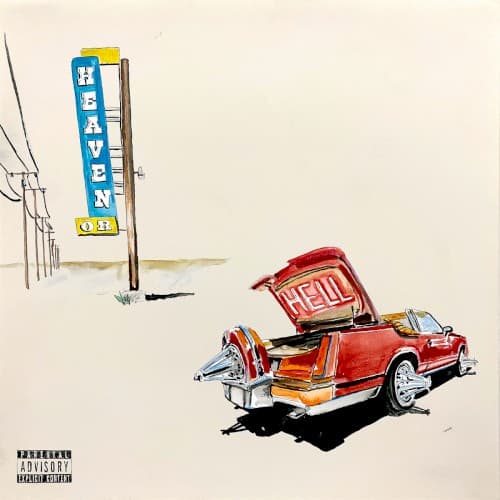
Heaven or Hell is a debut album that knows exactly what it wants to be: a thirty-four-minute haze of psychedelic trap where every beat floats and every vocal melts into Auto-Tune. Don Toliver, fresh off his Astroworld guest spot and a Cactus Jack deal, built his first project as a faithful recreation of the Travis Scott sound—same producers, same underwater mixing from Mike Dean, same druggy atmosphere. The thesis is simple: if Scott can turn mood into platinum records, why can't his signee do the same? The album answers that question with surprising commercial success—a top-ten debut, a platinum plaque three years later, breakout singles that still show up in playlists—but the creative answer is less clear. Toliver proves he can execute the formula, but not that he has a reason to beyond riding the wave.
The stakes in 2020 were whether Cactus Jack could build a roster or just a vanity project. Toliver was the first test case: a singer-rapper Scott discovered and shaped, given the full label machinery and the same production bench. The result is an album that sounds expensive and considered, sequenced like a proper statement rather than a SoundCloud dump. But it also sounds like a mood board that never becomes a vision. The psychedelic trap aesthetic that felt like discovery on Rodeo in 2015 feels like house style here, applied competently but without the risk that made the original compelling. Toliver has the voice and the melodic instincts to carry this approach—his Auto-Tuned croon finds hooks in every corner—but the album never escapes the question of why we need this version when the blueprint still gets regular play.
The Cactus Jack Formula, Applied by the Book
The production team reads like a Cactus Jack family tree: WondaGurl on five tracks, Mike Dean mixing and co-producing across the entire album, Travis Scott himself contributing to three beats, Frank Dukes and Sonny Digital handling the remainder. What they build is a consistent sonic world—psychedelic trap with bass frequencies that rumble under the mix, synths that drift in and out like smoke, drums that hit hard but never clutter the空间. The aesthetic is Astroworld's drugged-out carnival minus the chaos, smoothed into something more hypnotic and less jagged. Tracks like "Euphoria" and "Candy" layer mellotron swells and reverb-drenched vocal loops over 808s that feel designed for car systems, while "Can't Feel My Legs" rides a fluttering synth line that WondaGurl and Forthenight stretch across three minutes without ever resolving. The sequencing never breaks the trance: no tempo shifts, no acoustic interludes, no jarring features. It's a masterclass in atmosphere as product.
Toliver's writing, however, never rises to meet the production. The lyrics stay locked in the same rotation of partying, vague romantic gestures, and altered states, delivered in phrases so general they could slot into a hundred other songs. He sings about wasted nights and fleeting connections but offers no images specific enough to remember, no wordplay sharp enough to rewind, no storytelling that moves past the first verse. Themelodies do most of the work—his Auto-Tuned delivery on "After Party" and "No Idea" creates hooks that lodge in your brain through sheer repetition and vocal texture—but when he raps, as on "Spaceship" and "Had Enough", the flow is workmanlike and the bars are filler. Quavo and Offset show up on "Had Enough" and sound exactly like Quavo and Offset in 2020: competent, interchangeable, taking up space that Toliver himself could have filled just as easily.
The album's greatest strength is also its ceiling: it knows what it is and never pretends otherwise. Toliver is not trying to be a lyricist or a conceptual artist; he's building a vibe and trusting the production and melodies to carry it. That approach works more often than it doesn't, but it also means the project has no peaks, no moments that outgrow the house style. The mixing from Mike Dean is impeccable—every element sits in its pocket, the bass never muddies the vocals, the space around each sound is deliberate—but impeccable mixing in service of songs that blur together is still just a very nice blur. The album's biggest weakness is that it sounds like a debut from an artist who has not yet figured out what he brings to the sound beyond a pleasant voice and good taste in producers.
A Straight Line From Start to Finish
At thirty-four minutes across twelve tracks, Heaven or Hell earns its length by refusing to overstay. The pacing is a flat line—no dramatic arc, no dips into experimentation, no back half sag—and that monotone sequencing is both the album's discipline and its limitation. The intro sets the tone and the outro lands exactly where you expect it to, with every song in between maintaining the same druggy tempo and underwater mix. Nothing peaks because nothing is supposed to; the album is designed to play straight through as background to a late-night drive or a chemical haze, not to demand your full attention.
The closest the album comes to a standout moment is the run from "After Party" to "Can't Feel My Legs", where Toliver's melodic hooks are sharpest and the production finds pockets of space that feel less overstuffed. But even those tracks function more as highlights within the monotone than as songs that break free of it. The sequencing never jolts you out of the zone, which means it also never surprises you. By the time "No Idea" closes the album with its TikTok-ready hook, you've been floating in the same sonic pool for half an hour, and whether that feels like a feature or a bug depends entirely on what you came for.
A Polished Formula Without a Perspective
Heaven or Hell is the debut of an artist who can execute a sound but has not yet decided what he wants to say with it. Toliver proves he belongs in the Cactus Jack ecosystem—his voice is a real instrument, his melodic instincts are sharp, and his taste in collaborators is impeccable—but the album plays like a well-funded proof of concept rather than a statement. It's psychedelic trap by committee, built with expensive tools and released at the right moment to catch the streaming wave, and it succeeded on those terms: a top-ten debut, platinum certification, and a handful of singles that still get spun. But strip away the Mike Dean mixing and the WondaGurl beats and you're left with songs that could have been sung by any number of Scott-adjacent crooners, with writing that stays surface-level and flows that never take a risk.
This is a debut for fans who want more of the Astroworld sound and don't care whether it comes from the original or a faithful apprentice. If you're looking for Auto-Tune melodies over expensive production and you don't need the lyrics to do anything beyond set a mood, Heaven or Hell delivers exactly that for half an hour. If you're looking for an artist with a perspective or a sound of his own, you'll hear a capable singer who hasn't found his yet. The album works best as a playlist rather than a statement: start with "No Idea", "After Party" and "Can't Feel My Legs" to hear Toliver at his most locked-in, then decide if the rest is worth your time. For next steps, go back to Travis Scott's Astroworld to hear the blueprint executed with higher stakes, or forward to 070 Shake's Modus Vivendi for another Cactus Jack-adjacent artist who actually has something to say.
Track by track
Track Listing
Heaven or Hell (intro)
SolidWondaGurl and Mike Dean open with a minute of ambient synths before Toliver's Auto-Tuned voice enters, setting the album's drowsy tone. The production is all atmosphere—no drums until the final thirty seconds—and Toliver uses the space to sketch the album's themes in broad strokes: intoxication, fleeting pleasure, the blurred line between euphoria and numbness. It's an effective table-setter that establishes the sonic palette, but it's too short to develop an idea or build tension. As an intro it works; as a standalone track it's a mood piece that evaporates the moment it ends.
Euphoria
SolidThe first full song brings Travis Scott and Kaash Paige into a hazy, three-part suite where all three artists float over Sonic Major's spaced-out production. Scott shows up in full mentor mode, his verse adding star power but little that Toliver couldn't have handled himself, and Paige's sung outro adds texture without changing the song's direction. The structure is loose—more vibe than verse-chorus-verse—and the melodic ideas are strong enough to hold it together. What's missing is any reason this needed to be a posse cut rather than a solo track; the features feel like label strategy rather than creative necessity. The production is lush and Mike Dean's mixing gives every element room to breathe, but the song drifts when it should build.
Cardigan
StandoutSonny Digital and Frank Dukes construct a minimal, hypnotic loop and Toliver rides it with one of his sharpest vocal melodies, the Auto-Tune stretching syllables into new shapes. The hook is immediate—within one listen you can hum it—and the production choice to keep the beat sparse lets Toliver's voice do the heavy lifting. Lyrically it's more mood than meaning, the usual rotation of partying and vague romantic entanglement, but the melody is strong enough that the words don't matter. The track works because it knows its job: get in, deliver the hook, get out in under three minutes.
After Party
StandoutThis is the album's commercial peak, the track that was teased in Travis Scott's Netflix documentary and built hype for a year before release. Sonny Digital and Cubeatz build a beat that's both minimal and immediate—a snaking synth line, crisp hi-hats, bass that hits in the right pockets—and Toliver delivers his most confident vocal performance, the melody locking into the groove without ever feeling forced. The song was originally supposed to feature a Travis Scott verse that got cut, and the final version is stronger for it; Toliver carries the track alone and proves he doesn't need the cosign. The lyrics are standard late-night fare but the execution elevates them. This is the track that made Toliver a name beyond the Cactus Jack roster, and it's easy to hear why: it's the rare moment where the formula and the artist's instincts line up perfectly.
Wasted
WeakCássio's production is airier than the rest of the album, with more negative space and a guitar loop that feels like it wandered in from a different project. Toliver's vocal melody is solid but the song never builds momentum; it floats for two and a half minutes and ends without leaving a mark. The writing is the weakest on the album—clichés about being too gone to care, no images sharp enough to distinguish this song from a dozen others in the same lane. It's not offensively bad, just forgettable, the kind of track that disappears in the middle of a playlist.
Can’t Feel My Legs
StandoutWondaGurl, Forthenight and Freakey build a fluttering, off-kilter beat that never resolves, synths rising and falling in waves while the drums stay locked in a hypnotic pocket. Toliver's vocal performance is one of his most interesting—he leans into the disorientation, his melodies weaving in and out of the beat's gaps rather than sitting on top of it. The hook is a earworm, the kind of phrase that gets stuck in your head not because it's clever but because the cadence and Auto-Tune texture make it impossible to shake. Lyrically it's thin—more feelings than ideas—but the production and delivery create something that holds up on repeat. This was the album's second single and it's easy to hear the TikTok appeal: short, sticky, built for a fifteen-second loop.
Candy
SolidWondaGurl and Travis Scott layer mellotron swells and warped vocal samples over a beat that feels designed for arenas, and Toliver responds with a melodic performance that's confident but not showy. The production is the busiest on the album—keyboards from Nkenge 1x add extra texture, Mike Dean's mixing stacks elements until the mix feels thick—and the song works because it never tips into clutter. The writing is again general, the usual rotation of indulgence and fleeting pleasure, but the melody is strong enough to carry it. The song is solid but not essential, the kind of deep cut that works in the album's sequence but doesn't demand to be pulled out on its own.
Company
StandoutWondaGurl and Frank Dukes strip the production back to a minimal, looping synth line and let Toliver's vocal melody do all the work. The hook is immediate and the verses stay out of the way, letting the song breathe without overstaying. It's one of the album's shorter tracks and it earns the brevity—nothing here needs a third verse or a beat switch, just two and a half minutes of a good idea executed cleanly. The lyrics are forgettable but the melody isn't, and that's enough.
Had Enough
SolidTM88 and El Michels build a darker, more aggressive beat than the rest of the album, and Quavo and Offset show up to deliver exactly the kind of verses you'd expect from a 2020 Migos feature: competent, formulaic, taking up space without adding much. Toliver holds his own but the song feels like label math—add the Migos for streaming numbers—rather than a creative choice. The track was also included on the JackBoys compilation, which suggests it was built for that project and dropped here to pad the tracklist. It's not bad but it breaks the album's trance without offering anything worth the disruption.
Spaceship
WeakSheck Wes shows up for a guest verse that's more energy than craft, his barked delivery clashing with the album's drowsy vibe. Sonny Digital and Frank Dukes try to split the difference with a beat that's more uptempo than the rest of the project, but the song never finds a groove. Toliver's hook is solid but his rapping in the verses exposes his limitations as a technical rapper—the flow is stiff, the rhymes are predictable, and the writing is generic. The track feels like an attempt to add variety to the tracklist, but variety isn't the same as quality.
No Photos
SolidWondaGurl and Cubeatz return to the psychedelic trap formula with a beat that's hypnotic but unremarkable, and Toliver delivers a vocal performance that coasts on Auto-Tune texture rather than melodic ideas. The song is pleasant enough as background music but it offers nothing that the previous ten tracks haven't already done better. By this point in the album the formula is wearing thin, and "No Photos" highlights the problem: when every song is the same mood and tempo, even the solid ones start to blur together.
No Idea
StandoutThe album's lead single and its biggest commercial success closes the project with the stickiest hook Toliver wrote for the entire album. WondaGurl and Cubeatz build a minimal, hypnotic beat—just bass, hi-hats, and a looping synth line—and Toliver rides it with a vocal melody that became a TikTok phenomenon a year after release. The song is pure formula—no risks, no surprises, just a well-executed earworm—but the formula works. The lyrics are the usual vague romance clichés but the delivery makes them feel immediate, and the production is clean enough that the song holds up on endless repeat. It's the track that justified the entire album rollout, the one song that broke through to a wider audience, and it's a fitting closer: Toliver at his most focused, doing the one thing he does better than anyone else in the Cactus Jack orbit.
Frequently Asked Questions
Is Don Toliver Heaven or Hell worth listening to?
What are the best songs on Heaven or Hell?
How does Heaven or Hell compare to Travis Scott's albums?
Styles