The scorecard
5.4/10 · Weak
- Writing25%
- 5.5
- Production25%
- 6.0
- Delivery15%
- 6.0
- Cohesion15%
- 5.5
- Originality10%
- 3.5
- Replay value10%
- 4.0
The verses borrow too heavily from Nas and AZ without adding new ideas, though tracks like Maxine show competent rhyme schemes and storytelling that occasionally rise above the derivative approach.
Mr. Porter's soul samples and Proof's drum programming create workable backdrops that serve the rapping adequately, though the lo-fi mix and generic boom-bap arrangements lack definition.
The borrowed vocal cadence from East Coast models makes it sound like imitation rather than invention, even as the flow mechanics and multi-syllabic patterns show real skill.
The spiritual references on It's O.K. clash with the hustler narratives elsewhere and the interlude adds nothing, though the eleven tracks occasionally cohere around themes of ambition and survival.
Eminem himself admitted he was trying to sound like AZ, and the album's complete lack of distinct perspective or production approach leaves it indistinguishable from existing mid-90s East Coast templates.
The lack of personality and the muddy mix make most of the album forgettable after the first listen, with only occasional technical flourishes providing reasons to return.
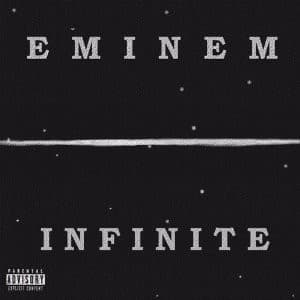
Eminem Infinite — The Apprentice Work Before the Invention
Infinite is the sound of a rapper who can do everything except be himself. The debut arrives with all the tools already sharp: the internal rhymes lock into place, the multi-syllabic runs never stumble, the storytelling on Maxine sketches a full narrative in under four minutes. What it does not have is a reason to exist beyond proving Eminem could do what Nas and AZ were already doing. He admitted as much later, calling it a demo that got pressed up, a growing stage where he was still figuring out how he wanted to sound. The problem is not that the influences show; the problem is that nothing else does.
The stakes were immediate and practical. Eminem had a newborn daughter, a minimum-wage job washing dishes, and a thousand copies of this album to sell out of his car in Detroit. He made the songs radio-friendly on purpose, aiming for local airplay that never came. Around seventy copies sold. The failure sent him into the spiral that produced the Slim Shady character a year later, which means Infinite is most useful as the before picture: the moment when technical skill without a distinct voice was not enough. The album works as an audition tape for a style Eminem would abandon completely, which makes it more interesting as a career document than as a listening experience.
Borrowed Clothes That Fit Too Well
The writing is capable but derivative. Eminem structures verses the way Nas did on Illmatic, with vivid street-level images and internal rhymes that cascade into the next bar without a wasted syllable. On 313, he describes Detroit with the same kind of neighborhood specificity that made Queensbridge feel like a character in Nas's debut, and on Tonite he strings together complex rhyme patterns about ambition and survival that never lose the thread. The mechanics are already there.
What is missing is a perspective that makes those mechanics necessary. The verses catalog struggle and hunger in broad strokes: the desire to get rich, the weight of fatherhood on limited funds, the grind of the underground rap circuit. It's O.K. pivots without warning to spiritual language about finding Christianity through God, which never appears again on the album and sits oddly next to the hustler narratives on the rest of the tracklist. The writing is competent, but it describes situations rather than inhabiting them.
Mr. Porter produced most of the beats, with Proof programming the drums, and the sound is mid-90s soul-sample boom-bap with no regional identity. The samples are well-chosen: Grover Washington Jr. on 313 and Maxine, Curtis Mayfield on Open Mic, Quincy Jones on Searchin. The loops are clean and the drums knock in the standard way, but the lo-fi basement mix flattens everything into the same muddy register. Nothing hits hard enough to stand out, and the arrangements do not take risks. Compare it to what DJ Premier or Pete Rock were doing in the same year and the production sounds like a capable imitation of an approach that had already been perfected elsewhere. The soul-loop template was crowded by 1996, and Infinite does not add anything to it.
The delivery is where the album almost breaks through. Eminem's flow is already fully developed, with the internal rhyme clusters and the breath control that would become his signature. On Maxine and Never 2 Far, he rides the beat with the same ease AZ showed on Doe or Die, which is both the album's strength and its fatal flaw. He sounds exactly like AZ, down to the vocal tone and the cadence choices, which makes the performance impressive as an exercise but weightless as expression.
The guest verses from Proof, Eye-Kyu and the other Detroit rappers do not add much; they are solid and anonymous. The weakness is that Eminem has not yet figured out that his voice could be a weapon. He is trying to fit into a mold, and the fit is so precise that there is no room left for anything that might be his.
A Demo Tape That Never Builds Momentum
The album does not have a shape. It opens with the title track, which is the most polished song here and the only one that got a second life when a remix appeared twenty years later. From there it moves through ten more tracks with no clear progression or thematic arc. The brief interlude serves no purpose; the Christianity angle gets introduced and then dropped; the other highlights feature the tightest verses and the most listenable beats, but they are separated by weaker cuts that do not justify their presence.
The narrative about a woman who sets the narrator up to be robbed works because the story has stakes, but it is surrounded by tracks that cover similar betrayal themes with less focus. The sequencing does not earn the length. At eleven tracks, the album should be lean, but the second half sags under the weight of repetition. By the time the closing run arrives, the album has already made its case and is circling back over the same ideas.
There is no peak and no climax, just a steady mid-level consistency that occasionally rises to good and never falls to bad. The pacing is flat. Eminem would learn on later albums how to build an arc, how to place the bangers and the introspective cuts and the skits so that the whole thing moves. Here, every song sounds like it could be track four.
The Demo That Proved What Needed to Change
Infinite sits at the bottom of Eminem's catalog not because it is incompetent but because it is unnecessary. It shows a rapper who can execute someone else's vision with precision but has not yet found a reason to make his own music. The writing is solid, the flow is already elite, and the production is workable, but none of it adds up to an album that justifies returning to it when the version of Eminem who knew who he was would arrive three years later. It is the document of a dead end: the proof that technique without personality was not enough, and that the East Coast sound he was chasing in 1996 was not going to work for a white kid from Detroit trying to sell tapes out of his trunk.
In the discography, it ranks last, below even the messy experiments of Revival and the half-hearted provocations of Encore, because those albums at least had a point of view. Infinite is a reveal with no one to reveal yet. The failure of the album, the seventy copies sold and the collapse that followed, is what forced Eminem to invent Slim Shady, which means the value of Infinite is not in the music but in what it made necessary. If you are working backward through the catalog, this is the last stop, and even then it is more interesting as context than as listening.
Who should start here: no one. If you want to hear Eminem before the character work and the shock tactics, start with the title track Infinite and maybe 313 and Tonite, which show the rhyme skill in the clearest form. For the rest, go to The Slim Shady LP to hear what he became when he stopped trying to be someone else. If you want the album that best shows Eminem's technical ceiling, go to The Marshall Mathers LP. Infinite is for completists and for people curious about the apprentice stage, and even then it is a short listen that makes its point quickly.
Track by track
Track Listing
Infinite
StandoutThe title track is the album's clear peak and the only song that held any value outside of 1996. The beat built around soul loops is the most polished production here, and Eminem's verse chains internal rhymes and multi-syllabic runs with the kind of precision that makes you rewind to catch the mechanics. The storytelling is minimal, mostly declarations of hunger and ambition, but the flow itself is enough to carry it. The hook is functional, and the Detroit guests add solid support. This is the track that made it to Spotify twenty years later and the one that got a Bass Brothers remix when the album turned twenty, which tells you everything about how the rest of the material has aged. If you listen to one song from Infinite, this is the one, and it still works as a demonstration of raw skill even if it does not hint at the character work that would define the career.
W.E.G.O. (interlude)
WeakA one-minute interlude with Proof and Eye-Kyu trading bars over a minimal loop. It does not set up anything or break up the album in a useful way; it is just filler that could have been cut.
It’s O.K.
SolidThe spiritual detour, where Eminem raps about finding Christianity through God in the midst of insanity, which never appears anywhere else on this album or in the catalog until a Kanye West remix in 2022. The verse is competent, the soul-sample beat from Mr. Porter is standard, and the theme does not connect to the rest of the tracklist. It is an odd moment that sits awkwardly next to the street narratives before and after it, more interesting as a footnote in Eminem's early lyrical range than as a song that holds up.
Tonite
StandoutOne of the stronger tracks. The Googie and Tom Cappola sample gives the beat a smoother feel than most of the album, and Eminem's verse about making it out and proving himself lands with more focus than the generic ambition talk elsewhere. The rhyme schemes are clean, the flow rides the groove without forcing it, and the guests do not drag it down. It is still derivative of the East Coast template, but it is well-executed and listenable. If you are sampling the album beyond the title track, this is the second stop.
313
StandoutA Detroit anthem built on a Grover Washington Jr. sample, and one of the few moments where Eminem tries to plant a flag for his city rather than just imitating the Queensbridge sound. The writing catalogs the neighborhoods and the struggle with the same kind of vivid specificity Nas used, and the delivery is confident. The beat is clean and the sequencing between verses works. It does not add much to the larger conversation about regional identity in mid-90s rap, but it is one of the more fully realized songs here and it shows the ambition to build something that could define Detroit even if the execution is not there yet.
Maxine
StandoutA narrative track about a woman who sets Eminem up to be robbed, and it is the best storytelling on the album. The Grover Washington Jr. sample on the beat is smooth, and the verse builds the story with enough detail to make it feel specific rather than generic. The structure is clear: setup, betrayal, consequence. The weakness is that the performance still sounds like borrowed technique rather than lived experience, but the craft is there. This is the kind of writing that would become a strength on later albums, and here it is the closest the album gets to creating a song that justifies its length.
Open Mic
SolidA cypher-style track with multiple Detroit rappers trading verses over a Curtis Mayfield sample and Naughty by Nature drums. Eminem's verse is solid but not standout, and the guests are competent without adding much personality. The beat is serviceable and the scratches from DJ Buttafingaz add some texture, but the song does not go anywhere. It is the kind of underground rap posse cut that filled albums in the mid-90s, and it has aged into pure filler.
Never 2 Far
SolidBuilt on a Maze sample, and the beat has a laid-back groove that works better than some of the harder-hitting loops elsewhere. Eminem's verse about staying motivated and outlasting the doubters is standard struggle-rap content, delivered with the same AZ-style cadence that defines the album. The hook is forgettable, and the track does not build to anything, but the flow is clean and the production does its job. It is fine, which is the problem: nothing here demands attention.
Searchin
SolidA Quincy Jones sample and another verse about trying to make it, and by this point in the tracklist the themes have started to blur together. The rhyme schemes are tight and the flow does not stumble, but the writing does not add anything new. The beat is decent, the performance is technically solid, and the whole thing is entirely skippable unless you are studying Eminem's early rhyme mechanics.
Backstabber
WeakBuilt on samples from Soul Intent, LL Cool J and Craig Mack, and the song is about betrayal and jealousy in the same way Maxine and Jealousy Woes II are. The theme is overplayed by now, and the track does not bring a new angle. The beat is cluttered with too many sample sources fighting for space, and the verses are competent but repetitive. It feels like an album track that should have been cut in editing.
Jealousy Woes II
SolidThe closer samples Idris Muhammad, LL Cool J and Nas, which is fitting given how much the album leans on Nas's blueprint. The writing circles back to the same betrayal and envy themes that have already been covered, and the track does not offer a conclusion or a payoff. The beat is fine, the flow is fine, and the whole thing ends the album on a shrug. It is not bad enough to be offensive, just uninspired enough to make you forget it by the time it is over.