Scorecard: 8.2/10 · Great
How we score- Writing(25%)
- 8.5
Guru delivers precise observations about street ethics, industry betrayal and personal accountability across twenty tracks without losing focus or resorting to filler bars.
- Production(25%)
- 9.5
Premier's sample flips and drum programming reach their absolute peak here, from the haunting strings on the title track to the menacing horn stabs on "The Militia" to the jazz loops on "Above the Clouds."
- Delivery(15%)
- 8.0
Guru's monotone lacks dynamic range but the consistency serves the material, and guests like Inspectah Deck, Scarface and Freddie Foxxx deliver crucial energy when needed.
- Cohesion(15%)
- 6.5
Twenty tracks test the patience; the second half sags with similar-sounding relationship songs and street tales that blur together despite strong individual moments.
- Originality(10%)
- 7.5
Premier refines boom-bap to its final form rather than inventing it, and Guru's street philosophy deepens what Hard to Earn started without breaking new thematic ground.
- Replay value(10%)
- 8.0
The title track, "Above the Clouds," "Work" and "The Militia" remain essential East Coast rap, though the album's length makes full playthroughs increasingly rare over time.
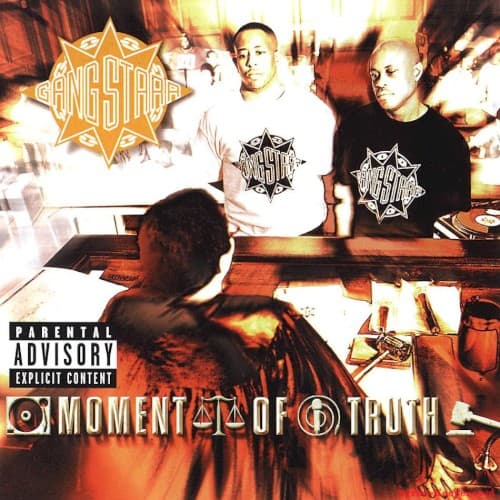
Gang Starr Moment of Truth — The Album That Closed the Book on Boom-Bap
Moment of Truth is the sound of a style reaching its upper limit. Released in 1998 after a four-year gap during which DJ Premier had become the most sought-after producer in rap, the album applies everything he learned working with Jay-Z, Nas and The Notorious B.I.G. to the stripped-down formula he and Guru built across four albums. The result is boom-bap at its technical peak: twenty tracks of chopped jazz, orchestral stabs and snare hits so crisp they could cut glass, all supporting Guru's steadiest and most focused writing. The thesis here is accountability, examined from every angle: personal responsibility on the title track, industry treachery on "Betrayal," class warfare on "Robbin Hood Theory," and the cost of fake friendship on "B.I. vs Friendship." Guru was facing a potential five-year prison sentence for a gun charge during recording, and that pressure shows up as clarity rather than desperation.
The album sold half a million copies, hit number one on the R&B charts, and arrived at the moment when mainstream rap was splitting into two paths: the Jiggy era's crossover ambitions and the underground's purist retreat. Gang Starr chose neither. They made the most expensive-sounding boom-bap album possible, with guest verses from the best technical rappers available, and proved that the style could still compete commercially without softening a single drum hit. The problem is that they also proved the style had nowhere left to go. Moment of Truth is Gang Starr's best album and the format's most polished execution, but it is also the end of an argument. After this, Premier would keep refining the same tricks for two more decades, and boom-bap would become a museum piece that younger producers either worshipped or ignored.
When Technique Becomes the Whole Point
Premier's production here is his masterwork, the summation of every idea he developed from 1989 forward. The title track builds its drama from a two-note piano loop and a bass rattle that sounds like a judge's gavel, letting the empty space do the emotional work. "Above the Clouds" layers flutes and strings over a jazz sample that breathes, each element entering at the exact moment to support Guru's meditation on perspective and Inspectah Deck's scene-setting. "The Militia" hits with distorted horn stabs that feel like physical threats, the kind of beat that demands the hard rhyming Freddie Foxxx and Big Shug deliver.
Every track has a signature sound: the rolling piano on "You Know My Steez," the ticking clock percussion on "Work," the mournful strings on "Betrayal." Premier never wastes a sample or overstays a loop, and the scratches function as punctuation rather than decoration.
Guru's writing sharpens in response to the legal pressure. The title track paraphrases his situation without self-pity, framing the gun charge as a test of character and resolve. "Robbin Hood Theory" makes the case for wealth redistribution with specific economic language rather than slogans. "Work" condenses the work-ethic theme into under three minutes with no wasted lines.
His monotone delivery, a limitation on earlier albums, works here because the verses themselves carry the weight; he is reporting findings, not performing emotion. The voice stays level while the words indict fake friends, crooked lawyers, industry leeches and anyone chasing trends.
The guests raise the album's ceiling. Inspectah Deck's verse on "Above the Clouds" is the best guest appearance on any Gang Starr album, vivid storytelling that matches Guru's philosophical framing. Scarface on "Betrayal" brings Southern grit to a New York production without friction. Freddie Foxxx turns "The Militia" into a sparring session.
K-Ci and JoJo singing the hook on "Royalty" is the album's only real miscalculation, a reach for radio play that disrupts the mood.
The weakness is length. Twenty tracks is a statement of ambition, but the album sags in the final third. "She Knowz What She Wantz" and "The Mall" are competent but inessential, street tales that cover ground already handled better earlier.
"Make 'em Pay" and "Next Time" feel like B-sides included to meet a track count. The problem is not that these songs are bad; it is that they sound like Premium and Guru executing the formula on autopilot, which makes the album feel longer than it needs to be. At fourteen or fifteen tracks, this would be airtight. At twenty, it tests patience.
The Shape of Diminishing Returns
The album front-loads its strongest material. The opening run establishes the sound, the stakes and the skill level within twenty minutes, and the emotional and technical peaks arrive before the halfway point. This is deliberate sequencing: Guru and Premier knew where the knockout punches were and threw them early.
The problem is what comes after. The second half maintains quality but loses urgency, recycling themes and tempos until the distinctions blur. Multiple tracks address loyalty and snakes, making the same argument from different angles. Multiple tracks assert Gang Starr's superiority without adding new evidence.
The pacing never crashes, but it plateaus. The album is sequenced for depth rather than dynamics, a steady mid-tempo march that rewards close attention but does not build or release tension the way a great album sequence should. The closing statement works because it finally shifts the mood, a somber roll call of fallen friends that earns its runtime by changing the emotional register. But getting there requires sitting through five or six songs that feel like variations on earlier, better tracks. The length is not justified by the material; it is a declaration that Gang Starr had enough ideas and enough budget to fill seventy-three minutes, whether or not seventy-three minutes were necessary.
The Ceiling and the Wall
Moment of Truth is Gang Starr's best album and the most technically accomplished boom-bap record ever made, but it is also proof that the style had reached its limits by 1998. Premier could not make his drums hit harder or his samples cut deeper than they do here, and Guru could not write more focused verses than the ones on the best tracks. They achieved mastery and discovered that mastery was not enough to keep the format evolving.
Fans of East Coast purist rap should own this; it is the high-water mark. Fans of the duo should start here and then work backward to Hard to Earn to hear the same ideas in leaner form. Listeners who find boom-bap repetitive will not be converted by even the best example of it.
The album holds up because Premier's production remains unmatched in the subgenre and because Guru's writing is sharp enough to survive his limited vocal range. Twenty-five years later, the best tracks are still essential additions to any serious rap playlist, and the title track remains the definitive statement on facing consequences. But the full album is a lot to sit through now, and it was probably a lot to sit through then.
Start with the first eight tracks. If those hit, the rest will reward you. If they do not, no amount of additional runtime will change your mind. For context on where Premier took these ideas next, listen to Jay-Z Reasonable Doubt or Nas Stillmatic. For proof that Guru could carry a concept without sprawl, go back to Hard to Earn.
Track Listing
You Know My Steez
▲The opening statement and lead single sets the template: rolling piano loop, crisp snares, Guru cataloging his skills and reputation over three verses with no hook to interrupt. The minimalism is the flex. Premier lets the piano breathe, adding scratches as accents, and Guru's flow rides the pocket without rushing or embellishing. It is confidence expressed as control. The track works as both an album intro and a standalone single, which is why it charted. No wasted motion, no filler bars, just technique on display.
Robbin Hood Theory
▲Guru argues for wealth redistribution with economic specificity rather than slogans, naming the widening gap between rich and poor and framing crime as a logical response to inequality. Premier's production is darker here, minor-key loops and a bass rumble that supports the thesis. The writing is direct and the argument is clear: if the system is rigged, breaking the rules is rational. One of the album's most focused tracks, built around a single idea and executed without detours.
Work
▲Under three minutes of pure work-ethic ideology: Guru links effort to success and dismisses shortcuts, laziness and entitlement. The ticking-clock percussion reinforces the theme, and the brevity is the point. No second verse needed, no extended metaphor, just the message compressed to its essence. The track appeared in a 1998 film and a 2019 bank commercial, which says something about how well the thesis translates outside rap.
Royalty
●The K-Ci and JoJo hook is the album's clearest bid for crossover play, and it disrupts the mood. Guru's verses about loyalty and realness are solid, but the sung chorus feels grafted on from a different project, too smooth for the hard drums underneath. The production is strong, but the tonal clash between Guru's monotone and the R&B harmonies never resolves. Least essential track in the album's first half.
Above the Clouds
▲The album's highest peak. Premier flips a jazz sample into something weightless, flutes and strings floating over a steady kick, and Guru opens with philosophical observations about perspective and distance from the streets. Then Inspectah Deck enters with the best guest verse on any Gang Starr record, scene-setting and wordplay that matches the beat's elegance without softening its edge. The track works as both a technical showcase and a thematic statement about elevation and clarity. Essential.
JFK 2 LAX
●Guru narrates a cross-country trip, cataloging the differences between coasts and the hustles he observes along the way. The beat is steady mid-tempo boom-bap, functional but not memorable. The writing is observational rather than argumentative, which makes the track feel like a travelogue entry rather than a statement. Solid but inessential.
Itz a Set Up
●A narrative track about a robbery gone wrong, with Hannibal Stax contributing a verse. Premier's production is tense, minor-key loops and spare drums that support the paranoia in the lyrics. Guru's storytelling is clear and the twist is earned, but the theme has been handled better elsewhere in the catalog. Competent execution of a familiar format.
Moment of Truth
▲The title track and the album's emotional center. Guru paraphrases his legal troubles and the possibility of prison time, framing the situation as a test of character and a moment that reveals who you are when consequences arrive. Premier's production is stark: a two-note piano loop, a bass rattle that sounds like a cell door, and empty space that lets the words carry the weight. The writing is direct and unsentimental, no self-pity or blame deflection, just accountability. The track appeared in The Lincoln Lawyer and on the Mr. Robot soundtrack, and it remains the definitive Gang Starr song, the clearest distillation of their sound and their themes.
B.I. vs Friendship
●M.O.P. joins Guru to explore the tension between business interests and personal loyalty, the question of when to cut off friends who are liabilities. The beat is aggressive, fitting M.O.P.'s energy, and the back-and-forth works. But the theme overlaps with "Betrayal" later in the tracklist, which makes this feel redundant in hindsight. Strong on its own, less necessary in the album context.
The Militia
▲Freddie Foxxx and Big Shug trade war rhetoric with Guru over one of Premier's hardest beats: distorted horn stabs that sound like air-raid sirens, drums that demand aggression. All three rappers deliver, Foxxx especially, his verse a barrage of threats and technical skill that raises the energy level. The track is pure battling, no deeper theme, just three MCs proving they can outrap anyone. One of the album's most replayable moments, the kind of posse cut that defines an era.
The Rep Grows Bigga
●Guru asserts Gang Starr's superiority and longevity, cataloging accomplishments and dismissing competition. The beat is solid mid-tempo boom-bap, but the theme is too similar to "New York Strait Talk" later in the sequence. The writing is confident but the argument has been made more effectively on earlier albums. It feels like a victory lap that arrives too early.
What I’m Here 4
●Under three minutes of purpose-driven rhyming: Guru explains his mission and his commitment to real hip-hop without compromise. The beat is sparse, just drums and bass, and the brevity keeps it focused. But the theme is familiar and the track does not add much that "Work" did not already cover. Solid filler.
She Knowz What She Wantz
●A relationship track, Guru observing a woman who is direct about her desires and uninterested in games. The beat is smooth, almost too smooth for the album's overall tone, and the subject matter feels like a detour. The writing is fine but the track does not earn its place in the sequence. Skippable.
New York Strait Talk
●Guru represents for New York, cataloging the city's toughness and dismissing outsiders who do not understand the culture. The beat is hard, classic Premier drums and a looped sample that hits, but the theme is too similar to "The Rep Grows Bigga" and the execution is too familiar. It is well-made boom-bap that does not justify its existence on an album this long.
My Advice 2 You
●Guru offers counsel to younger listeners: stay focused, avoid shortcuts, respect the craft. The beat is minimal and the track is short, which keeps it from dragging. But the advice is generic and the delivery is flat. It feels like an interlude stretched to song length.
Make ’em Pay
●Krumb Snatcha joins Guru for a revenge fantasy, threats and retribution over a menacing beat. The production is strong and both rappers deliver, but the theme is underdeveloped and the track feels like a B-side included to meet a quota. Competent but inessential.
The Mall
●G. Dep and Shiggy Sha join Guru for a storytelling track about criminal activity in a shopping mall. The verses are vivid and the beat supports the narrative, but the concept is slight and the execution is too long for the idea. It is a well-made song that does not need to exist on an album already testing the listener's patience.
Betrayal
▲Scarface contributes the album's second-best guest verse, Southern grit applied to the theme of fake friends and industry treachery. Premier's production is somber, strings and a slow crawl that matches the subject matter, and Guru's writing is sharp, naming the specific ways people switch up when money arrives. The track works as a thematic bookend to "B.I. vs Friendship," deepening the argument rather than repeating it. One of the stronger late-album moments, proof that Gang Starr could still deliver when the material demanded it.
Next Time
●Guru reflects on mistakes and lessons learned, framing failure as education. The beat is mid-tempo and unremarkable, and the writing is competent but lacks the specificity that makes the best tracks on this album essential. It feels like a song included because there was studio time left, not because the album needed it.
In Memory of…
▲The closing track shifts the mood entirely: a somber roll call of fallen friends and peers, Guru and Premier naming the dead and reflecting on mortality. The production is stripped down, just piano and drums, and the vocal tone is quieter, more personal. It works as an ending because it finally changes the emotional register after an hour of mid-tempo aggression. The track earns its place by being different, a moment of genuine feeling after nineteen songs of technique and argument.