Scorecard: 8.8/10 · Essential
How we score- Writing(25%)
- 9.5
Nutmeg's offbeat stream-of-consciousness rhythm and One's chaotic imagery rewrote what dense lyricism could sound like, trading mafioso clarity for surreal leaps that still landed.
- Production(25%)
- 9.0
RZA's needle-and-thread approach to reworking multiple producers' beats into a unified whole created the album's elastic, twitchy coherence, from Mighty Healthy's layered funk breaks to Malcolm's drowsy soul chop.
- Delivery(15%)
- 8.5
Ghostface's uptempo, breathless flow rides the pocket sideways on tracks like Buck 50 and Apollo Kids, turning rapid-fire syllable clusters into rhythmic propulsion rather than technical exercise.
- Cohesion(15%)
- 7.5
The core album from Nutmeg through Wu Banga 101 flows with intention, but three separate Iron's Theme bookends and multiple skits stretch 21 tracks past the hour mark without earning it.
- Originality(10%)
- 9.0
Supreme Clientele abandoned the crime-film sweep of Ironman and Only Built 4 Cuban Linx for abstract storytelling and surreal imagery, establishing a template for emotional abstraction in rap that barely existed before.
- Replay value(10%)
- 8.5
The best songs reward hundreds of listens as new images emerge from the wordplay, though the back half's momentum sags under the weight of its own length.
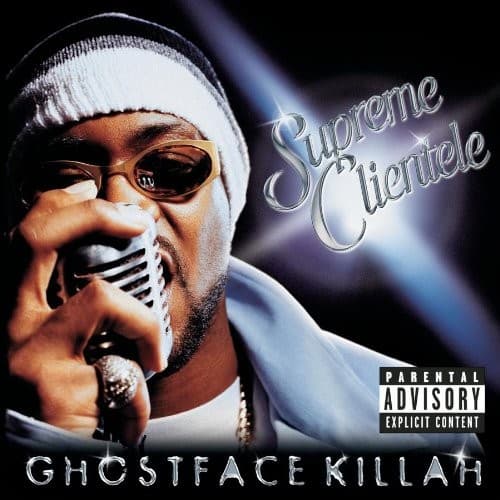
Ghostface Killah Supreme Clientele — The Flood That Rebuilt the Sound
Supreme Clientele is the argument that abstraction is clarity, that stripping away the explicit crime narratives and designer labels of mid-nineties Wu-Tang could reveal more than another Lex Luger story ever would. Ghostface Killah returned from a trip to Africa and a stint at Rikers Island with a writing style that treated verses like freeform thought, syllables tumbling over bar lines in rhythms that made no concession to the expected. The thesis arrived on Nutmeg, a song written without a beat to anchor it, where Ghostface's cadence twists sideways through the pocket like he is chasing an idea he cannot name. The album asks whether rap lyricism needs linear storytelling to communicate emotional truth, and by the end of Mighty Healthy the answer is settled.
The stakes in 2000 were the Wu-Tang Clan itself. The second wave of solo albums after Wu-Tang Forever had been met with shrugs, and RZA had mostly stepped back from production duties across the crew's projects. Supreme Clientele was the first full collaboration between RZA and a Wu member since the group album, and it needed to prove that the sound could evolve past the visual mafioso soul of the first run without losing what made it matter. Ghostface and RZA rebuilt from scratch after a basement flood destroyed hundreds of RZA's beats, bringing in outside producers but then reworking and stitching every contribution into a unified aesthetic. The result sounds like nothing else from the era: twitchy, elastic, dense without being oppressive, surreal without disappearing into its own abstractions. It became the most acclaimed Wu-Tang project of the second generation and remains the clearest answer to what the sound could be when it stopped repeating itself.
The Needle and Thread Rewiring the Boom Bap Blueprint
The production is RZA's response to losing everything. After a flood destroyed his basement studio and several hundred beats, he and Ghostface took contributions from JuJu, Mathematics, Carlos Broady, Haas G and others, then reworked and remixed nearly every track to create what RZA called a needle-and-thread approach. The result is a sound that moves like thought: beats skip and stutter, samples arrive chopped into fragments, and the low end hits in bursts rather than steady thud. Mighty Healthy layers Herb Rooney's Synthetic Substitution break under James Brown stabs and a Biz Markie vocal chop, building a groove that feels off-kilter even as it knocks.
The Grain flips two Rufus Thomas samples into a minute-and-a-half sprint that refuses to settle. One, produced by JuJu, buries a Street Inspiration soul loop under distortion and lets Ghostface careen through it. The clarity is in the chaos: every element fights for space but nothing overpowers the voice.
Ghostface's writing abandons the explicit materialism and crime detail of Ironman for something harder to parse and more durable. He explained that the trip to Africa shifted his focus away from Tommy Hilfiger and Polo references toward something less concerned with status. The imagery on Supreme Clientele is surreal and personal: color-saturated snapshots, non-sequitur interplay, emotional declarations that arrive without context. Nutmeg was written without music, and the verse structure shows it, syllables piling up in clusters that land on offbeats and spill past bar lines.
Apollo Kids and Buck 50 move at double-time, Ghostface's delivery pushing the tempo until the flow itself becomes the subject. Raekwon and Method Man match the energy on their features, but Redman on Buck 50 sounds like he is from a different album, his punchline clarity clashing with the abstract drift around him. The weaker guest spots, particularly from lesser-known affiliates on tracks like We Made It, add length without adding much beyond proof that the crew was deep.
The delivery is the hinge. Ghostface's flow on Supreme Clientele is uptempo and breathless, cramming syllables into pockets that should not hold them and riding beats sideways. On Saturday Nite he sprints through a minute-and-a-half over a Carlos Broady loop, the verse structured more like a single exhalation than a series of bars. On Child's Play the cadence is looser, almost conversational, then tightens back up for the next image.
The variety keeps the density from becoming exhausting, but the relentless pace across twenty-one tracks is its own problem. By the back third the effect wears thin, not because the writing weakens but because the album gives no room to breathe. The skits, three separate Iron's Theme segments and the Clyde Smith interlude among them, break up the flow without adding much beyond evidence that the crew had time to fill. The skit addressing 50 Cent's How to Rob verse draws a line in the sand but takes nearly three minutes to do it.
The Arc That Earned Its Length Until It Stopped Earning It
The sequencing front-loads the strongest material and trusts the momentum to carry the hour-plus runtime. The opening stretch plants the two densest and most inventive tracks where they do the most work to establish the sound. The early run continues without letting up, and the first stretch is as consistent as anything in the Wu-Tang catalog.
The pacing stumbles after the initial momentum peaks. A three-minute skit arrives just as the album hits cruising speed, and the back half never fully recovers. The middle section drags past its welcome without justifying the length, and parts of it feel like leftovers. The second intermission is a full minute-thirty of instrumental that adds nothing.
The late stretch rally is real but incomplete. The closing run includes direct storytelling, an interpolation with enough charm to justify the concept, and the posse cut the album needed earlier, all hitting harder than most of what came before. But the placement is the problem: by the time the final run arrives, the album has already spent ten minutes on skits and interludes and guest spots that did not need to be there. Supreme Clientele would be a better album at fifteen tracks, cutting the excess and tightening the back third. At seventy-three minutes it proves its point, then keeps going.
The Album That Saved the Wu and Invented a Sound
Supreme Clientele is Ghostface Killah's best album and one of the three or four most important Wu-Tang solo records, the one that proved the sound could evolve past the mafioso cinema of the first wave without losing its authority. It sits above Ironman for ambition and execution, and it established the template for Fishscale six years later. The writing is denser and more inventive than anything Ghostface had done before, the production is RZA's most cohesive work since Wu-Tang Forever, and the best songs rewrote what abstract lyricism could accomplish in rap. The weaknesses are real: the length is not earned, the skits and weaker guest features pad the runtime past the hour mark, and the back half sags under its own weight. But the peaks are high enough to make the flaws beside the point.
This is for anyone who wants to hear what Wu-Tang sounded like when it stopped repeating the formula, and for anyone who needs proof that Ghostface Killah is one of the best writers in rap history. It is not for listeners who need clear narratives or conventional song structures; the abstraction is the point, and it does not compromise. Start with the opening stretch to understand what the album is attempting, then move to the highlights to hear it working at full force.
If those tracks land, the rest of the album is worth the length. Skip it if the only Ghostface you know is the straightforward storytelling on Raekwon's Only Built 4 Cuban Linx, because Supreme Clientele is solving a different problem. The albums to hear next are Ironman to understand where Ghostface came from, and Fishscale to hear where this sound led. Supreme Clientele rebuilt the Wu-Tang aesthetic from the ground up and proved that the crew's best work was not behind them, even if most of the second generation projects suggested otherwise.
Track Listing
Iron’s Theme (intro)
●Forty-six seconds of instrumental that sets the tone without overstaying. The brevity is the point.
Nutmeg
▲The thesis statement and the album's best song. Ghostface wrote the verse without a beat to anchor it, and the rhythmic structure shows: syllables pile up in offbeat clusters, the cadence twists sideways through the pocket, and the imagery arrives in surreal fragments that communicate emotional truth without linear narrative. RZA's vocal on the hook adds texture without crowding the frame. The beat, produced by Black Moes-Art and reworked by RZA, samples Eddie Holman's It's Over into a skeletal loop that gives Ghostface room to operate. The verse is dense enough to reward hundreds of listens, new images emerging each time. This is what the album promised and what it delivered at its best: abstraction as clarity, chaos as structure, thought as rhythm.
One
▲JuJu's production buries a Street Inspiration soul sample under distortion and grime, and Ghostface sprints through it with the same breathless energy as Nutmeg. The writing is even more abstract here, color-saturated snapshots and non-sequitur juxtapositions that refuse to resolve into a single story. The T.M.F. feature adds little beyond proof that the crew was deep. The song works because the chaos is intentional, every disorienting leap in the verse justified by the twitchy, claustrophobic production underneath.
Saturday Nite
▲A minute-thirty sprint over a Carlos Broady loop, the verse structured like a single exhalation. Ghostface's delivery is relentless, cramming syllables into pockets that should not hold them. The brevity keeps it from wearing out its welcome, and the energy makes the short runtime feel earned rather than incomplete.
Ghost Deini
●Superb's feature is competent but unremarkable, and the track itself is solid without reaching the heights of the opening run. The Blaquesmiths' production, reworked by RZA, has the same twitchy energy as the rest of the album, but the writing is less inventive here. A good song on an album where good is not always enough.
Apollo Kids
▲Raekwon's feature is the best on the album, his mafioso clarity a useful counterpoint to Ghostface's abstraction. The beat, produced by Haas G and reworked by RZA, flips Solomon Burke's Cool Breeze into a soulful loop that breathes more than most of the album's production. Ghostface's verse is dense and double-time, the flow pushing the tempo until the rhythm itself becomes the subject. The hook is minimal and effective. This is the template for how the album's guest features should have worked: two strong writers trading verses over production that serves both without crowding either.
The Grain
●Two-and-a-half minutes of RZA flipping Rufus Thomas samples into a sprint that refuses to settle. Ghostface and RZA trade verses, both moving at double-time, the energy higher than the writing can support. The brevity keeps it from dragging, but the track feels like a leftover from a longer session, good enough to include but not essential.
Buck 50
●Method Man and Cappadonna match Ghostface's energy, and RZA's production layers breaks and stabs into a beat that knocks harder than most of the album. Redman's feature is the problem: his punchline-heavy style clashes with the surreal abstraction around him, and the verse sounds like it belongs on a different album. The track works in spite of the tonal mismatch, but it would be stronger with a different third verse or no third verse at all.
Mighty Healthy
▲Mathematics' production is the album's best beat, layering Herb Rooney's Synthetic Substitution break under James Brown stabs and a Biz Markie vocal chop. The groove is off-kilter but propulsive, and Ghostface's verse is one of his most quotable without sacrificing the abstraction that defines the album. The hook is minimal and the structure is loose, but the song holds together through sheer force of energy. This is what the album sounds like when every element works at once: dense writing, inventive production, relentless delivery, all in service of a sound that refuses to sit still.
Woodrow the Basehead
▼A three-minute skit that arrives just as the album hits cruising speed and kills the momentum. Some of the dialogue is funny, but the length is not justified, and the placement is a mistake. This should have been thirty seconds or cut entirely.
Stay True
▼Ninety-nine seconds of Inspectah Deck production and a 60 Second Assassin feature. Too short to build any momentum, too slight to matter. Filler.
We Made It
▼Four-and-a-half minutes with features from Superb, Chip Banks and Hell Razah over a Carlos Broady beat. None of the guests match Ghostface's energy, and the track drags without justifying its length. The production is fine, the writing is fine, but fine is not enough this deep into an hour-plus album. This needed to be two minutes shorter or not here at all.
Stroke of Death
▼RZA and Solomon Childs trade verses over a sparse RZA beat for two minutes. The track feels like a leftover, included because there was room rather than because it added anything essential. Skippable.
Iron’s Theme (intermission)
▼Ninety seconds of instrumental that breaks up the album without adding anything. Unnecessary.
Malcolm
▲The back half's best song and one of the album's highlights. Ghostface floats over Choo the Specializt's drowsy Isaac Hayes chop with some of the album's most direct storytelling, the writing less abstract here but no less dense. The production breathes, the verse structure is more conventional, and the track works as a palette cleanser after the chaos of the front half. This is proof that Ghostface could write straightforward narratives when he chose to, and that the abstraction elsewhere was a choice rather than a limitation.
Who Would You Fuck
▼A nearly three-minute skit that outstays its welcome. Some of the dialogue is amusing, but the bit does not justify the length. Another minute that could have been cut.
Child’s Play
●RZA's production is sparse and the writing is solid, Ghostface's delivery looser and more conversational than the uptempo sprint that defines most of the album. A good song that suffers from its placement this late in the runtime, when the album has already asked too much of the listener's patience.
Cherchez LaGhost
▲The interpolation of Dr. Buzzard's Original Savannah Band is charming, and Carlos Bess's production has enough swing to justify the concept. U-God's feature is competent, and Ghostface's verse is playful without sacrificing the density that defines the album. A late highlight that proves the album still had ideas this deep into the tracklist, even if the sequencing did not earn the placement.
Wu Banga 101
▲The posse cut the album needed ten tracks earlier. GZA, Cappadonna, Masta Killa and Raekwon trade verses over a Mathematics beat that hits harder than most of the production that came before it. Every guest delivers, and the track feels like a statement of crew strength rather than an obligation. The problem is the placement: by track nineteen, the album has already spent too much time on skits and weaker material, and the rally feels too late to salvage the pacing.
Clyde Smith (skit)
▼Raekwon addresses 50 Cent's How to Rob verse with voice distortion for nearly three minutes. The diss draws a line in the sand, but the length is not justified. This should have been forty-five seconds.
Iron’s Theme (conclusion)
●Two minutes of instrumental to close the album. Fine as a bookend, but the runtime did not need it.