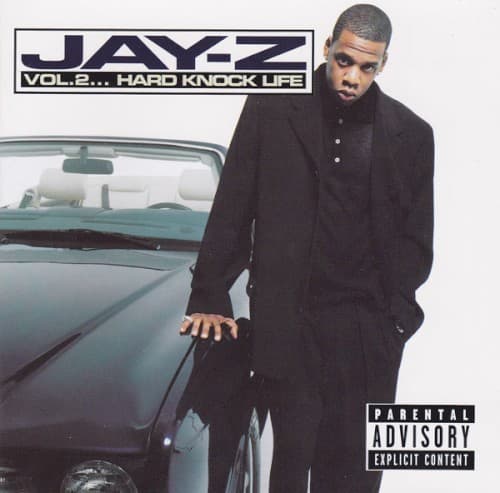
The scorecard
7.6/10 · Great
- Writing25%
- 7.5
- Production25%
- 8.0
- Delivery15%
- 8.0
- Cohesion15%
- 7.0
- Originality10%
- 7.0
- Replay value10%
- 7.5
Hard Knock Life (Ghetto Anthem) and Nigga What, Nigga Who (Originator 99) show tight, fluent rhyming, while the guest-heavy middle repeats a narrow vocabulary of money and loyalty.
The skeletal Swizz Beatz tracks and the Timbaland and 45 King beats give the album an inventive, bouncy sound with real range.
Jay-Z moves from relaxed authority to rapid-fire speed without strain, and the posse cut Reservoir Dogs shows him holding his own among hungry guests.
The main disc varies texture effectively and keeps moving across its reasonable hour-long run, though the mid-album guest cuts blur together and the bonus disc adds unnecessary length.
Turning a showtune sample into a street anthem was fresh for its moment, but parts follow a formula and the hook-first approach borrows more than it builds.
The headline songs hold up well, but the radio-built filler and the bonus disc make front-to-back plays less rewarding.
Jay-Z Vol. 2... Hard Knock Life: The Hustler's Ledger Goes Pop
Vol. 2... Hard Knock Life is the record where Jay-Z decided the hustler's ledger could be a pop product without losing its hustle. Its thesis is simple and deliberately commercial: take a street narrator, hand him the biggest hooks available, and let the contrast between the grit in the verses and the gloss in the beats become the point. The result is uneven, and its best songs are among the sharpest of the late 1990s, yet the album's central achievement is balance. It sells the lifestyle and keeps a voice of reckoning inside it.
That balance matters because of where it sits. Heard against the West Coast tradition, from G-funk's long, warm grooves to gangsta rap's long-form menace, this is an East Coast record that borrows the West's lesson about the hook. The West learned early that a rapper could be both ominous and singable; Jay applies that lesson with a different palette, trading synth whistle and live-band funk for a stuttering, jittery bounce. He earns the comparison honestly in places, and in others he borrows more than he builds.
The album's opening move establishes the stakes. A DJ Premier production on the intro sets a hard-headed tone, and then the title track flips an orphan's showtune into a hustler's anthem, announcing that the record will be funny about its own audacity. That sample choice is the whole album in miniature: a risky idea that works because the delivery sells it.
Jay's role here is part storyteller, part salesman, and the tension between those jobs gives the album its energy. He raps about money and ambition with clarity, and about danger with an almost bookkeeping calm. The weaknesses are as concrete as the strengths: the sequence is front-loaded, several guest cuts are more formula than inspiration, and the second disc of bonus material adds length without adding argument. What follows weighs those against the high points.
Tight Rhymes, Borrowed Hooks, Many Worlds
The writing is the album's steadiest asset. Jay builds verses out of tight, quick rhymes and a conversational authority that makes boasts sound like observations. He is at his best when the cadence tightens: lines pile up with internal rhymes, and the delivery stays relaxed even as the pace accelerates. On the fastest cut he treats speed as proof of skill, and the technique is closer to a sprint than to a story. The more reflective songs are plainer on the page but benefit from his dry, unhurried reading, which lets menace and regret sit in the same sentence.
Production is where the album shows its commercial ambition and its range. The fact sheet notes that the sound is rougher than the glossier Bad Boy production of his previous record, most notably through three tracks by Swizz Beatz, whose skeletal, stop-start beats give If I Should Die, Money, Cash, Hoes and Coming of Age (Da Sequel) an urgent mechanical bounce. The pop-leaning singles bring in Timbaland, Jermaine Dupri and Irv Gotti, and those records do the bright, hook-first work. A dense chop or sample appears on Reservoir Dogs and in the credits elsewhere, and DJ Premier opens the record. The variety is a strength in moments and a risk in the aggregate.
The comparison to West Coast records is instructive. The West's strongest albums of the era built a single sonic world and let the rapper live inside it; this album has several worlds and a rapper who commutes between them. The result is less immersive but more flexible, and Jay's voice is the connective tissue. Where a West Coast record like a long G-funk set earns its mood by repetition, this one earns its momentum by variation and singles. Both are legitimate, but the second makes the sound less cohesive and the album's identity less rooted.
The weakness is that identity gap. When the hooks come from guests, the song can feel borrowed: Can I Get A… and Money Ain't a Thang are built for radio rather than for the narrator, and the choruses lift the songs more than the verses do. Some collaborations lean on a named guest's charisma instead of a shared idea, and a few verses coast on formula. The lyrics also repeat a core vocabulary of money, rivals and loyalty, so the themes can blur across a long running order.
Even so, the performances are consistently confident, and the best production choices are inventive rather than safe. The album proves that a mainstream rap record could be both hard and singable, a lesson that other regions had already shown and that Jay translates into his own accent. It is not the deepest set he made, and it is not trying to be; it is built to move quickly, sound big, and leave the listener humming a hook that was clearly designed to be hummed.
Strong Opening, Soft Middle, Surplus Disc
As a sequence, the album is front-loaded and then stretches out. The first third is strong: the intro, the title track and the Swizz Beatz run give the opening a rapid sense of escalation, with each song raising the stakes before the middle section settles into guest-driven territory. By the time the pop-oriented singles arrive, the album has proven its range, and the question becomes whether the remaining tracks can sustain it.
The middle is the soft spot. Several songs share a similar tempo and a similar structure, a guest hook followed by a verse that tells a familiar story, and the energy dips before Reservoir Dogs reasserts the posse-cut spirit with a crowded, competitive roll call. That track marks the peak of the back half, and the final trio of songs is breezier and more melodic, closing the main disc on a light note instead of a heavy one.
Fourteen songs at around an hour is a reasonable length for the era, and the main disc largely earns its running time because the changes in producer and mood keep it moving. The bonus disc is a different matter. Its eight extra tracks include freestyle material, a skit and an outro, and they function more as an archive than as part of the sequence. Taken together with the main album, the total is long for the argument it makes, and the extra disc dilutes a record that was already generous. Cutting the bonus material would sharpen the album's shape without removing any of its central songs.
What the sequence gets right is variety of texture. The jumps between a hard beat, a playful pop single and a loping guest cut keep the album from settling into one groove, which suits its hit-making ambition. What it gets wrong is the lack of an emotional arc: the record does not build toward a climax so much as keep offering good songs in a slightly different order. That is acceptable for a commercial blockbuster, but it keeps the album from the narrative strength of Jay's best-sequenced work.
Between the Blockbuster and the Reckoning
Vol. 2... Hard Knock Life sits in the middle of Jay-Z's catalog as it stands on this site: clearly above Watch the Throne, which is heavier on scale than on songs, and clearly below 4:44, which has the tighter writing and the more mature perspective. That ordering is deliberate. This album has better individual hooks and a more confident sound than the collaboration, but it cannot match the later record's coherence or its honesty, and the scores reflect that.
It is for listeners who want rap with hooks and bravado and a sense of how the genre crossed into the mainstream at the end of the 1990s. It also suits anyone interested in comparing regional approaches: the West Coast's craft of the hook shows up here in an East Coast accent, and the contrast teaches something about both. Skip it if you want a tightly conceived concept album or a deep personal narrative, because the record is a collection of strong songs more than a single story. Fans who prefer an uninterrupted mood will find the stylistic hops frustrating.
The record has aged unevenly but well. The Swizz Beatz material still sounds sparse and strange, the title track remains an audacious piece of sampling, and the pop singles hold up as period pieces with real craft. The guest-heavy filler sounds more dated than the headline songs, and the bonus disc has little reason to exist outside completists' interest. The fact sheet notes strong sales, a Grammy for Best Rap Album and a Rolling Stone ranking among the best albums of the 1990s, and the music supports the first two points more clearly than the third.
Start with Hard Knock Life (Ghetto Anthem) for the sample flip, If I Should Die for the Swizz Beatz bounce, and Reservoir Dogs for the posse-cut payoff. For a next step, 4:44 shows what the same voice sounds like with fewer hooks and more reflection, and Watch the Throne shows the same ambition at a much larger scale. The most lasting thing about this record is how plainly it demonstrates that a hit single and a hard verse could share a three-minute song.
Track by track
Track Listing
Intro – Hand It Down
StandoutA short, confident opener with a DJ Premier beat and a Memphis Bleek feature that passes the torch in the title. Jay sounds relaxed and in control, and the track sets the hard-headed tone before the pop moves begin. It is more of a statement than a song.
Hard Knock Life (Ghetto Anthem)
StandoutThe album's defining move: a musical-theater sample turned into a hustler's anthem. The 45 King's production is bouncy and unmistakable, and Jay's delivery plays the humor of the idea straight. The verses are efficient and vivid, and the hook turns hardship into a sing-along without erasing it. It works because the contrast between the cheerful source and the grim subject is audible in every bar, and it remains the album's calling card. It also shows the commercial instinct at its sharpest.
If I Should Die
StandoutA Swizz Beatz production with a stop-start, mechanical bounce and a tense mood. Jay writes about mortality with an almost businesslike calm, and Da Ranjahz add rough texture. The beat is distinctive and the song is one of the album's more atmospheric moments, though the guest contribution is less memorable than the production.
Ride or Die
SolidA Stevie J production, the only Bad Boy-linked beat on the album, which keeps a trace of the glossier sound of Jay's previous record. It is smooth and loyalty-themed, and Jay's flow is comfortable, but the song is more conventional than the Swizz Beatz tracks around it. Solid but not essential.
Nigga What, Nigga Who (Originator 99)
StandoutA Timbaland beat, a Big Jaz guest spot and a rapid-fire delivery make this the album's technical showpiece. The rhymes are dense and the cadence is relentless, and the printed lyrics in the liner notes suggest he wanted the writing to be examined. It is more about speed and swagger than about meaning, but the sheer fluency is impressive. A key track for anyone who wants to hear what his voice can do at full tilt.
Money, Cash, Hoes
StandoutDMX guests on a Swizz Beatz beat built from a video-game sample, and the result is raw, loud and punchy. The pairing of two gruff voices makes the song feel like a face-off, and the sparse, stripped-down production keeps the energy high. The hook is blunt and the subject matter is familiar, but the performance carries it. One of the harder moments on the record.
A Week Ago
SolidToo $hort's presence gives this a West Coast flavor, and the Isley Brothers sample adds warmth. The song moves at a patient pace that lets the groove breathe. It runs a little long, and the lyrical ideas are more sketched than developed, but the mood is distinctive and the track is a rare slow burn on the main disc.
Coming of Age (Da Sequel)
SolidA Swizz Beatz beat and a Memphis Bleek feature in a mentor-and-protege setup. The production is jumpy and the verses are competent, and it rounds out the Swizz run without adding much beyond it. Fine, though the protege's verse is plainer than the headliner's.
Can I Get A…
SolidBuilt for radio, with Ja Rule and Amil on the hook and an Irv Gotti production aimed squarely at pop listeners. Jay handles it with polish, but the song depends more on its chorus than on his writing, and it sits at the commercial end of the record. It was designed to be a hit, and it plays like one, for better and worse.
Paper Chase
StandoutA Timbaland production with Foxy Brown trading verses in a playful, flirtatious back-and-forth. The beat is quirky and rhythmic, and the chemistry between the voices is the point. It is lighter than the street material but fits the album's pop-hard blend, and the performance is fun without being deep.
Reservoir Dogs
StandoutThe posse cut with The LOX, Beanie Sigel and Sauce Money, and the back half's highlight. The crowded roster turns it into a competition, with each verse trying to outdo the last, and the beat's heavy sampling keeps the mood grimy. Jay holds his own among hungry guests, and the energy is genuinely competitive. It is the clearest contrast to the pop singles and proves the street credentials are not for show. A key moment in the sequence.
It’s Like That
SolidKid Capri produces and appears, bringing a block-party feel to a loose, upbeat song. It is breezy and likable, but it is also slight, and the record has more memorable material than this. A pleasant, forgettable breather.
It’s Alright
SolidMemphis Bleek returns on a Damon Dash-produced cut with a sample drawn from sources that include Kraftwerk and Talking Heads. The unusual source material makes the beat interesting, but the song is more a showcase for the track than for the writing, and the Bleek verse is not a highlight. Mildly filler.
Money Ain’t a Thang
SolidJermaine Dupri produces a glossy, upbeat closer built on a funk sample, and the song is about as radio-friendly as the album gets. Jay's verse is smooth and confident, but the writing is thin and the hook does most of the work. It ends the main disc on a light note, which is a deliberate choice that undercuts the tension built earlier.
DJ Clue Snippets
WeakA bonus-disc snippet collection with no real song structure. It is a curio for completists and adds nothing to the album's argument.
Cru Love
SolidA bonus-disc cut that plays as a loose extra instead of a finished statement. It is listenable but not essential, and it does not change how the main album reads.
Respect
SolidAnother bonus-disc track that works as an extra instead of an album piece. It is competent but easy to skip, and it adds length more than substance.
Are You Ready (Sweaty)
SolidA bonus-disc entry that keeps the energy moving but offers little new. Fine as an extra, and unlikely to be a first pick for anyone sampling the record.
Can I Live
SolidA bonus-disc track that sits outside the main album's shape. It is worth a listen for Jay's delivery, but it adds little to the record's argument.
Beanie Sigel Freestyle
SolidA freestyle that functions as a guest showcase rather than an album track. It is rough by design, a snapshot of a hungry rapper, and appealing mainly as a document of the Roc-A-Fella circle.
Things Groupies Say (skit)
WeakA skit, and filler. It is a brief bit of comedy that interrupts the music and does not hold up on repeat plays.
Pain in da Ass (outro)
SolidAn outro that closes the bonus disc as a coda. It is a brief sign-off with little music to analyze, and it works more as a farewell than as a song.
Frequently Asked Questions
Is Jay-Z's Vol. 2... Hard Knock Life a good album?
What are the best songs on Vol. 2... Hard Knock Life?
Did Vol. 2... Hard Knock Life win a Grammy?
Styles