Scorecard: 8.1/10 · Great
How we score- Writing(25%)
- 7.5
Q-Tip's rhymes show craft and clarity, addressing self-improvement and hip-hop politics with intelligence, though few verses cut deep enough to match his Tribe Called Quest peak.
- Production(25%)
- 9.0
The live band approach with jazz players like Robert Glasper and Kurt Rosenwinkel creates a warm, organic sound that honors boom-bap's soul without feeling nostalgic or backward-looking.
- Delivery(15%)
- 8.0
His ever-cool flow rides the rhythms with ease, syllables landing exactly where they should, though the mellow consistency sometimes trades urgency for smoothness.
- Cohesion(15%)
- 8.5
Brilliant sequencing carries the listener through mood shifts without jarring breaks, each track flowing into the next with the natural feel of a live set despite the varied tempos and guests.
- Originality(10%)
- 7.0
The live instrumentation distinguishes it from sample-chop contemporaries, but the jazz-rap blueprint was laid by Tribe and peers a decade prior; this refines rather than reinvents.
- Replay value(10%)
- 8.0
The warm production and melodic hooks reward repeated listens, revealing layers in the arrangements, though the laid-back mood limits the peaks that pull you back immediately.
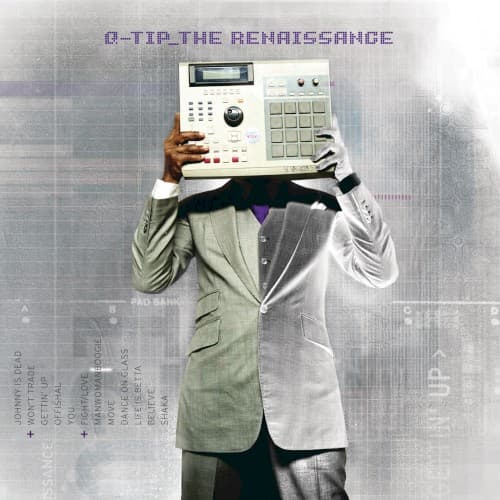
Q-Tip The Renaissance — The Argument for Letting Jazz Players Play
The argument The Renaissance makes is simple: hip-hop does not need to choose between authenticity and evolution. After Kamaal the Abstract sat in a vault for six years because Arista heard it as too experimental and Open got shelved by Universal Motown for the same reason, Q-Tip came back with a record that splits no difference. He hired a band with Robert Glasper on keys and Kurt Rosenwinkel on guitar, let them take solos, programmed drums that sound like drums, and rapped about self-knowledge and industry cynicism over arrangements that move like water. The result is a jazz-rap album in 2008 that does not sound like a throwback or a concession, but like the logical next step for an MC who never stopped believing that live musicianship and sampling could coexist.
The stakes were higher than a comeback. By 2008 the Native Tongues aesthetic that Q-Tip helped build with A Tribe Called Quest had been declared commercially dead for a decade, buried under the South's rise and the ringtone era. The Renaissance does not pander to either trend. It opens with the minor-key tension of Johnny Is Dead, where Derrick Hodge's bass and Mark Colenburg's drums lock into a groove that feels recorded in one take, and it closes with the hypnotic Shaka, where Q-Tip rides a syncopated rhythm for three and a half minutes without a hook. Between those points the album builds a case that swing and pocket matter more than flash, that a verse can be conversational without being soft, and that guest spots from D'Angelo and Norah Jones can deepen a rap record instead of diluting it. The question is whether refinement is enough when the writing rarely matches the ambition of the sound.
When the Band Listens to the Rapper
The production works because Q-Tip treats the musicians as collaborators, not session players filling out loops. On Official, James A. Hunt's keyboard chords shift under the verses, responding to the flow rather than repeating a static vamp. On Gettin Up, which samples Black Ivory but adds live bass from Antuan Barrett, the arrangement breathes in ways a straight loop cannot, stretching and contracting as Q-Tip accelerates and decelerates his cadence. The J Dilla-produced Move, built on a Jackson 5 sample, is the outlier: a more traditional chop that bangs harder than anything else here but feels like it belongs to a different project. The sequencing is smart enough to bury it in the middle where it works as a gear shift rather than a rupture.
Q-Tip's writing aims for wisdom and lands on clarity. He counsels self-improvement on You, dismisses industry compromise on Won't Trade, and celebrates hip-hop's roots on Official, all without preaching or coasting on platitudes. The problem is specificity. Where his Tribe verses painted scenes or twisted wordplay into knots, these verses make their points and move on. On WeFight/WeLove, where Raphael Saadiq sings the hook, Q-Tip argues that conflict and love are two sides of the same intensity, but the idea stays general, more thesis than story.
On Life Is Better, with Norah Jones on background vocals, he celebrates resilience, and the performance is assured, but the verses do not build to anything sharper than affirmation. The craft is there, the syllables land cleanly, the internal rhymes show skill, but few lines stop you.
The guest contributions do more work than the guests usually do on rap albums. D'Angelo on Believe adds gravity, his hum anchoring the track's spiritual undertow. Amanda Diva on ManWomanBoogie, which samples Can's Aspectacle, trades verses with Q-Tip in a call-and-response that loosens the album's meditative mood. Saadiq's bass playing on Believe adds bottom end that programming would flatten. The weakness is unevenness: Dance on Glass feels like a sketch, its groove solid but its purpose unclear, and the album's mellow consistency means that when a track sags it drags the momentum with it. The sequencing mostly compensates, but the second half needs more peaks.
The Architecture of Patience
The pacing rewards patience and punishes skipping. The album moves in waves, building tension in the opening stretch, releasing it early, then pulling back into an introspective middle section before a jolt of energy arrives. The stretch that follows is where the patience either pays off or tests you, depending on whether the vibe holds your attention. The emotional peak arrives near the end, and the closer finishes the record with a hypnotic insistence that feels like an argument against the singles-focused streaming era that was already beginning to reshape how albums were made and heard.
The length is earned. At thirteen tracks, including the digital bonus, nothing feels like padding, but the lack of dramatic peaks means the flow state can flatten into background music if you are not engaged. The sequencing does the heavy lifting: transitions are seamless, tempos vary just enough to keep the ear interested, and the live-band warmth gives the whole record a coherence that makes it feel shorter than it is. The album works best as a front-to-back listen, which in 2008 was already becoming a request rather than an assumption.
Where It Stands When the Dust Settles
The Renaissance sits between the boom-bap classicism of the nineties and the blog-rap experimentation of the late 2000s, leaning toward the former but executed with the confidence of someone who does not need to prove anything. It ranks as Q-Tip's most consistent solo work, more cohesive than Amplified and more accessible than Kamaal the Abstract once that finally surfaced years later. The production is among the best jazz-rap records of its decade, full stop. The writing is sharp enough to carry the album but not sharp enough to make it essential the way his Tribe work is.
This is for listeners who value craft, sequencing and live musicianship, who want a rap album that sits comfortably next to Robert Glasper's own records without sounding like fusion compromise. Skip it if you need urgency, if mellow grooves lose you, or if you expect every verse to justify its existence with quotable lines. Start with Gettin Up for the best synthesis of sample and live playing, then Life Is Better for the melodic peak, then Official for the writing at its most direct. From here, go to A Tribe Called Quest's The Low End Theory to hear where this sound was born, or to Common's Be for a parallel take on live-band hip-hop from the same extended circle.
The Renaissance made the case that jazz-rap could still work in 2008, that swing and pocket and live musicians taking solos had a place in hip-hop's future. The genre mostly ignored the argument, but the album holds up as proof that the case was sound. It is polished where it could be raw, smooth where it could cut, and wise where it could be urgent, which makes it a very good album that stops just short of great.
Track Listing
Johnny Is Dead
▲The opener sets the tone with minor-key unease, Derrick Hodge's bass walking under Q-Tip's meditation on artistic mortality and reinvention. The live drums from Mark Colenburg hit with the snap of a band playing together in a room, not quantized to a grid. The track works as both mission statement and mood setter, arguing that tension matters more than immediate resolution. Q-Tip's flow is unhurried, confident, letting the spaces between phrases do as much work as the words.
Won’t Trade
▲Built on a Ruby Andrews sample, this is Q-Tip drawing a line between integrity and compromise. The verse catalogs what he will not give up for commercial success, and the conviction in the delivery sells it even when the specifics stay general. The production is warm, the hook simple and effective, and the track's brevity keeps it from turning into a lecture. A mission statement that works because it does not overstate.
Gettin Up
▲The Black Ivory sample meets Antuan Barrett's live bass, and the combination shows what the album does best: honoring the boom-bap tradition while adding organic texture that a loop cannot provide. Q-Tip celebrates the act of creation itself, the daily discipline of making something, and the production mirrors that ethic, every element placed with care. The groove is immediately danceable, the best pure hip-hop moment on the record, and the sequencing is smart to place it early.
Official
▲Q-Tip addresses hip-hop's commercialization with intelligence and no bitterness, arguing for craft over trend-chasing. James A. Hunt's keys shift under the verses, the chords moving in response to the flow rather than staying static. The writing is direct without being preachy, the delivery confident, and the track works as both a personal statement and a broader commentary. One of the album's sharpest moments lyrically.
You
●A love song that doubles as self-affirmation, with Q-Tip on bass and Robert Glasper on keys creating a lush, melodic bed. The production is gorgeous, the flow smooth, but the writing stays surface-level, more feeling than detail. It works as a mood piece and the sequencing benefits from the breather, but the verse does not build to anything unexpected. Solid without being memorable.
WeFight/WeLove
●Raphael Saadiq sings the hook, his voice adding warmth and gravity, while Q-Tip explores the duality of conflict and affection. The production layers live drums, keys and Saadiq's vocal into a groove that feels lived-in. The idea is compelling, the execution smooth, but the verses do not dig into the contradiction deeply enough to make it more than a sketch. The track benefits from Saadiq's presence more than the writing earns.
ManWomanBoogie
▲Amanda Diva trades verses with Q-Tip over a Can sample, the groove polyrhythmic and loose, the back-and-forth adding energy that the surrounding tracks do not have. Mike Moreno's guitar threads through the arrangement, and the whole track feels like a jam session. Diva's verse lands with confidence, and the chemistry between the two MCs keeps the track from settling into the album's usual mellow zone. A welcome change of pace.
Move
▲The J Dilla production, built on a Jackson 5 sample, hits harder than anything else on the album, all thump and swing. It feels like it belongs to a different project, more traditional boom-bap, less live-band warmth, but the sequencing buries it in the middle where it works as a jolt of energy. Q-Tip's flow locks into the pocket Dilla creates, and the track is a reminder of what that partnership sounded like. A standout for pure knock, even if it disrupts the album's sonic coherence.
Dance on Glass
●The groove is solid, Q-Tip on bass creating a melodic foundation, but the track feels like a sketch, its purpose unclear. The verse is competent, the production pleasant, but nothing about it demands attention or builds to a payoff. It works as a transitional piece in the album's flow, but on its own it sags. Filler by the album's own standards.
Life Is Better
▲Norah Jones on background vocals lifts this into the album's emotional peak, her warmth blending with Robert Glasper's keys and Mark Colenburg's drums to create a track that feels like exhaling after tension. Q-Tip celebrates resilience and gratitude, and the sincerity in his delivery makes the affirmation land without feeling cloying. The production is gorgeous, the sequencing places it perfectly, and the track earns its place as the record's heart. One of the best moments here.
Believe
▲D'Angelo's hum anchors this meditation on faith and persistence, his presence adding gravity that the track needs. Raphael Saadiq plays bass, the low end grounding the spiritual undertow, and Q-Tip's verse explores doubt and conviction with more introspection than most of the album allows. The production is sparse, the mood heavy, and the track works as a statement of purpose. Short enough to avoid overstaying, deep enough to matter.
Shaka
▲The closer rides a hypnotic, syncopated rhythm for three and a half minutes, no hook, just Q-Tip's flow and the groove. The production is minimal, James A. Hunt's keys and Kurt Rosenwinkel's guitar weaving around the drums, and the whole track feels like an argument against the singles era, a refusal to resolve into something easily digestible. It works as a closing statement, confident in its own patience, though it will lose listeners who need peaks. A fitting end to an album that values vibe over fireworks.
Good Thang
●The digital bonus is lightweight, a groove and a verse that do not add much to the album's argument. Pleasant enough, competently executed, but easy to skip. It feels like a B-side for good reason.