The Abstract Architect: Q-Tip's Journey from Queens to Hip-Hop Visionary
Q-Tip stands as one of hip-hop's most complete artists — a rapper whose conversational flow redefined lyrical delivery, a producer whose crate-digging instincts built entire sonic worlds, and a curator whose taste shaped the genre's relationship with jazz, soul, and musicality itself. Born Jonathan Davis in Harlem and raised in Queens, he emerged in the late 1980s as the voice and production mind behind A Tribe Called Quest, a group that fundamentally altered what hip-hop could sound like and stand for. While his groupmates Phife Dawg, Ali Shaheed Muhammad, and Jarobi White each contributed essential elements, Q-Tip's vision anchored Tribe's ascent from Native Tongues collective members to generational touchstones.
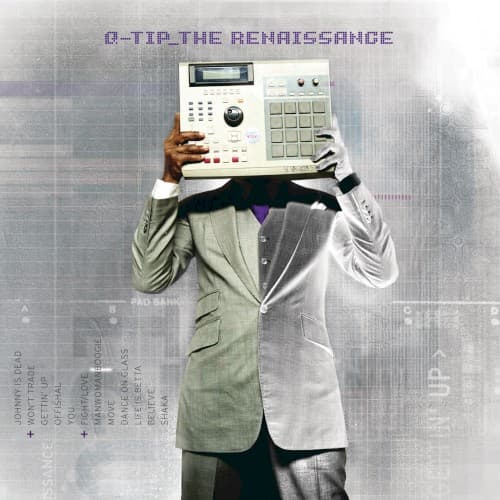
His solo work, though sporadic and often delayed by label politics, reveals an artist uninterested in commercial compromise. The Renaissance arrived in 2008 after years of shelved projects and industry frustration, a statement of artistic survival that proved his approach remained relevant even as hip-hop's center shifted. Q-Tip's influence extends beyond his own catalog — his production fingerprints appear on foundational records by Nas, Mobb Deep, and countless others, always recognizable by their warmth, their swing, and their refusal to sacrifice musicality for hardness. He represents a lineage of hip-hop that valued sophistication without pretension, intelligence without elitism, and groove above all else.
The Textured Sound: Q-Tip's Production Philosophy and Vocal Approach
Q-Tip's production aesthetic draws from jazz's improvisational spirit and soul's emotional depth, filtering both through hip-hop's percussive backbone. His beats breathe — they leave space for the bassline to walk, for Rhodes keys to shimmer, for upright bass to anchor the low end with organic weight. He favors samples that suggest entire narratives: a horn stab that feels like yearning, a piano loop that evokes late-night introspection, drum breaks that shuffle rather than march. This approach, evident throughout A Tribe Called Quest's catalog and refined across his solo output, created what became known as jazz rap, though the term undersells the breadth of his palette. He pulls from Brazilian bossa nova, West African percussion, Detroit soul, and bebop with equal fluency, always in service of the groove.
As an MC, Q-Tip pioneered a conversational flow that prioritized clarity and rhythm over aggressive display. His voice carries a laid-back confidence, his cadence bending around beats with the ease of someone who built the track and knows every pocket. He rarely shouts, rarely forces emphasis, letting ideas land through precise word placement and subtle inflection. His lyrics blend Afrocentric consciousness with everyday observation, philosophical reflection with humor, creating a persona that feels approachable without being ordinary. On The Renaissance, his flow adapted to a slightly more muscular production approach while maintaining that signature ease, proving the style transcended any single sonic context. Where many rappers treat the beat as opposition to conquer, Q-Tip moves through production like water, finding the path of least resistance that somehow becomes the most compelling route.
From Native Tongues to Renaissance: Q-Tip's Evolution Across Decades
Q-Tip's recorded career begins with A Tribe Called Quest's 1990 debut People's Instinctive Travels and the Paths of Rhythm, an album that introduced his production sensibility and rhyme style alongside Phife Dawg's grounded counterpoint. The group's second album, The Low End Theory, elevated them to canonical status — its stripped-down bass-heavy production and seamless integration of jazz samples created a blueprint still referenced decades later. Q-Tip's work on tracks like "Scenario" and "Check the Rhime" demonstrated how minimalism could amplify impact, how restraint could intensify groove. Midnight Marauders continued this trajectory, its warmer production and deeper sample palette showcasing Q-Tip's growth as a sound architect.
During Tribe's prime, Q-Tip's production work for other artists established him as a go-to collaborator for MCs seeking elevated sonics. His work on Nas's "One Love" brought narrative storytelling to life through melancholic keys and shuffling drums. His production on Mobb Deep's "Give Up the Goods" proved he could serve street narratives without abandoning musicality. These outside projects revealed his versatility — he could match an artist's energy rather than imposing a signature stamp, though his touch always remained audible in the sample selection and arrangement choices.
A Tribe Called Quest's dissolution in 1998 after The Love Movement left Q-Tip's solo trajectory uncertain. His debut solo album Amplified arrived in 1999, a more commercial effort that scored radio success with "Vivrant Thing" but divided critics who expected jazz-rap purity. The album's blend of R&B smoothness and pop accessibility showed Q-Tip testing new waters, though it lacked the cohesion of his Tribe work. His intended follow-up Kamaal the Abstract was recorded in 2001 but rejected by Arista Records for being too experimental — its eventual 2009 release revealed a deeply electronic, genre-blurring project that vindicated his artistic instincts while explaining label fears about its commercial viability.
The Renaissance, finally released in 2008 after protracted label battles and creative restarts, marked Q-Tip's return with purpose and focus. The album balanced his jazz-rap foundations with contemporary energy, featuring production that felt both classic and current. Tracks like "Gettin' Up" and "Life Is Better" carried the weight of experience without nostalgia's burden, while collaborations with D'Angelo, Raphael Saadiq, and Norah Jones expanded the sonic palette. The album's critical success — including our 8.1 rating — reaffirmed Q-Tip's relevance beyond Tribe's shadow, though its modest commercial performance underscored the challenge facing alternative hip-hop in an increasingly polarized market. His production work continued steadily, contributing to Kanye West's albums and serving as musical consultant for network television, but another solo album has yet to materialize.
A Tribe Called Quest's 2016 reunion album We Got It from Here... Thank You 4 Your Service, recorded before Phife Dawg's death, provided unexpected closure and creative resurgence. Q-Tip's production felt reinvigorated by the group context, his rhymes sharper and more urgent than in years. The album's success demonstrated the enduring power of the Tribe formula while highlighting what made Q-Tip's solo work challenging — his vision thrives in collaboration, in dialogue with other voices and ideas, making the solitary album format potentially limiting for an artist whose strength lies in creating ecosystems rather than monuments.
Abstract Influence: Q-Tip's Lasting Impact on Hip-Hop's Musical DNA
Q-Tip's influence operates on multiple registers simultaneously. As a producer, he helped establish that hip-hop could embrace musical complexity without alienating its core audience, that jazz samples could coexist with street narratives, that warmth and swing could carry as much power as aggression and hardness. His production approach directly influenced the Soulquarians movement of the late 1990s and early 2000s, with artists like Common, The Roots, and D'Angelo building on the musical foundation he helped establish. Contemporary producers from J Dilla to 9th Wonder to Madlib cite his sample selection and arrangement as foundational, his ability to make loops breathe and evolve rather than simply repeat.
As an MC, Q-Tip demonstrated that conversational delivery could carry weight, that clarity need not sacrifice complexity, that intelligence could wear casual clothes. His flow influenced generations of rappers who favored rhythmic precision over volume, from Mos Def to Common to contemporary artists navigating the space between underground credibility and accessible appeal. His thematic range — Afrocentric consciousness, romantic vulnerability, everyday observation — expanded what alternative hip-hop could address without becoming preachy or didactic.
Perhaps most significantly, Q-Tip represents a model of artistic integrity within commercial constraints. His career includes commercial successes and label battles, radio hits and shelved experiments, but maintains a through-line of refusing to compromise core values for market demands. The Renaissance stands as proof that artists can survive industry indifference and return with work that honors their vision. His willingness to experiment, even when labels rejected the results, validated risk-taking for subsequent generations navigating similar pressures. In an era of rapid reinvention and calculated pivots, Q-Tip's consistency of purpose — finding the groove, honoring the music, speaking clearly — remains quietly radical.