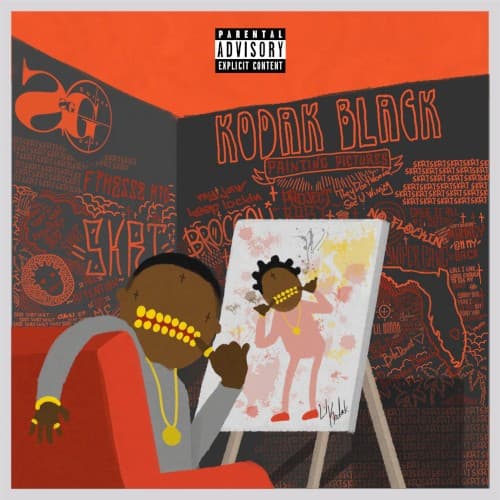
The scorecard
6.6/10 · Good
- Writing25%
- 6.5
- Production25%
- 6.5
- Delivery15%
- 7.0
- Cohesion15%
- 6.5
- Originality10%
- 6.5
- Replay value10%
- 6.5
The confessional framing gives the album a spine, but the best songs state their regret in plain terms and the weaker ones circle the same grievances without adding detail.
Piano-heavy, minor-key beats on the opener and the LBeats pair carry real weight, while the bounce of the lead singles keeps the mood from sinking.
Kodak's slurred, bending melodic phrasing makes the hooks stick and sells the hurt, though the same cadence appears on far too many songs.
The sequence holds together through the first half, then the Gnarly and MoshPit run pulls toward radio just as the mood was settling.
It folds Florida street rap into a melodic, penitent mode that peers were also exploring, with its strongest idea being the sincerity rather than the sound.
At sixteen tracks that mostly stay under four minutes the record is easy to revisit, and the singles carry plenty of repeat value, though the middle stretch blurs.
Kodak Black Dying to Live: Penance Set to Melody, and the Question of Who Gets to Ask for It
Dying to Live asks for forgiveness in a voice that never quite stops sounding like the person who needs it. That tension is the whole record. Kodak Black arrived at his second studio album fresh out of jail, with a chart-topping debut ahead of him and a public image that critics had trouble separating from the music. The album's answer is to turn the confessional into a genre, to treat regret as a hook and mortality as a mood. When it works, the result is the most coherent thing he had made up to that point. When it does not, it plays like a man performing remorse for an audience that has already decided what it thinks.
The thesis is simple enough to state early: this is a good album, and a more serious one than its commercial sheen suggests, but its sincerity is limited by a delivery style that flattens the very feelings it is meant to carry. Kodak is at his most affecting when the beat gives him room to sound tired, as on the sober opening stretch, and at his weakest when a feature or a bounce asks him to sound like everyone else on the radio. The record speaks for a specific community, young men in South Florida who grew up around the same violence he describes, and it speaks to that same audience, offering a version of the street narrative where the consequences arrive on schedule instead of being glamorized.
That positioning matters because the trope it leans on is old. The reformed hustler, the prayer after the funeral, the thanks to a mother, these are staples of the form, and an album that uses them has to earn them. Dying to Live earns most of it through texture. The pianos are heavy, the tempos are unhurried, and Kodak's voice cracks and slides in ways that sound unrehearsed. Critics at the time called it an imperfect window into a troubled soul, and that phrasing is fair. What follows tests how much of the window is clear glass and how much is a mirror, and whether the music is strong enough to make the question secondary.
Heavy Pianos, Bouncing Hooks, and a Voice That Bends Around Both
The sound is built from two competing impulses. One is the slow, minor-key trap of the album's opening and its late reflective stretch, where beats from Major Nine, LBeats and others give Kodak a solemn bed to talk over. The other is the brighter, hook-first material that the label clearly wanted for singles, handled by producers such as D. A. Doman, Ben Billions and the Jake One and Southside pairing. The album moves between them without much friction, which is its biggest production achievement. A record with this many credited hands could have sounded like a compilation, but the mixing, handled mostly by one engineer across the bulk of the tracklist, keeps the low end consistent and the vocals forward.
Kodak's delivery is the central instrument. He raps in a half-sung slur that stretches the ends of lines upward, then drops into a flat, almost spoken tone when he wants a point to land. It is a distinctive voice and it suits melodic trap, because the hooks are built from the same bent syllables as the verses. The problem is range. Over sixteen songs the phrasing keeps returning to the same few shapes, so the emotional temperature is more uniform than the subject matter should allow. A song about grief and a song about getting paid can end up with the same melodic outline, which weakens the contrast the album is trying to draw between them.
The writing is plain-spoken rather than dense. Kodak favors direct statements over elaborate wordplay, and when the subject is loss, that directness is an asset. There are no ornate metaphors to hide behind, and the shorter songs in particular have the economy of a diary entry. The weakness is that directness also exposes repetition. Several verses restate the same thesis, that he has seen too much and wants more than the street offered, without adding a new scene or a new detail. The best moments are the ones that move from the general to the specific, and there are fewer of those than the album's reputation suggests.
Guest spots are used with more discipline than usual for a major-label rap album. Travis Scott and Offset on the biggest single add texture without taking over, and the Juice Wrld feature gives a pop-leaning song a melodic lift that fits Kodak's own approach. The Lil Pump collaboration is the clearest misstep, a loud and thin cut that treats the album's mood as an obstacle. It is also the weakest argument for the record's seriousness, because it shows how quickly the tone can be traded for a trending sound. The sampling is more careful, particularly on the song that places Malcolm X speech excerpts beside an Anita Baker sample, a bold pairing of soul and politics that the music mostly justifies even if the lyrics around it do not fully live up to the borrowed gravity.
From Prayer to Party and Back: How the Album Holds Its Shape
The sequencing shows more planning than most debut-era major-label albums manage. The first quarter is deliberately heavy, opening with Testimony and moving into material that lets the voice settle before any guest arrives. This is smart, because it frames everything that follows as the work of someone who has already said his piece. The pacing through the first half is brisk, with songs that rarely run past three minutes and a steady alternation between reflection and hook-driven momentum.
The weak patch arrives in the middle. The run that includes the Lil Pump and Juice Wrld features pulls the album toward a younger, louder audience at the moment the mood had been built into something more personal. The tone never recovers fully, and the next several songs feel like variations on a template already established. It is not filler in the strict sense, since each song has its own hook and its own beat, but the cumulative effect is of a record treading water for ten or fifteen minutes before it remembers what it was about.
The closing stretch recovers a good deal of ground. The final songs return to slower tempos and more personal subject matter, and the sequencing makes the last track feel like a deliberate conclusion rather than an afterthought. Whether sixteen tracks is the right length is a fair question. The runtime is short enough that the album never drags the way many streaming-era releases do, but it carries about three songs more than the idea requires. Trimming the middle would have sharpened the arc without losing a single single. As it stands, the album peaks twice, once early and once late, and sags in between, which is a better shape than most records of its size and commercial ambition manage.
Where It Sits: Kodak's Most Complete Statement, With Its Doubts Intact
Dying to Live is a strong album that stops short of a great one. It is the most unified work in Kodak Black's discography on this site so far, though no other albums by him are rated here yet, so the ranking is provisional. Compared with the loose, mixtape-style projects that preceded it, this one commits to a mood and mostly holds it, which is both its main virtue and the reason its flaws are easier to see. The scores reflect that balance: production and replay lead, while writing and originality sit lower because the ideas are sincere without being especially new.
The album is for listeners who want melodic trap with some moral weight, and for anyone curious about Kodak beyond the viral moments. Fans of Florida street rap and of artists who treat vulnerability as a hook will find the most to like. It is a poor fit for listeners who need dense lyricism or who cannot separate the performer from his public record, since the album invites exactly that comparison and does not resolve it. Those who dislike heavily auto-tuned phrasing should also skip it, because the voice is the main event.
It has aged reasonably well. The singles still sound current, the slower material avoids the dated trends of the moment, and the commercial success, a first number-one on the Billboard 200, has not obscured the record's more reflective core. Start with Zeze for the big-hook version, Calling My Spirit for the melodic one, and Malcolm X.X.X. for the track that best shows how much weight the production can carry. For a follow-up, hear Travis Scott for a more stylized treatment of the same melodic trap and Offset for the Atlanta counterpart to Kodak's Florida approach. The most telling thing about Dying to Live is that its best song and its most doubtful claim to sincerity are separated by only a few minutes of playing time.
Track by track
Track Listing
Testimony
StandoutA somber, piano-led opener that sets the album's terms: slow, grave and unadorned. It works as a statement of purpose, and Kodak's flat, tired delivery here is more convincing than anything he does at higher tempos. It is the best case for the record's seriousness.
This Forever
SolidA short, melodic cut that stays in the reflective mood without adding much to it. The hook is pleasant and the beat is smooth, but it reads as a bridge between statement and singles.
Identity Theft
SolidA brief, low-key track at just over two minutes. It is more mood than argument and passes quickly, which is its main virtue.
Gnarly
WeakThe Lil Pump feature drags the album toward a louder, thinner sound. It is the least convincing fit with the record's tone and plays as filler beside what surrounds it.
ZEZE
StandoutThe album's biggest hook and its most successful pivot to a lighter mood. The beat from D. A. Doman bounces without rushing, Travis Scott's melodic contribution adds lift, and Offset's verse supplies a change of cadence. Kodak sounds relaxed here in a way that benefits the whole album, since it shows the range he can reach when the production gives him room. Critics rightly pointed to its vibrancy as a counterweight to heavier material, and it earns that role. It is the track most likely to be played on its own, and it holds up without the context of the rest of the record.
Take One
StandoutA compact single with a clean melodic hook and a swaying beat. Kodak's phrasing is at its most fluid here, and the track gets in and out without wasting time.
MoshPit
SolidJuice Wrld's melodic feature gives the song a pop-leaning lift, and the pairing makes sense because both artists bend their syllables in similar ways. The energy is higher than the album's average, which is both its appeal and its small tonal compromise.
Transgression
SolidA short, tense cut that lets Kodak talk his way through regrets. It feels like a sketch more than a finished statement, but the mood fits the album's themes.
Malcolm X.X.X.
StandoutThe most ambitious track on the record. It places recordings of Malcolm X speeches over a warm soul sample, with the Anita Baker source giving the beat its emotional color. The production carries real dignity, and Kodak's verses respond to it with a seriousness that suits the setting. The borrowed gravity is a heavy load for the lyrics to carry, and they do not always match the weight of the samples, which is the song's central tension. Even so, the arrangement is the clearest example of what the album could have been if it had committed fully to this mode, and it is the best argument that Kodak's ambitions exceeded the trap formula.
Calling My Spirit
StandoutA melodic single built on the Jake One and Southside beat, with a hook that is easy to sing back. It strikes a balance between prayer and anthem, and it is the best example of the album's hybrid approach. At two and a half minutes it never overstays.
In the Flesh
SolidA mid-tempo track that continues the album's reflective vein without pushing it forward. The production is competent, and the hook is serviceable, though it lacks the distinctive touch of the stronger cuts.
Close to the Grave
StandoutThe first of two LBeats productions that reopen the album's heavier side. The pace slows, the beat is mournful, and Kodak's delivery settles into a lower, more weary register. It is a strong return to the record's central mood after the lighter stretch in the middle, and the subject matter feels earned.
From the Cradle
StandoutA companion piece to the track before it, with a similar sonic palette and a reflective look back. It is slightly less distinctive but works as part of a pair, giving the late album a sense of purpose.
If I’m Lyin, I’m Flyin
StandoutThe lead single, and a compact two-minute argument that Kodak could make hits without losing his edge. The Ben Billions beat is sparse, the hook is direct, and the swagger is the opposite of the album's penitent tone, which makes it a useful reminder of where he started. It is short, sharp and unexpectedly funny in its confidence, though it sits oddly against the surrounding material.
Needing Something
SolidA softer, more melodic track that leans on vulnerability. The beat is understated and the hook is gentle, though the writing stays general and the song does not leave a strong mark.
Could of Been Different
StandoutA fitting closer that returns to regret and what-ifs in a restrained tone. The production is moody without being heavy-handed, and the title states the album's theme plainly. It ends the record on a quiet note, which suits the project better than a final bang would have.
Frequently Asked Questions
Is Kodak Black's Dying to Live a good album?
Who produced Dying to Live?
Which guests appear on Dying to Live?
Styles