The scorecard
6.5/10 · Good
- Writing25%
- 6.5
- Production25%
- 6.5
- Delivery15%
- 7.0
- Cohesion15%
- 6.0
- Originality10%
- 6.0
- Replay value10%
- 6.5
Titles like Corrlinks and JPay and Reminiscing point to a real post-jail perspective, but too many verses fall back on stock street and romance phrasing.
The Ben Billions-heavy middle is serviceable but thinner, though Tunnel Vision from Metro Boomin, Southside and Cubeatz and the Wheezy-built Top Off Benz are sharp.
Kodak's slurred, melodic drawl is instantly recognizable and carries There He Go, though the same mid-tempo cadence repeats across eighteen songs.
At eighteen songs the record sags in the middle, with several interchangeable cuts and a guest-heavy stretch that scatters the focus.
The beat templates and guest slots follow the trap-album playbook of the moment, though his wounded, sing-song voice stands apart from Florida peers.
The singles and a handful of album cuts hold up well, while the rest is a projection of low-stakes background listening rather than songs worth returning to.
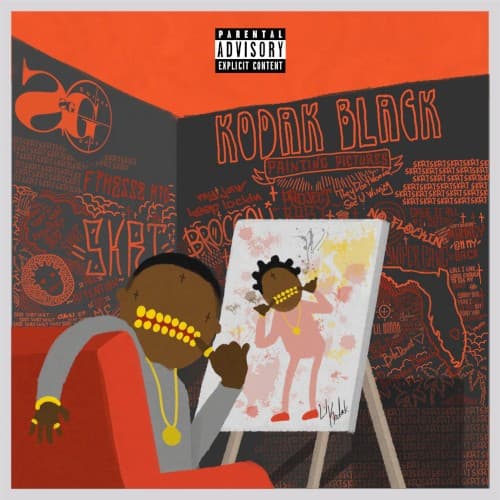
Kodak Black Painting Pictures: A Debut Written Between Probation Check-Ins
Painting Pictures is the sound of a young rapper trying to turn a hard stretch of his life into a career before the window closes, and the pressure shows in both the best songs and the worst. Kodak Black came home from jail and started recording almost immediately, working under house arrest and probation, and the album carries that urgency in its short songs, its restless sequencing and its plainspoken confessions. The thesis is that this is a debut with an unusually distinct voice and a loosely edited tracklist: the voice gives it a real identity, and the editing keeps it from becoming a great record.
What the album does well is let Kodak Black sound wounded without sounding weak. His delivery is slurred, melodic and conversational, and over trap beats that might sound generic with another vocalist he bends the lines into something closer to singing than rapping. The best songs treat freedom, loyalty and money as unstable ground, and they sound like they come from someone who cannot assume tomorrow will look like today. That tension is the record's most valuable asset, and it gives the album a sense of consequence that most debut trap albums lack.
The identity question matters here. Rap has a long tradition of the young street narrator speaking for a neighborhood and for people who rarely get the microphone, and this album sits squarely in that tradition while resisting the grand statements the tradition often demands. Kodak speaks mostly for himself and his immediate circle, and he does it in small, specific gestures instead of manifestos. That restraint is both the album's charm and its limit. It can feel intimate when the writing is concrete, and slight when it relies on familiar boasts and romantic scenes. The record is good because the voice is strong; it is not better because the voice is carrying too much weight alone.
A Wounded Drawl Over Radio-Ready Trap
The central strength of the record is Kodak's voice. He stretches syllables, lets lines trail off and leans into a sing-song cadence that makes even simple statements sound emotionally loaded. That delivery turns plain writing into mood, and it is the reason the album works at all. His hooks tend to be short and sticky, built from repetition rather than complicated phrasing, and the best of them lodge in the head after a single listen. The vocal personality is strong enough that producers can almost get away with anything underneath it.
The production is a mix of big-name polish and in-house workmanlike beats. Metro Boomin, Southside and Cubeatz built the album's biggest single, and Mike Will Made It and Wheezy deliver some of its most striking moments. The rest of the list leans heavily on Ben Billions, along with a long roster of smaller names, and the quality drops accordingly. The better beats leave open space for his voice and use cold synths, spare bass and clipped drums. The weaker ones reach for the same dark piano and rolling hi-hats that crowded the trap market of the period, and several songs in the middle blur together for that reason.
Writing is where the album is most uneven. When Kodak writes from a specific vantage, such as the experience of being locked up and trying to stay connected to people outside, the lines gain real weight. When he turns to relationships and spending, the language becomes stock, and a listener can predict the next image. The record also relies on a narrow emotional palette: defiance, devotion and regret, rotated through a limited set of images. Because his delivery is so consistent, the repetition is more noticeable than it would be with a more varied performer.
The guest list is a mixed blessing. Future, Young Thug, Bun B, Jeezy and A Boogie wit da Hoodie each add color, and the features are placed sensibly instead of crammed in for chart value. But some guests outshine the host on their own songs, and a few of the collaborations feel more like industry networking than creative exchange. The album's most notable weakness is length. Eighteen songs is too many for a debut whose ideas are this consistent, and the extra material dilutes the better cuts. Fewer songs would have made the voice feel like a signature instead of a habit, and would have sharpened the sense of urgency that the circumstances behind the record promise.
Front-Loaded Energy and a Long Middle Stretch
The album opens with short, punchy songs that run under three minutes and establish the voice quickly. That pacing is a smart choice. Kodak does not wait to introduce himself, and the early run moves with the restlessness of someone trying to make up for lost time. The first several tracks establish a pattern of tight hooks and compact verses that makes the record feel immediate, and the sequencing gives the listener little room to get bored.
The record reaches its commercial peak around the middle, where its biggest single arrives and the guest features begin to cluster. This is the stretch that holds the most variety. Producers change, tones shift between menace and tenderness, and the featured artists pull the sound in different directions. It is also the stretch where the album is most exciting, since the best songs sit next to each other and make the case for Kodak as a hitmaker.
After that peak the sequence loses shape. Several songs in the second half share tempo, mood and subject matter, and the guest verses are no longer spaced to refresh the pacing. The album does not collapse, but it settles into a groove that rewards casual listening more than close attention. The closing run lifts again with the lead single, which works well as a celebratory coda, though placing it at the very end means a first-time listener hears the most triumphant song last, after the best of the tension has already been spent.
The length is only partly earned. Eighteen songs at an average of roughly three and a half minutes is a manageable runtime, and no individual song overstays. The problem is cumulative: the record has perhaps twelve songs with a reason to exist, and the remainder pad the tracklist without adding a new angle. A leaner version would have kept the early momentum and made the final stretch feel like a payoff instead of a restatement of ideas the album had already covered.
A Strong Voice Still Looking for Its Best Songs
As the first Kodak Black album on this site, Painting Pictures has no internal ranking to defend, so the question is how it stands on its own terms. The answer is that it is a good debut with a great voice and uneven songwriting. The scores land in the good range because the highs are real, in the form of a hit single that earned its chart run and a handful of vocal performances that lodge in memory. The lows are not bad so much as indistinct, which keeps the record from reaching the next tier.
It is for listeners who respond to atmosphere and vocal personality more than lyrical density, and for anyone curious about the melodic, emotionally exposed branch of 2010s trap. It is a particularly good starting point for fans of the Florida scene and for people who want the album that introduced Kodak to a wide audience. Skip it if you need intricate wordplay, if you dislike mumbled or slurred delivery, or if a bloated tracklist is a dealbreaker. Those readers will find the stretch between the single and the closer tedious.
Start with Tunnel Vision for the biggest production and the album's clearest hook, then There He Go for the voice at its most celebratory, and Corrlinks and JPay for the strongest case that Kodak had something particular to say. Top Off Benz is worth a listen for the guest chemistry.
In terms of age, the record holds up as a snapshot of a moment when street rap and melodic trap were merging, and its hits still sound current. For a next step, a listener who wants more of the Atlanta-leaning beat style might try Young Thug, whose guest spot here shows the contrast in approaches. The cleanest summary is that Painting Pictures has the best voice in its class and about twelve songs worth the space it gives them.
Track by track
Track Listing
Day for Day
StandoutA short, direct opener that introduces the voice without ceremony. The beat is cold and spare, the hook is simple, and the song sets the album's tone of restless urgency in under three minutes.
Coolin and Booted
SolidA compact, melodic early cut with a loping beat and an easygoing hook. It is pleasant and well made, though it sounds closer to a template than to a statement.
Candy Paint
StandoutBun B's guest verse gives the song a veteran anchor, and the contrast between his steadier cadence and Kodak's looser drawl is the point of the track. The beat is bright and glossy, the hook is immediate, and the song works as a nod to Southern rap tradition without sounding like homage.
Up in Here
SolidA short, energetic track that leans on attitude and a repeating hook. It does its job as a mid-tempo change of pace, but there is little here a listener will remember afterward.
U Ain’t Never
SolidA solid, mood-driven track in which the melodic hook carries most of the weight. The production stays out of the way and Kodak's phrasing does the rest.
Twenty 8
SolidA brief, stripped-back track that feels more like a sketch than a finished song. It is not bad, but it is the kind of cut the album could lose without anyone noticing.
Patty Cake
StandoutA catchy, bouncy song with a playful hook that gives the middle of the record a lift. The beat is built around a distinctive melodic figure, and Kodak's delivery turns a slight idea into something memorable through sheer sing-song charm.
Save You
SolidA more tender, melodic piece that shows his R&B instincts. The hook is warm and the beat is soft, though the writing leans on familiar romantic language.
Conscience
StandoutFuture brings his own melodic gloom to the song, and the two voices blend better than their different styles would suggest. The production is moody and slow-burning, and the track gives the album one of its more atmospheric moments. It is solid rather than essential, but it shows how well Kodak's voice can sit beside a peer.
Tunnel Vision
StandoutThe album's centerpiece and its biggest hit, and it earns the position. Metro Boomin, Southside and Cubeatz supply a cold, sparse beat that gives Kodak room to deliver one of his most hypnotic hooks, and his drawl sounds both menacing and weary. It reached the top ten of the Billboard Hot 100, which says something about how effectively the song translates his voice for a mass audience. The writing is simple, but the delivery turns repetition into momentum, and the track is the clearest argument for the album's commercial ambitions. It is the first song to play for anyone new to him.
Corrlinks and JPay
StandoutThe title alone, which names prison communication services, signals the album's most grounded subject matter, and the track delivers a more specific and personal Kodak than most of the record. Mike Will Made It and 30 Roc give him a spacious, atmospheric beat that lets the confessional tone breathe. At just over three minutes, it is brief but effective, and it is the best argument that he has more to say than the hooks suggest. A key track and one of the few places the writing feels truly lived in.
Reminiscing
SolidA melodic duet with A Boogie wit da Hoodie that fits the album's softer side. The two voices are well matched, and the hook is pleasant, though the song is more mood than substance.
Side Nigga
WeakA mid-album relationship song that relies on familiar themes and a predictable structure. It is competent but forgettable, and it is among the cuts that make the second half feel interchangeable.
Off the Land
StandoutA harder, more energetic beat from Wheezy and Rex Kudo breaks up the mid-tempo sag. Kodak's delivery sharpens in response, and the song is a welcome jolt, even if the writing stays on well-worn ground.
Top Off Benz
StandoutYoung Thug's guest turn brings a flexible, strange energy that contrasts nicely with Kodak's steadier drawl. Wheezy's production is bouncy and playful, and the two rappers trade ideas without competing. It is one of the more fun songs on the record, and a key track for anyone who enjoys the more experimental edge of Southern trap. The hook is light but infectious, and the chemistry between the two voices makes the track a highlight of the album's guest-heavy stretch.
Feeling Like
SolidJeezy lends the song a gravelly, authoritative presence, and the pairing with Kodak's younger, softer delivery is interesting. The track is solid but not memorable, and it sits in the stretch where the album begins to blur together.
Why They Call You Kodak
SolidA reflective late-album track that returns to the voice-and-hook formula in a more introspective mode. It is a decent song in a crowded part of the sequence, and it would have benefited from a stronger beat.
There He Go
StandoutThe lead single and a celebration of his release from jail, and the joy in the performance is audible. The beat is spare and buoyant, the hook is instantly catchy, and Kodak sounds relieved and energized in a way that gives the song real emotional stakes. It works as a closing statement because it reframes everything before it as a return home. A key track and the record's clearest portrait of the man behind the voice, even if its placement last means the album ends on a victory lap.
Frequently Asked Questions
Is Kodak Black's Painting Pictures good?
What are the best songs on Painting Pictures?
How did Painting Pictures perform commercially?
Who produced Painting Pictures?
Styles