Scorecard: 7.4/10 · Good
How we score- Writing(25%)
- 7.0
Ross delivers vivid luxury rap imagery and confident boasts, but rarely ventures beyond drug dealing and excess; guests like Jay-Z and T.I. outwrite him on their own verses.
- Production(25%)
- 8.5
J.U.S.T.I.C.E. League, No I.D., and Kanye West craft lush, orchestral beats with soul samples and cinematic sweep that define the Maybach Music sound.
- Delivery(15%)
- 7.5
Ross's rumbling baritone and deliberate enunciation command attention, though his flow stays in one gear; Drake and Styles P bring needed versatility.
- Cohesion(15%)
- 6.5
The album splits between soulful epics and harder trap cuts without a unifying arc; at 50 minutes it avoids filler but lacks intentional pacing.
- Originality(10%)
- 6.5
Ross refines the luxury kingpin persona he established earlier, and Lex Luger's stripped trap production on two tracks pointed toward the decade ahead.
- Replay value(10%)
- 7.5
The best tracks remain listenable a decade later for their production and mood, though the lyrical one-note wears thin on full album runs.
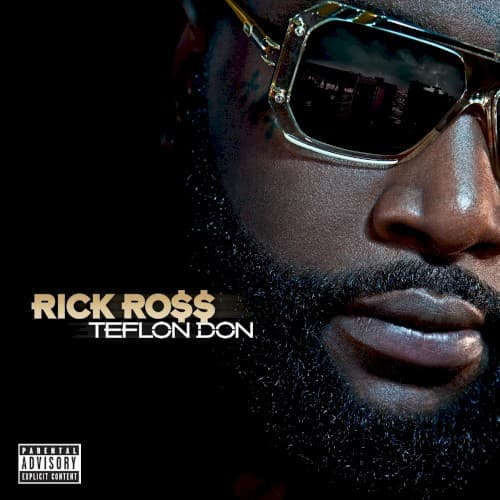
Rick Ross Teflon Don — The Album That Chose Escapism Over Apology
In July 2010, Rick Ross released Teflon Don six months after an Alabama show shooting and a year into constant credibility attacks over his correctional officer past. The move signaled a choice: rather than address the noise, he built an album that doubled down on the drug lord fantasy and made it sound as expensive as possible. The thesis of Teflon Don is that style can be substance if the style is immersive enough, and that a rapper with a rumbling voice and elite producers can will a fictional world into existence through sheer consistency of vision. Whether that world is worth visiting for an hour depends entirely on whether you want escapism or examination from your rap albums.
What makes the album work as a commercial and creative gamble is that Ross and his producers understood the assignment completely. This is Planet Boss rendered in high definition: J.U.S.T.I.C.E. League strings, No I.D. soul chops, Kanye West's lush arrangement on a six-minute posse cut, and Lex Luger's early trap minimalism all in service of a persona that never blinks or second-guesses itself. The guests are A-list, the beats are expensive, and the sequencing keeps the tone consistent even when the styles shift.
The cost of that consistency is depth. Ross rarely says anything on Teflon Don that he had not said on his previous three albums, and the few moments where a guest vocalist adds emotional texture only highlight how flat his own verses can be. The album is the sound of a rapper who learned that his greatest asset was not his pen but his ear for production and his ability to sound unbothered, and who decided to make that the whole product.
Beats Built to Sound Out of Reach
Teflon Don wins on production because every beat sounds like it cost more than the listener makes in a month, which is exactly the point. J.U.S.T.I.C.E. League builds orchestral soul on three tracks here, layering strings and piano over hard drums in a way that became the Maybach Music template. No I.D. flips a Willie Hutch sample on Tears of Joy into something sweeping and elegiac, giving Cee Lo Green room to sing the hook while Ross glides over the changes. Kanye West stretches Live Fast, Die Young to over six minutes with a beat that layers Caldera and James Brown into something that sounds like a slow-motion victory lap, and the length is earned because the production keeps shifting. The sound is deliberately maximal: not just expensive but audibly so, built to make the luxury boasts in the verses feel like the natural subject matter.
The surprise is Lex Luger, who produced MC Hammer and B.M.F. and brought the Brick Squad trap sound to a major-label rap album before it became ubiquitous. Those two tracks strip out the soul samples and orchestration and replace them with 808s, minimal synths, and drums that hit like car doors slamming. The contrast could have wrecked the album's flow, but instead it works as a gear shift: the Maybach Music tracks build a world, and the Lex Luger tracks remind you that the world has consequences. Ross sounds just as comfortable over both, which speaks to his adaptability as a voice even when his writing does not change much between them.
Clark Kent and Danja handle the radio attempts, and they are competent but not inspired. Super High has a slick Ne-Yo hook and a beat that samples Enchantment, and it sounds exactly like a 2010 crossover single should, which is both its strength and its ceiling. No. 1 with Diddy and Trey Songz is a club record with no personality. The weakest production on the album is the safest, which tracks with the broader truth that Teflon Don works best when it commits fully to either the visual luxury or the trap menace and fails when it tries to split the difference for radio.
Ross's writing is vivid in flashes and repetitive over the runtime. He knows how to set a scene, how to drop a punchline that lands on the beat, and how to make drug dealing sound like high finance. What he does not do here is expand the subject matter or add complexity to the persona. Every verse is about money, drugs, cars, or the combination of the three, and the imagery rarely gets more specific than brand names and dollar amounts. The best moments come when a guest adds a different tone: Jay-Z on Free Mason brings wit and wordplay, T.I. and Jadakiss trade tough verses on Maybach Music III, and Drake on Aston Martin Music brings melody and introspection that Ross himself never attempts. The guests consistently outwrite Ross on his own album, which becomes a problem when you realize the star is the least interesting rapper in the room on half the tracklist.
An Album of Peaks Without a Plan
Teflon Don works as a collection of strong individual tracks and struggles as a sequenced album. The run from the early stretch through the first third is the heart of the record: three long, soulful, carefully built songs that let Ross operate at the speed and scale he does best. That stretch gives the album its identity and its Metacritic score. The Lex Luger cuts show up in the back half and shift the tone completely, which could have worked as an intentional arc if the album committed to building toward them, but instead they feel like singles dropped into a tracklist.
The sequencing issue is that the album has no real peaks or valleys, just a series of well-produced songs at roughly the same energy level. The opener states intent but delivers no real hook or memorable moment. The biggest single is gorgeous but arrives after the trap pivot and feels like a tonal reset rather than a climax. The back stretch includes a smooth but forgettable collaboration and a bonus track that sounds like one. At 50 minutes the album avoids the bloat that sank other 2010 rap releases, but it never builds momentum because Ross and his team did not sequence for narrative or pacing. They sequenced for variety, which gives you strong songs in isolation and not much reason to play them in order.
The Album That Made the Case for Ross as a Curator
Teflon Don is Ross's best album because it is the one where he figured out that his job was not to be the best rapper in the booth but to assemble the best possible version of the world he was selling. The production is elite, the guests deliver, and Ross himself sounds completely confident in a persona that would have collapsed under scrutiny if he had let any doubt into his voice. It remains his most critically acclaimed release because critics in 2010 were ready to judge a luxury rap album on its own terms rather than demand authenticity, and because the producers he worked with were at the top of their games. The album has aged well as a mood piece and a document of a specific moment in rap before trap became the default, though the lack of lyrical depth makes it hard to return to front-to-back once the novelty of the sound wears off.
This is not the album to start with if you want to understand Ross as a writer or as a commercial force; for that you would need Deeper Than Rap or God Forgives, I Don't. Teflon Don is the album to play when you want 50 minutes of expensive-sounding beats and a voice that never wavers, even when the words do not add up to much. The best entry points are Tears of Joy for the No I.D. soul, Live Fast, Die Young for the Kanye posse cut, and B.M.F. for the Lex Luger trap blueprint.
Skip the radio singles unless you need something for a playlist. If you like this, try Clipse - Hell Hath No Fury for luxury rap with sharper writing, or Future - Pluto for where the Lex Luger sound went next. Teflon Don is not deep, but it is deliberate, and in 2010 that was enough to make it essential for anyone paying attention to where rap was headed.
Track Listing
I’m Not a Star
●Ross opens by rejecting celebrity for boss status over a J.U.S.T.I.C.E. League beat that is solid but not memorable. The hook is a statement of intent, the verses are standard Ross boasts about money and power, and the track works as an introduction but not as a song you would return to. It sets the tone without earning its place in the sequencing.
Free Mason
▲Jay-Z shows up and outclasses Ross on his own album, bringing wordplay and double meanings to Illuminati conspiracy imagery over a minimal Inkredibles beat. Jay's verse is the reason to play this: clever, loose, and more interesting than anything Ross says in response. John Legend adds atmosphere on the outro. Ross sounds competent but clearly in the presence of a better writer, and the beat does not give him anywhere to hide.
Tears of Joy
▲The album's emotional peak, built on a Willie Hutch sample and No I.D. production that gives the track sweep and weight. Cee Lo Green sings a hook about survival and loss, and Ross delivers one of his better performances here, sounding reflective without breaking character. The beat shifts and breathes, the six-minute runtime is earned, and the track works as the kind of cinematic statement the album was aiming for. This is Ross at his most effective: letting the production do the heavy lifting while he provides just enough specificity in the verses to make the mood land.
Maybach Music III
▲The franchise entry, with T.I., Jadakiss, and Erykah Badu over a lush J.U.S.T.I.C.E. League flip of a Caldera sample. All three guests outrap Ross: T.I. brings complexity, Jadakiss brings grit, and Badu's sung outro adds class. Ross himself is fine, but this is another track where the appeal is the guest verses and the orchestration, not the star. The beat is beautiful, the posse cut format works, and the sequencing puts it right after Tears of Joy to build the album's strongest run.
Live Fast, Die Young
▲Kanye West produces and appears on a six-minute track that samples three different records and never feels long because the beat keeps evolving. West's verse is strong, Ross sounds engaged, and the production is the kind of maximalist soul rap that Kanye was doing better than anyone in 2010. The track works as a statement piece and as the end of the album's soulful first half, and the length gives it weight that the shorter tracks lack. One of the album's clear highlights.
Super High
●The first single, a crossover attempt with Ne-Yo on the hook and a Clark Kent beat that samples Enchantment. It is smooth, professional, and forgettable: the kind of song designed to get radio play without offending anyone or saying anything. Ne-Yo does his job, Ross delivers standard luxury boasts, and the track disappears as soon as it ends. Not bad, just unnecessary.
No. 1
▼Diddy and Trey Songz show up for a club record over a Danja beat that sounds like every other 2010 club record. Ross is outshined again, this time by guests who are not even trying that hard, and the track has no personality beyond its function as filler between the more interesting songs. Skip this.
MC Hammer
▲The first Lex Luger production on the album, and the blueprint for the trap sound that would dominate the next decade. Gucci Mane delivers a memorable guest verse, the MC Hammer vocal sample on the hook is absurd and effective, and the 808s hit hard enough to justify the hype. Ross sounds comfortable over the minimalism, and the track works as both a moment and a pivot point in the album's sequencing. The contrast with the soul production earlier is stark, and Luger's stripped sound makes it clear why he became the most important producer of the early 2010s.
B.M.F. (Blowin’ Money Fast)
▲The second Lex Luger cut and the album's defining single, built on a menacing synth loop and drums that leave room for nothing but the hook and the verses. Styles P adds a tough verse, Ross delivers one of his most quotable performances, and the track became a signature song because it distills the whole Teflon Don persona into four minutes of blunt force. The hook is simple and effective, the beat is iconic, and the song works as both a club record and a mission statement. The highest point of the album's second half.
Aston Martin Music
▲Drake and Chrisette Michele turn a J.U.S.T.I.C.E. League beat into the album's most successful single, and Drake's melodic verse is the reason. Michele sings a lush hook, Ross delivers smooth verses about romance and luxury, and the track works as a late-album come-down after the Lex Luger aggression. The interpolation of LL Cool J's I Need Love is subtle, and the production is gorgeous. This became the biggest hit because it had crossover appeal without sounding like a crossover attempt, and because Drake in 2010 could make anything feel like an event. Ross is fine here, but again the guests are doing the work.
All the Money in the World
●Raphael Saadiq sings on a smooth Olympicks production, and the track is pleasant but slight. Ross delivers standard luxury raps, Saadiq adds soul to the hook, and nothing about the song sticks. It works as a palate cleanser but not as a statement, and it arrives too late in the album to build momentum. Competent filler.
Audio Meth
●A bonus track with Raekwon over a Runners beat that interpolates Shook Ones. Raekwon brings the New York grit, Ross holds his own, and the beat is hard enough to justify the inclusion. This works better than some of the album proper, but it is clearly a leftover and the sequencing treats it as such. Worth a listen for the Raekwon verse.