Scorecard: 8.7/10 · Essential
How we score- Writing(25%)
- 9.0
Specific imagery and narrative structure on "PROM / KING" demonstrate rare control of diaristic storytelling, though some tracks lean on simpler emotional statements.
- Production(25%)
- 8.5
Minimalist beats from daedaePIVOT, Daoud and Saba create deliberate space for the rapping, with textural choices that reinforce isolation and grief throughout.
- Delivery(15%)
- 8.0
Flow shifts from conversational to urgent across tracks, with cadence mirroring emotional states, though guest features are brief and functional rather than memorable.
- Cohesion(15%)
- 9.5
Ten tracks sequenced as a single arc from numbness through breakdown to tentative recovery, with no filler and careful pacing that earns the seven-minute centerpiece.
- Originality(10%)
- 8.0
Advances Chicago's introspective lineage with structural ambition and tonal restraint uncommon in 2018 rap, though the grief album framework itself was not new.
- Replay value(10%)
- 8.5
Emotional weight and structural detail reveal new layers on repeat listens; the album has aged as an essential Chicago document from the late 2010s.
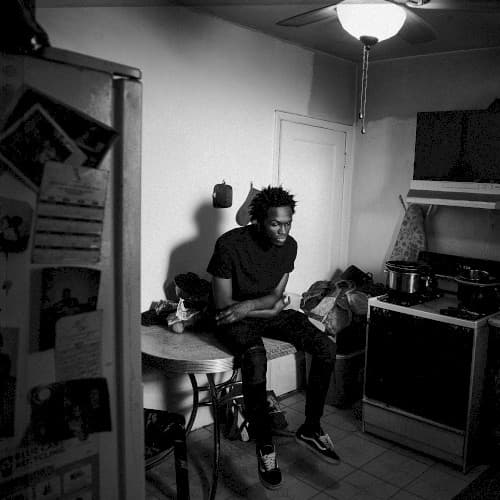
Saba CARE FOR ME — The Album That Refused to Look Away
Most grief albums in rap either numb the listener with rage or dissolve into abstraction. Saba's second studio album does neither. CARE FOR ME, released in April 2018, is built around the February 2017 stabbing death of his cousin and Pivot Gang member John Walt, but it refuses the comforts of both catharsis and distance. The thesis is in the structure: ten tracks sequenced as a single movement from dissociation through collapse to a recovery so fragile it barely qualifies as hope. The album opens with sirens and closes with a tentative affirmation, and every song in between tracks the specific mechanics of trying to function while grieving someone who shaped your daily life.
What makes the album worth the attention it received is not the subject but the formal control. Saba and his producers daedaePIVOT and Daoud build beats that leave room for silence, and Saba uses that space to slow down and speed up his delivery in ways that mirror dissociation and panic. The seven-minute "PROM / KING" was written as the outro, a blind-date story that ends with Walt's murder, but Saba moved it to track nine because he understood that ending there would be manipulative. The final track, "HEAVEN ALL AROUND ME", is the album's most optimistic moment, but it is optimistic in the way of someone who has just realized he might survive the week. The claim here is that CARE FOR ME is Saba's best album because it is the one where the writing, the sequencing and the tonal discipline are all in service of a single idea, executed with no wasted motion.
The Sound of Trying Not to Break
The production across CARE FOR ME is minimal in a way that forces the writing to carry the weight. daedaePIVOT, Daoud and Saba built beats from sparse drums, single-note bass lines and samples chopped into fragments, leaving negative space where most 2018 rap records would add layers. "BUSY / SIRENS" opens with a distant vocal loop and a kick drum that drops out for bars at a time, creating a rhythm that feels like walking through a city while dissociated. "LIFE" is two minutes and forty-two seconds of nearly a cappella rapping over a skeletal piano loop, with no hook and no dynamic shift, which makes the song feel like an unedited thought. The minimalism is not an aesthetic choice for its own sake; it is the sound of someone too exhausted to decorate.
Saba's writing on the album is built around concrete images rather than declarations. On "BROKEN GIRLS" he describes women who remind him of his own fractures, using physical details and small behaviors instead of emotional summaries. "CALLIGRAPHY" is about the gap between the version of himself he performs and the one who cannot get out of bed, and the verse moves between those two perspectives without announcing the shifts. The weakest writing is on "SMILE", where the hook leans on a simple "smile for me" refrain that does less work than the verses around it, and the emotional payoff is stated rather than earned. "LOGOUT" with Chance the Rapper is the album's most straightforward track, a two-and-a-half-minute reflection on social media and mental health that functions as a breather in the sequence but does not add much beyond its premise.
Saba's delivery across the album mirrors the emotional states he is describing. On "GREY" he raps in a conversational tone that suddenly tightens into rapid-fire triplets when the verse turns to panic, and the flow shift does more to convey anxiety than the words themselves. On "FIGHTER" with Kaina, his cadence is slow and deliberate, matching the exhaustion in the lyric. The guest appearances from theMIND, Kaina and Chance are brief and functional, serving the album's tone rather than offering contrast. The album is produced, rapped and sequenced to feel like a single thought rather than a collection of songs, and that cohesion is its primary formal achievement.
The Album as a Single Descent and Climb
CARE FOR ME is sequenced as a deliberate arc, and the pacing is careful enough that the ten-track, forty-one-minute runtime feels earned. The first stretch moves from numb busyness to fractured relationships to a blunt two-minute statement that lands like the moment when avoidance stops working. The middle section is the album's flattest stretch, not in quality but in emotional register: these are the songs about trying to keep moving, and they are intentionally repetitive in tone. The back half includes the first track where the numbness cracks into something sharper, and the album uses it as a pivot into the climax.
The structural and emotional center is a seven-and-a-half-minute narrative that moves from a high school memory to Walt's murder in a single unbroken flow. The first half is a lighthearted story about a blind date Walt set up to save Saba from showing up to prom alone, and the second half turns without warning into the night Walt was killed. The track was originally written as the album closer, but Saba moved it to track nine because he understood that ending there would leave the listener with no exit. HEAVEN ALL AROUND ME follows as the only moment of tentative recovery, a short reflection on survival that does not promise resolution but acknowledges the possibility of it. The sequencing is the album's smartest formal choice: it builds to the breakdown and then steps back just enough to let the listener breathe.
Where It Lands in the Catalog and Who Should Start Here
CARE FOR ME is Saba's best album because it is the one where every element is disciplined in service of a single idea. Few Good Things, released in 2022, is a broader and more musically varied record, but it does not have the tonal control or the structural ambition of this one. CARE FOR ME ranks among the best Chicago rap albums of the late 2010s, alongside Noname's Room 25 and Mick Jenkins' Pieces of a Man, and it is the clearest example of the city's introspective lineage in that moment. The album is not for someone looking for bangers or variety; it is a grief album that stays in grief for most of its runtime, and the only levity comes in brief memories before they turn dark.
Who should start here: anyone interested in narrative rap, Chicago's 2010s scene, or albums that use structure as an argument. Who should skip it: anyone not prepared for forty minutes of unrelieved emotional weight. Start with "BUSY / SIRENS" to hear the album's tonal blueprint, "LIFE" for the writing at its most stripped down, and "PROM / KING" for the centerpiece that justifies the album's reputation. After this, hear Noname's Room 25 for another Chicago album from the same year that approaches introspection from a different angle, or go back to Saba's Bucket List Project to hear where the writing started before this level of focus. CARE FOR ME is the album where Saba stopped trying to do everything and did one thing completely.
Track Listing
BUSY / SIRENS
●The album opens with a distant vocal sample and scattered drums that drop out for bars at a time, creating a rhythm that mirrors dissociation. Saba raps about staying busy as a deflection, moving through obligations while disconnected from them, and theMIND's feature adds a melodic anchor without shifting the tone. The sirens in the title are literal and symbolic, present in the mix and in the lyric as a constant background hum. The track sets the album's sonic template: minimal beats that leave room for silence, and writing that describes numbness without trying to escape it. The sequencing choice to open here is deliberate, establishing the emotional baseline before the album begins to crack it.
BROKEN GIRLS
●Saba describes relationships with women who remind him of his own fractures, using physical details and small behaviors rather than emotional summaries. The production is a slow loop with almost no percussion, which forces the verse to carry the track. The writing is specific enough to avoid the generic "damaged people" framework: he names the ways these relationships fail without blaming anyone. The hook is functional but thin, repeating the title phrase without adding much to the verse. It is a solid track that establishes the album's focus on interpersonal damage as a mirror for internal damage, but it does not reach the level of the album's best writing.
LIFE
▲Two minutes and forty-two seconds of nearly a cappella rapping over a skeletal piano loop, with no hook and no dynamic shift. Saba uses the space to deliver a verse that feels like an unedited thought, naming the gap between the public performance of being fine and the private reality of barely functioning. The lack of production ornamentation is the point: this is the album's bluntest statement, the moment when the numbness gives way to a clear-eyed catalog of what is broken. The brevity is a strength; the track says what it needs to say and ends before it turns into catharsis. It is one of the album's most effective pieces of writing, precisely because it refuses to do anything but describe.
CALLIGRAPHY
●The track is about the gap between the version of himself Saba performs in public and the one who cannot get out of bed, and the verse moves between those two perspectives without announcing the shifts. The production is slightly more textured than the previous tracks, with a looped sample and a crisp snare, but it still leaves most of the space empty. The writing is sharp on the details of code-switching and masking, but the hook does not land with much force. It is a necessary piece of the album's argument about performance and collapse, but it is not one of the standout tracks.
FIGHTER
●Kaina's feature on the hook provides the album's first moment of overt melody, and the track is built around the tension between fighting to survive and the exhaustion of that fight. Saba's verse is slow and deliberate, with a cadence that matches the fatigue in the lyric. The production is warmer than the previous tracks, with a muted horn sample and a steady kick, but it still maintains the album's minimal approach. The writing is straightforward, describing the daily effort of staying functional without dramatizing it. It is a solid track that earns its place in the sequence, providing a slight tonal shift without breaking the album's overall mood.
SMILE
▼The weakest track on the album, built around a simple hook that repeats "smile for me" without adding much to the verses around it. The production is spare, with a looped vocal and minimal drums, and Saba's verse is about the pressure to perform happiness while grieving. The writing is competent but the emotional payoff is stated rather than earned, and the hook leans on repetition instead of development. It is not filler in the sense of being irrelevant to the album's arc, but it is the one track where the execution does not match the ambition.
LOGOUT
●Chance the Rapper appears for a two-and-a-half-minute reflection on social media and mental health, and the track is the album's most straightforward moment. The production is slightly brighter than the surrounding tracks, with a cleaner mix and a more conventional structure. Saba and Chance trade verses about the need to disconnect, and both verses are clear and direct without much formal ambition. The track functions as a breather in the sequence, a lighter moment before the album pivots into its darkest section, but it does not add much beyond its premise. It is competent and listenable, but it is the one track that could have been cut without damaging the album's arc.
GREY
▲The first track where the numbness cracks into something sharper. Saba raps in a conversational tone that suddenly tightens into rapid-fire triplets when the verse turns to panic, and the flow shift does more to convey anxiety than the words themselves. The production is built around a muted bass line and scattered hi-hats, with no melodic elements to soften the tension. The writing is about the specific mechanics of a panic attack, described without metaphor or decoration. The track is the pivot point in the album's sequence, the moment when the controlled numbness of the first half gives way to the breakdown of the second. It is one of the album's most effective pieces of delivery, using rhythm and cadence to mirror the emotional state being described.
PROM / KING
▲The album's centerpiece and its most ambitious piece of writing. The first half is a lighthearted story about a blind date Walt set up to save Saba from showing up to prom alone, told with specific details and a playful tone. The second half turns without warning into the night Walt was killed, and the tonal shift is abrupt enough to feel like the emotional rupture it describes. Saba raps the entire seven-and-a-half-minute narrative in a single flow, with no hook and no structural breaks, which gives the track the feeling of an unedited memory. The writing is specific enough to avoid sentimentality: he names the restaurant where they ate, the car they drove, the moment when the date's brother arrived with a knife. The production is minimal, a looped piano and a kick drum, which forces the narrative to carry the entire track. The final verse describes Walt's murder in plain language, and the track ends with uncredited vocals from Walt himself, a recording that lands like a gut punch. It was originally written as the album closer, but Saba moved it to track nine because he understood that ending there would be manipulative. The decision to follow it with a moment of tentative recovery is the album's smartest formal choice. This is the track that justifies the album's reputation, a piece of narrative rap that earns its length and its emotional weight through structural discipline and refusal to decorate.
HEAVEN ALL AROUND ME
▲The album's only moment of tentative recovery, a short reflection on survival that does not promise resolution but acknowledges the possibility of it. The production is the warmest on the album, with a gentle piano loop and no drums, and Saba's delivery is quiet and measured. The writing is about noticing small moments of beauty while grieving, described without overselling the optimism. It is a necessary counterweight to "PROM / KING", providing just enough of an exit to make the album feel complete rather than unresolved. The track is optimistic in the way of someone who has just realized he might survive the week, and that restraint is what makes it work. It is not a triumphant closer, but it is the right closer for this album.