The scorecard
7.0/10 · Good
- Writing25%
- 6.5
- Production25%
- 8.0
- Delivery15%
- 7.5
- Cohesion15%
- 6.0
- Originality10%
- 6.5
- Replay value10%
- 7.0
The seduction and status songs, such as Wasn’t Your Fault and You Got What I Want, circle familiar subjects, while the diss on Pimp Slapp’d shows the sharper writer when he has a target.
The Neptunes singles, the Just Blaze and DJ Premier cuts and the Fredwreck and Battlecat grooves each deliver a distinct sound, with Lollipop and Batman & Robin as high points.
Snoop slides from the Neptunes' spare funk to DJ Premier's hard drums without strain, and he sings and harmonizes comfortably on the hooks.
Twenty tracks including a skit, a message track and an intro, with the middle third blurring into a run of similar mid-tempo songs, though the front-loaded opening run and late recovery create a few clusters of excellence that work as an album.
The pairing with the Neptunes and the East Coast producers gave a West Coast veteran a new pop-rap shape that his catalog had not yet tried, though the compromise between gangsta credibility and radio-ready accessibility is more effective than it is groundbreaking.
The singles and the hardest guest cuts still sound fresh, but the filler middle makes front-to-back plays less appealing.
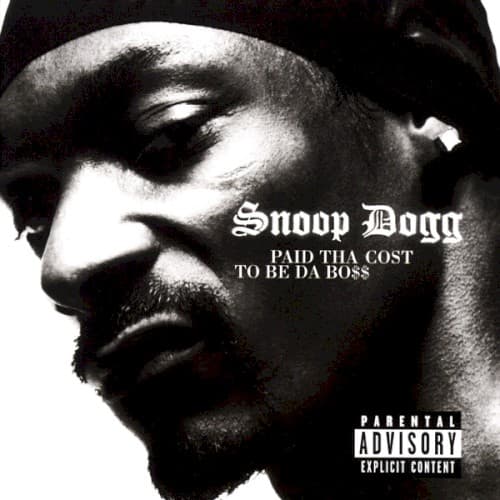
Snoop Dogg Paid tha Cost to Be da Bo$$: The Reset That Hired Everyone
Paid tha Cost to Be da Bo$$ is the sound of a West Coast rapper walking out of a bad contract and discovering that his voice works on any beat you hand him. After his run on No Limit, Snoop Dogg needed a reset, and the record answers by hiring everyone: The Neptunes, Hi-Tek, Just Blaze, DJ Premier, Fredwreck, DJ Battlecat and a handful of Long Beach regulars. The result is not a Long Beach album in the strict G-funk sense. It is a stylish, crowded, frequently very good pop-rap record with a gangsta accent, and its best moments come from the places where the accent and the pop sheen agree.
That is the thesis: the album works because Snoop's delivery is flexible enough to bridge the gap between the Neptunes' angular, minimalist funk and the older Los Angeles groove he helped invent, and it falters when the guest-and-producer carousel overrides any sense of an album. The strongest songs are the ones where one producer's idea is fully committed to, and where Snoop sounds relaxed rather than rushed. The weaker ones are stretches of competent mid-tempo R&B, filler skits and sequencing that spends its energy early.
The stakes were real. The Doggystyle era was a decade behind him, the No Limit years had blurred his identity, and the market for a solo gangsta rap veteran was narrower than the market for a pop crossover. The album debuted at number 12 on the Billboard 200 with 174,000 copies sold in its first week and went platinum, which is a comfortable result rather than a triumph. What it earns, more than sales, is a creative second act: for the first time in years Snoop sounds like he is choosing his surroundings, and the choice of Pharrell and the Neptunes would shape the next phase of his career.
Three Producer Camps, One Easygoing Voice
The production is split into three camps, and the album's quality tracks closely with which camp is in charge. The Neptunes supply the two singles, built on sparse, bouncing percussion and electronic color, and they put Snoop in a clean, open space where his voice carries the whole song. Hi-Tek, Just Blaze and DJ Premier bring a harder, sample-based approach that gives the album its East Coast backbone, and the sample sources, from Eric B. & Rakim to Parliament and the Sugarhill Gang, show an album in conversation with hip-hop's whole history. The Long Beach contingent, Fredwreck, Jelly Roll, DJ Battlecat and Leimberg, supplies the traditional bounce. Each camp is good on its own terms, and the sound that results is varied rather than unified.
Snoop's delivery is the thread that holds the pieces together. He raps with the loose, behind-the-beat cadence that has always been his trademark, but on this record he is also willing to sing, to harmonize and to ease into a hook without strain. That flexibility is why the Neptunes tracks work: a stricter rapper would have fought the spare production, whereas Snoop slides into it. His interplay with Nate Dogg, Kokane and Goldie Loc on the more traditional tracks is just as natural, and the guest list is handled with taste. Jay-Z, Ludacris, Redman and Warren G each appear for a reason, not for a marketing line.
The writing is competent and sometimes sharp but rarely ambitious. The album's most common subjects are women, money and status, and the lyrics circle them with charm rather than depth. There are exceptions: the diss record that closes the album has real venom, and the DJ Premier songs push him toward tighter, more focused verses. But the album's central weakness is that too much of its running time is spent on interchangeable seduction songs, and several of them feel like the same mid-tempo idea with different guests. Snoop's charisma carries them, but charisma is not a substitute for a new angle.
A second weakness is the length. Twenty tracks, including a brief intro, a spoken skit and a message track, make this a long album, and its second half is less disciplined than its first. The better ideas are concentrated in the opening and in a few late high points, and the rest is a solid but unsurprising sequence of club and bedroom songs. A tighter selection would have made the strengths harder to ignore and the weaknesses easier to forgive.
Front-Loaded Ideas and a Twenty-Track Sprawl
The sequencing front-loads the album's biggest ideas and then spreads them thin. The opening run is the best part of the record: a short spoken intro hands off to a quick, funky setup track, and then the album moves into a stretch of ambitious, differently flavored songs that show how much range the new team provides. It feels purposeful, like a statement about who Snoop is now and who he intends to work with.
The middle third is where momentum slows. Several songs in a row use similar tempos, similar vocal arrangements and similar subject matter, and the energy of the opening gives way to a comfortable, even-keeled run that is pleasant without being memorable. Songs that would stand out in isolation blur together when played in order, and the length begins to show. This is the stretch where the album most needs a hard cut or a change of pace, and it does not get one.
The late section recovers with a block of harder-edged songs. A trio of tracks built on DJ Premier and Fredwreck production restores a sense of grit, and the guest verses become more competitive, which seems to sharpen Snoop's own performances. The final run is the album at its most Los Angeles-minded, and the closer is a pointed, antagonistic finish that gives the record a sting it otherwise lacks.
Whether the length is earned depends on the listener. As a collection of strong singles and good deep cuts, it is generous. As a front-to-back album, it would be better at fourteen songs than at twenty. The best way to hear it is to treat the sequence as a playlist with a few clusters of excellence: the opening three or four songs, the late DJ Premier pairing, and the finale. Everything else is a pleasant way to spend a Saturday afternoon, but it does not demand the same attention, and the album does not argue otherwise.
Snoop Learns to Be a Pop-Rap Star Without Losing the Gangsta
Paid tha Cost to Be da Bo$$ sits well below Doggystyle and well above BODR. It does not have the debut's menace, the production unity of Dr. Dre's work or the sense of a new sound arriving, but it does have something the later, more erratic records lack: a clear point of view. This is the album where Snoop figured out how to be a pop-rap star without losing his gangsta credibility, and the best songs prove that the compromise worked. Compared with BODR, which sounds uncertain about what it is, this is a confident record by someone who knew what he was doing.
It is for listeners who like Snoop at his most accessible and who enjoy the Neptunes' minimalist funk. If you want a record that bridges Los Angeles rap and radio-ready pop, with strong guests and a handful of true standouts, this is a good place to start after the debut. It is also useful for anyone interested in how veteran West Coast rappers adapted to the new millennium. Listeners who want a unified G-funk album, deep lyrical content or a tight running time should skip it or program a short playlist.
It has aged better than many records from the same period. The Neptunes singles still sound clean and distinctive, the DJ Premier songs are timeless, and the guest list reads like a snapshot of a particular moment in rap. The weaker tracks, the generic seduction songs and the skits, have not improved, but they never dominated the album's reputation either.
Start with From tha Chuuuch to da Palace for the Neptunes at their most stripped-down, Lollipop for the guest chemistry and Batman & Robin for the DJ Premier edge. For a next step, go back to Doggystyle for the full strength of what he was doing at his peak, or try R&G (Rhythm & Gangsta) for the further development of the Neptunes relationship. The album's real achievement is that, after years of uncertainty, Snoop sounds relaxed again, and that ease is its best quality.
Track by track
Track Listing
Don Doggy
SolidA forty-second spoken intro that sets the tone. Filler by design, but short enough not to matter.
Da Bo$$ Would Like to See You
StandoutE-Swift's production samples Diana Ross and runs just under two minutes. It works as a quick, funky setup that gets the album moving without wasting time, and Snoop's relaxed delivery establishes the mood immediately.
Stoplight
SolidA Jelly Roll production built on a Parliament sample and running over four minutes. The groove is classic funk, and Snoop rides it comfortably, but the song has no hook sharp enough to justify its length. A decent mid-album cut that does not stand out.
From tha Chuuuch to da Palace
StandoutThe lead single, produced by The Neptunes with Pharrell, builds on a sample of Malcolm McLaren's Buffalo Gals. The beat is spare and percussive, leaving enormous space for Snoop's voice, and the contrast between its modern minimalism and his old-school drawl is the album's core idea in miniature. Pharrell's falsetto on the hook adds a pop shine without overwhelming the rap. It is a crisp, well-judged single that shows the new partnership working at full strength. Even on a record that sprawls, this is the song that best explains the sound he was moving toward.
I Believe in You
SolidHi-Tek produces this one, with LaToiya Williams on the hook. It is a soulful, sincere mid-tempo song that gives the album some warmth, but it is also a little sleepy, and the vocals do more work than the verses.
Lollipop
StandoutJust Blaze produces and Jay-Z, Nate Dogg and Soopafly join the host. It is the album's strongest guest song: the beat is big and bright, Nate Dogg supplies the melodic hook, and Jay-Z raises the rapping standard. Snoop's verse is relaxed and playful, a good foil for the harder-edged guest. It balances club appeal with real rapping, and it is one of the places where the ambitious casting pays off completely. Short enough to avoid overstaying, it is a highlight and a strong second entry point for new listeners.
Ballin’
StandoutDJ Battlecat's production samples The Dramatics, who also appear, with Lil' ½ Dead. At over five minutes it is a smooth, soulful Long Beach groove with real warmth. The vocals add texture, and the pace is unhurried. A little long, but pleasant and true to the West Coast tradition.
Beautiful
StandoutThe second single, again from The Neptunes, with Pharrell and Charlie Wilson. It is a breezy, melodic song that leans toward R&B, and Wilson's voice gives it the warmth that makes it work. Snoop's verses are charming rather than deep, but the song's appeal is its mood, and the arrangement is well judged. Pharrell's own later comments admitted he did not expect a hit, and that modest self-assessment fits a song that succeeds through ease rather than force. It is a pop-rap single done well and it has outlasted a lot of its contemporaries.
Paper’d Up
StandoutFredwreck produces, with Kokane and Traci Nelson, over samples of Eric B. & Rakim and Dennis Edwards. The Rakim reference is a respectful nod across coasts, and the beat has a lean, hard-edged bounce. A good, focused cut that keeps the album in a gangsta register without drifting into pastiche.
Wasn’t Your Fault
SolidL.T. Hutton's production samples Cherrelle. It is a smooth, romantic mid-tempo song that feels generic next to the stronger tracks around it. Nothing wrong with it, but nothing to remember either.
Bo$$ Playa
SolidFredwreck again, this time on a five-and-a-half-minute track built on a Faze-O sample. The groove is rich, but the length is excessive, and the lyrics circle familiar territory of status and swagger. Pleasant background, but the song would be better if trimmed.
Hourglass
SolidJelly Roll produces, with Kokane and Goldie Loc, over a Cameo sample. The Long Beach crew chemistry is evident and the groove is easy, but the song is more atmosphere than substance. Solid, unremarkable.
The One and Only
StandoutDJ Premier's solo production, with a Tyrone Davis sample. Premier's chopped, hard-edged drums give Snoop a firm frame, and the host responds with a tighter, more focused verse than on most of the surrounding songs. It is an unusual pairing, East Coast boom bap meeting West Coast drawl, and it works because neither side compromises. A strong deep cut and one of the best uses of a guest producer on the record.
I Miss That Bitch
SolidHi-Tek produces, with E-White, over a Jerry Butler sample. A short, soulful track at just over three minutes that keeps the album's R&B thread going. Competent but forgettable.
From Long Beach 2 Brick City
StandoutA Fredwreck production built on a sample of Wikka Wrap, with Redman, Nate Dogg and Warren G. The coast-to-coast premise is the hook, and the chemistry among the guests is real: Redman's frenetic energy contrasts with Snoop's calm, while Nate Dogg and Warren G bring the G-funk lineage. It is a posse cut with a clear idea and a bouncy beat, and it is among the album's most fun songs. At under four minutes it moves quickly and gets out in time.
Suited ’n’ Booted
SolidA short, uncredited-producer cut with no guests. It is a quick interlude-length song that adds little to the sequence.
You Got What I Want
SolidJelly Roll produces, with Goldie Loc, Ludacris and Charlie Wilson. A seduction song with a polished hook, and it is competent. It sounds like one of several interchangeable songs in the late-middle of the record.
Batman & Robin
StandoutDJ Premier's second production, with The Lady of Rage and RBX, sampling a television theme. This is the album's hardest-hitting cut: the drums are heavy, the guests are sharp, and the old-school Death Row lineage is audible. Snoop sounds energized by the company, and the three-way chemistry gives the song a competitive edge that the album otherwise rarely has. At five minutes it earns its length. A highlight, and a fine reminder of how good he sounds when pushed.
A Message 2 Fat Cuzz
SolidA short spoken message track. Skit, and it adds nothing musically.
Pimp Slapp’d
StandoutLeimberg produces this closing diss aimed at Suge Knight, built on samples of the Sugarhill Gang, DJ Quik, Parliament and Jay-Z. It is the album's most pointed song, with a bitterness and focus that the rest of the record lacks, and its use of classic samples gives it a sense of occasion. It also became the subject of a lawsuit over a phone message included in the track, which the court dismissed in 2004. Musically it is a sharp, confrontational ending that gives the record a final jolt.