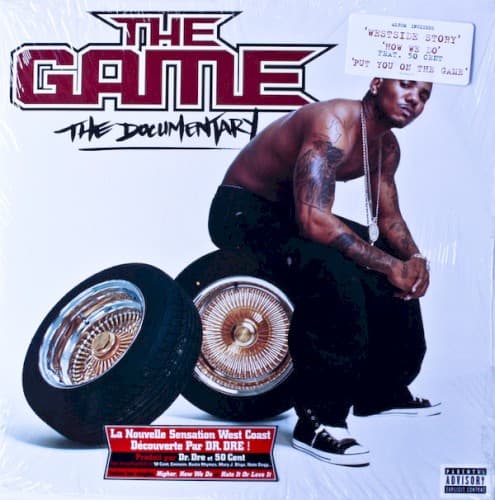
The Game The Documentary — The Last Time Dre Made Someone a Star
Dre had not picked a winner in years. By 2005 Aftermath was a graveyard of shelved projects and missed bets. Then here came this Compton kid covered in butterfly tattoos, rapping over soul samples like he was auditioning for a role that no longer existed. West Coast rap was supposed to be dead.
The radio belonged to the South. New York was eating itself. And The Documentary arrived like someone forgot to tell The Game the war was over.
This album carries the weight of a rescue mission. Dre needed proof he could still build a career from scratch. 50 Cent needed a little brother who could hold down California while G-Unit ran the East. Interscope needed a West Coast flagship that could move units without sounding like a nostalgia act.
The Game needed all of them, and he knew it. You can hear the hunger in every bar — the desperation of a 25-year-old who spent his entire twenties watching everyone else blow up while he was shot, dropped, and overlooked. What makes The Documentary work is how shamelessly it wears its influences. Could anyone else pull off name-checking Pac and Big in the same breath without sounding desperate?
The Game does not pretend to be inventing anything. He jacks flows from Jay-Z and cadences from 50. He lets Dre and Kanye and Just Blaze build the entire sonic foundation while he plays the role of California ambassador. It should feel derivative.
Instead it feels like a celebration — the sound of someone who loves rap so much he refuses to let the West Coast fade without a fight.
Soul Samples and Aftermath Polish
The production on The Documentary is a master class in expensive simplicity. Dre anchors the sound with the same formula that made 2001 a classic: heavy drums, clean bass, soul loops chopped just enough to feel widescreen without losing their warmth. Just Blaze brings his Broadway drama. Kanye West shows up with chipmunk vocals before Graduation made that sound exhausting.
Cool & Dre, Hi-Tek, and Timbaland round out the roster, and somehow none of it sounds cluttered. Every beat has space. Every sample breathes.
The Game's strength is his ear for melody. He rides these loops like someone who grew up on Doggystyle and Doggfather, letting the production do half the storytelling while he fills in the details. His voice has that Compton rasp — not quite Eazy, not quite Snoop, somewhere in between — and he uses it to anchor verses that move between street memoir and rap nerd reverence.
When he starts listing names it should feel corny. Instead it feels like respect. He is not trying to be Tupac. He is trying to remind you why Tupac mattered.
Lyrically this album lives in the past tense. The Game is always looking back — at his childhood, at the shooting that almost killed him, at the rappers who shaped him, at the Compton that raised him. It works because the nostalgia feels earned. He is not romanticizing gang life.
He is explaining how it shaped him, how it trapped people he loved, how it nearly ended him. The vulnerability cuts through the bravado. You believe him when he says he almost did not make it.
But the album is not perfect. The back half sags under the weight of too many ideas. Some tracks feel like label concessions — songs designed to chase radio play or satisfy Interscope's pop ambitions. Does The Documentary work best when it stays rooted in California, when it sounds like a Compton kid trying to prove he belongs in the same conversation as the legends?
When it wanders too far from that mission, it loses focus.
From Crenshaw to the Credits
The Documentary moves like a California freeway — smooth in the fast stretches, congested when it tries to do too much. The opening run establishes the album's thesis: this is a West Coast record built by East Coast architects, and the contradiction is the whole point. The first three tracks set the stakes, introduce the sound, and establish The Game as both student and ambassador. You know exactly what kind of album this is going to be before the fourth track drops.
The middle section is where the album peaks. This is the commercial heart of the project, the stretch designed to dominate radio and remind casual listeners that West Coast rap still had juice. The sequencing here is calculated — hit, then breather, then another hit. The momentum never stalls because the production never lets up.
Even the slower moments feel urgent.
The back half is where things get messier. The album starts chasing too many sounds at once, trying to satisfy too many audiences. Some tracks feel like afterthoughts, songs that landed on the final tracklist because the label wanted more options for singles. The pacing slows.
The focus blurs. By the time the album closes, you have heard enough. The Documentary is at its best when it stays lean and California-focused. When it tries to be everything to everyone, it loses the intensity that makes the first half so gripping.
The Last Great Aftermath Debut
The Documentary is the third-best album in The Game's catalog, behind only the sequel and his later conceptual work. It is also the last time Dre built a debut album this cohesive, this expensive, this committed to making someone a star. Nothing he touched after this carried the same weight. For fans who came up during the G-Unit era, this album is the bridge between two coasts, the moment when West Coast rap got a second life it did not deserve but absolutely earned.
New listeners should start here if they want to understand mid-2000s rap politics. This album captures the exact moment when 50 Cent's empire was at its peak, when Aftermath was still a hit factory, when West Coast rap needed a savior and got one with a butterfly tattoo and a memory like a rap encyclopedia. It has aged remarkably well — better than most albums from that era, better than anything else The Game released in the next five years.
The influence is subtle but real. The Documentary proved you could build a West Coast album on East Coast production and make it work. It showed that reverence for the past could coexist with commercial ambition. It reminded the industry that California still had stories worth telling, even if the storytellers needed a little help from New York.
Essential tracks: Hate It or Love It remains the gold standard. Dreams is the blueprint for every confessional California street record that followed. Similar albums: 50 Cent Get Rich or Die Tryin, Jay-Z The Blueprint, Nas Stillmatic. Long-term influence: every West Coast rapper who name-checked legends in their verses owes this album a royalty check.
This is the sound of someone who loved hip-hop so much he refused to let it forget about California.
Track Listing
Intro
▲Dre and The Game set the table with a minute of scene-setting and mission statement. The voiceover lays out the stakes without overexplaining. Short, functional, necessary.
Westside Story
▲Dre hands The Game a menacing piano loop and drums that sound like they were mixed for a car system. The Game responds with a Compton geography lesson, naming blocks and intersections like he is proving he actually lived there. The aggression is real but controlled. He is not trying to be the hardest rapper alive. He is trying to be the most Compton. The hook is serviceable, nothing special, but the verses carry enough weight to make it work. This is the sound of someone announcing himself without apology.
Dreams
▲Kanye flips a Faith Evans sample into something that feels like a confession booth. The Game uses the space to process trauma, recount the shooting that almost killed him, and explain how close he came to never making it. The vulnerability here is what separates this album from standard gangsta rap. He is not glorifying the violence. He is surviving it. The production floats, the drums knock just hard enough to keep it from feeling soft, and The Game rides the beat like someone who knows this might be his only chance to tell this story. One of the best songs he ever recorded.
Hate It or Love It
▲50 Cent and The Game trade verses over a pitched-up soul loop that sounds like childhood and regret at the same time. This is the album's emotional centerpiece, the song that proved The Game could write beyond gang politics and make something universal. 50's verse is cold and distant. The Game's is warm and specific. The contrast makes the song work. Every line feels like a memory you can see — the Reebok box with no Reeboks inside, the hunger that never left even after the checks cleared. The hook is perfect. The beat is perfect. This song aged better than anything else from 2005.
Higher
▲Just Blaze brings the drama with a gospel loop and drums that hit like a sermon. The Game and Nate Dogg tag-team the hook while the verses push back against the street life the rest of the album glorifies. The contradiction is the point. The Game is stuck between two worlds — the Compton that made him and the industry that wants to sell him. Just Blaze's production is overwhelming in the best way, all horns and soul and bass. The Game sounds small on it, and that vulnerability makes the song land harder.
How We Do
▲Dre strips the production down to drums, bass, and a whistle that sounds like it came from a 1970s cop show. 50 Cent shows up for the hook and immediately makes the song his. The Game does his job — he rides the beat, he delivers quotable lines, he plays the role of California representative — but this song belongs to Dre and 50. The minimalism is the flex. The beat has no melody, no sample, no decoration. Just rhythm and attitude. It worked on the radio. It still works in the car. Pure California energy.
Don't Need Your Love
●Faith Evans sings the hook while The Game works through a breakup that feels more like a business transaction than a relationship. The production is smooth, maybe too smooth, and the song never finds a compelling reason to exist. This is the first moment where the album loses momentum. The verses are fine. The beat is fine. Everything is fine. But fine is not enough when the previous six tracks set the bar this high. Skippable.
Church for Thugs
▲Kanye returns with another soul sample and The Game delivers a sermon about redemption and guilt. The production is gorgeous — layered vocals, warm bass, drums that knock without overpowering the melody. The Game is at his best when he is wrestling with contradictions, and this song gives him space to do that. He knows he is not a good person. He knows the streets do not lead anywhere worth going. But he also knows he cannot leave. The honesty cuts through the bravado.
Put You on the Game
●Timbaland produces, which means the beat sounds nothing like the rest of the album. The drums are mechanical. The melody is sparse. The Game adjusts his flow to match the production, and the result is one of the album's most aggressive moments. He is not storytelling here. He is threatening. The song works as a palate cleanser, a reminder that The Game can do more than soul samples and nostalgia. But it also feels out of place, like it belongs on a different project.
Start From Scratch
▲The Game recruits Marsha Ambrosius for a slow-burning narrative about a kid who tries to escape the streets and fails. The production is cinematic, all strings and piano and space. The Game tells the story in second person, which gives it distance and weight. This is the kind of song that proves he can write beyond his own experience, that he understands how to build a narrative with stakes and consequences. The ending is bleak. The production never lets up. One of the album's most underrated moments.
The Documentary
●The title track arrives late, and it feels like a thesis statement that should have come earlier. The Game reflects on the album itself, on the process of making it, on what it means to finally arrive after years of waiting. The production is understated, letting the lyrics do the work. The verses are solid but not revelatory. This song works better as a concept than as an actual track. It is the kind of moment that makes more sense on paper than in the sequencing.
Runnin'
●Tony Yayo shows up for a posse cut that never quite finds its groove. The production is fine. The verses are fine. Everything is fine. But the energy is flat compared to the first half of the album. This is the stretch where the Documentary starts to feel overstuffed, like the label wanted more songs and the creative team ran out of ideas. Not bad, just unnecessary.
No More Fun and Games
▲The Game returns to the Compton street narratives that made the first half of the album work. The production is dark and minimal, just bass and drums and a melody that sounds like a horror movie. The verses are sharp, focused, and aggressive. This song feels like a course correction after a few tracks that wandered too far from the album's core identity. The Game is at his best when he is rapping about survival, and this song gives him the space to do that without distraction.
We Ain't
●Eminem shows up for a posse cut that tries to recapture the magic of Hate It or Love It and falls short. The production is solid but unremarkable. The verses are competent but not memorable. Eminem phones it in. The Game does his job. The song exists, serves its purpose, and then disappears. This is what happens when you build an album around too many features and too many producers. Some songs just become filler.
Where I'm From
●Nate Dogg returns for a California anthem that feels like a victory lap. The production is warm and nostalgic, all soul loops and clean drums. The Game delivers a love letter to Compton, naming streets and people and moments that shaped him. This is the kind of song that works if you are from California and feels redundant if you are not. The hook is strong. The verses are solid. But the album has already said everything this song is trying to say.
Special
▼The Game recruits Pusha T for a song about women that sounds like every other mid-2000s rap song about women. The production is bland. The hook is forgettable. The verses are serviceable. This is the kind of song that makes you wonder why it made the final cut. Filler.
Don't Worry
●Mary J. Blige sings the hook on a song that tries to be inspirational and ends up sounding like a label concession. The production is overcooked, all strings and drama and not enough restraint. The Game delivers verses about struggle and perseverance, but the execution feels forced. This song works better as a concept than as an actual listening experience. Skippable.
Like Father, Like Son
▲Busta Rhymes closes the album with The Game on a posse cut that tries to end things on a high note and mostly succeeds. The production is energetic, the verses are sharp, and the chemistry between the two rappers keeps the song from feeling like an afterthought. This is not the strongest closer, but it works well enough to send the listener out on a positive note. The album could have ended three tracks earlier, but this is a solid enough landing.