The scorecard
8.3/10 · Great
- Writing25%
- 8.5
- Production25%
- 9.0
- Delivery15%
- 8.0
- Cohesion15%
- 7.5
- Originality10%
- 8.0
- Replay value10%
- 8.0
The lyrics dig into adult paralysis and legacy with a specificity rare in commercial rap, from parenthood doubt on Hey Jane to identity fraud on Take Your Mask Off.
The beats churn and clatter with live instrumentation and psychedelic textures that reject the playlist-optimized sound dominating 2024 rap.
Tyler shifts between sung melodies and conversational rap with intention, the vocal vulnerability elevating the writing even when Rah Tah Tah's shouting feels like a misstep.
The thematic arc from paranoia to self-reckoning holds across fourteen tracks, the sixty-minute runtime sagging in the middle before recovering with Balloon and the closer.
Among 2024 rap albums this sounds like nothing else in commercial circulation, built from samples and live playing rather than type beats and guest verse strategy.
The dense arrangements and uncomfortable specificity reward repeat listens, though whether the full sixty minutes justify the commitment long-term is a question for 2026.
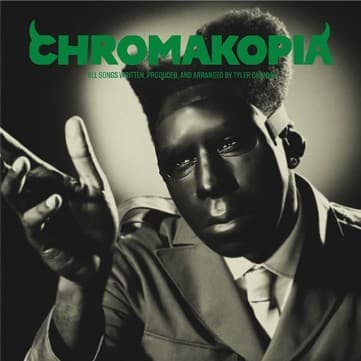
Tyler Okonma Chromakopia — The Cost of Finally Growing Up
Chromakopia opens with a military chant and ends with a plea to come home, and between those points Tyler Okonma spends sixty minutes arguing with himself about whether adulthood means surrender or just a different kind of honesty. The thesis arrives early: this is an album about the specific dread of your thirties, when the freedom you fought for in your twenties starts to feel like isolation and every choice forecloses another version of your life. Hey Jane lays out an unplanned pregnancy from both sides with none of the clarity rap typically demands from these moments, just two people thinking out loud in real time about whether they want to be parents. Take Your Mask Off catalogs four people living behind performed identities, including Tyler himself. The album asks what you owe to the people who raised you, the people you might raise, and the self you were before you learned to perform.
The stakes are higher than on previous albums because Tyler is working without the safety net of a concept or a character. There is no Igor here, no flower boy persona, just a thirty-three-year-old rapper trying to figure out what version of himself to carry forward. The production reflects that exposure: live drums that stumble and recover, samples chopped into anxious loops, bridges that collapse into noise before rebuilding. This is not music designed to slip into a playlist between Gunna and Lil Baby.
It demands the full hour and it earns most of it, though not all fourteen tracks justify their length. What separates Chromakopia from the therapy-rap that dominates streaming is that Tyler never arrives at an answer, never offers the listener a resolution. The album ends with I Hope You Find Your Way Home, a mother's voice and a question left open.
Seventy Instruments Playing Paranoia
The production on Chromakopia sounds like a band falling apart and catching itself measure by measure. St.Chroma builds from a whispered chant into a full orchestral churn, live horns stacked over a bassline that never settles into a groove. Noid runs on a sample flipped into a panic attack, the loop tightening and releasing as Tyler raps about surveillance and mistrust. The drums across the album are mixed to sound like they are being played in a room you can hear, not quantized into a grid. This is not boom bap nostalgia; it is psychedelic soul rebuilt for someone who listens to Erykah Badu and Portishead as much as Madlib.
The writing matches the production's density. Tyler has always been a sharp writer, but here the specificity is uncomfortable. Hey Jane is two verses of interior monologue, no hook, both people weighing the same decision and arriving at no conclusion. I Killed You confronts a friendship or relationship he ended, the guilt presented without self-justification.
Judge Judy turns a courtroom into a metaphor for self-judgment, the verses cataloging small betrayals and compromises. The wordplay is still present but it serves the argument instead of showing off for its own sake. When Tyler raps about legacy on Like Him, comparing himself to his father, the imagery is exact: specific memories, specific resentments, no broad strokes.
The sequencing is deliberate but the album does not pace itself evenly. The first seven tracks move from paranoia through relationships to self-reckoning, each idea given room to breathe. Sticky breaks that momentum with a posse cut that works as a song but not as a transition, the energy scattering instead of building. Thought I Was Dead makes the same mistake, another banger that interrupts the arc instead of advancing it. The album needed either fewer tracks or a stronger argument for why these moments belong in this sequence. Tomorrow and Balloon recover the focus, the former addressing aging and the latter offering a haunted lullaby, but the middle sag is real.
The vocal performance carries more weight than on previous albums. Tyler sings more than he raps across long stretches, the melodies doing the emotional work the bars used to handle. When he does rap, the delivery is conversational, closer to spoken word than to the clipped cadences of Rah Tah Tah. That track is the exception, Tyler shouting over a grimy beat that sounds like early Odd Future, and it is the least interesting song here because it relies on energy instead of ideas. The best moments come when the delivery matches the writing's vulnerability: the quiet desperation on Darling, the exhaustion on Take Your Mask Off.
An Album That Refuses to Peak
Chromakopia does not build to a climax; it spirals inward across fourteen tracks, the intensity rising and falling but never releasing. The sequencing mirrors the subject matter: this is what it feels like to live inside your own head for sixty minutes, the thoughts circling back and doubling over instead of resolving. The opening stretch sets the tone with its chanted intro and orchestral swell, establishing that this album will not sound like anything else in 2024 rap. The first half forms the emotional core, paranoia giving way to specific human dilemmas with no easy answers. Then the album stumbles.
The middle section sacrifices focus for variety. The posse-cut energy and banger aesthetics pull against the introspection that defines the rest of the record. By the time the album reaches its latter third it has to rebuild the atmosphere it had established earlier.
The back-loaded sequencing means the most vulnerable moments arrive after the listener has already spent forty minutes with the album. That is a choice that will reward deep listeners and frustrate casual ones. The length is the album's most significant flaw: at fourteen tracks and sixty minutes, Chromakopia asks for more patience than most 2024 rap albums and does not always justify the ask. Cut two tracks from the middle and the arc tightens. As it stands, the album meanders when it should coil.
The Streaming Era's Least Compromised Rap Album
Chromakopia is Tyler Okonma's most ambitious album and his least accessible, a sixty-minute argument with himself about legacy, parenthood and identity that rejects every concession to playlist culture. It is not his best album—that question cannot be answered without the rest of his catalog on the site for comparison—but it is the one that takes the most risks, both sonically and emotionally. The production alone makes it essential for anyone tracking where rap can go when it ignores what rap is supposed to sound like in 2024. The writing makes it essential for anyone who wants to hear what adult doubt sounds like when it is captured honestly instead of resolved into a motivational arc.
This album is not for casual listeners. It is too long, too dense, too unwilling to deliver the hooks and bangers that would make it an easy recommendation. Start with the opening stretch; if those first tracks feel like work instead of discovery, skip the rest. If they make you want to know where the argument goes, commit to the full album in sequence.
The weaknesses are real: the sagging middle, the uneven pacing, the moments where ambition overreaches execution. But the ambition itself is worth hearing. In a year when most major rap releases were designed to feed the algorithm, Chromakopia sounds like an album made for people who still listen to albums.
For context, pair this with his earlier work once it is reviewed here. For peers working in adjacent spaces, look to albums that prioritize live instrumentation and psychological depth over beats and bars: the lineage runs through Madlib, Kaytranada, and the rap albums that sound more like soul records. Chromakopia will age well because it does not sound like 2024; it sounds like an artist figuring out what he has to say now that the industry has given him the freedom to say it. Whether you want to hear that depends on whether you want your rap albums to comfort you or confront you.
Track by track
Track Listing
St.Chroma
StandoutThe album's opening statement begins with a military chant, voices layered in unison before the beat drops into orchestral chaos. Tyler establishes the sonic palette immediately: live horns, layered vocals, a bassline that refuses to settle. The production churns and expands, instruments entering and exiting without warning. Lyrically he introduces the paranoia and self-interrogation that will define the album, the delivery alternating between whispered confessions and shouted declarations. The track works as both an intro and a mission statement, announcing that this album will not sound like the rest of 2024 rap. The arrangement is too dense to work as a single but as an album opener it does exactly what it needs to: it clears the room of anyone looking for easy listens.
Rah Tah Tah
WeakThe album's most conventional banger, built on a grimy loop and shouted vocals that recall early Odd Future. Tyler raps with aggression here, the wordplay sharp but the energy doing most of the work. The beat knocks hard enough to carry the track but the performance grows exhausting by the second verse, the shouting wearing thin without enough lyrical substance to justify the intensity. This is the album's weakest moment, a concession to the expectation that a Tyler album needs at least one track that could work in a festival set. It does that job but it does not advance the album's argument.
Noid
StandoutThe paranoia hinted at on St.Chroma becomes explicit here, Tyler rapping about surveillance, mistrust and the cost of visibility. The production flips a sample into an anxious loop, the beat tightening and releasing as the verses catalog specific fears: people watching, motives questioned, privacy dissolved. The writing is exact, every image grounded in the experience of being observed constantly. The hook is minimal, just the loop and Tyler's voice layered into a chant. This is one of the album's best tracks, the sound and subject perfectly matched. The sample work is exceptional, chopped into something that feels like a panic attack translated into music. The track would work as a single for anyone willing to sit with discomfort.
Darling
StandoutA love song that doubles as an interrogation, Tyler addressing a partner while questioning his own capacity for the relationship. The production is softer here, built on keys and a bassline that actually grooves instead of churning. He sings more than he raps, the melody carrying the emotional weight. The writing examines the gap between wanting someone and being able to give them what they need, the verses filled with small admissions of failure. The track is vulnerable without being sentimental, Tyler refusing to resolve the tension into either commitment or breakup. It is a strong example of the album's core approach: present the dilemma, refuse the easy answer.
Hey Jane
StandoutThe album's most daring track, two verses from opposite sides of an unplanned pregnancy with no hook and no resolution. Tyler raps the first verse from his perspective, weighing fatherhood against freedom, legacy against fear, the specificity uncomfortable in its honesty. The second verse flips to her perspective, the same decision from the other side, the same doubts in different words. The production stays minimal, just keys and bass, giving the writing room to breathe. This is the best writing on the album, every line doing work, no filler. The track will be divisive because it offers no moral clarity, no answer, just two people thinking out loud. It is exactly the kind of subject commercial rap typically avoids and Tyler handles it without flinching. Essential.
I Killed You
SolidTyler confronts a relationship or friendship he ended, the verses cataloging guilt without self-justification. The production is built on a looped sample and live drums, the beat stumbling and recovering. He raps about the specific ways he failed someone, the small cruelties and large absences, the writing direct and unsentimental. The track does not offer redemption or reconciliation, just the admission of harm. It is another example of the album's refusal to provide easy resolutions. The performance is quiet, almost spoken, the delivery matching the subject's weight. Solid but not essential, the idea stronger than the execution.
Judge Judy
SolidA courtroom metaphor for self-judgment, Tyler putting himself on trial for compromises and betrayals. The production uses a sample of what sounds like courtroom proceedings, layered under a beat that feels unstable, the rhythm shifting. The verses list grievances against himself, the writing specific enough to avoid abstraction. The hook is repetitive and the metaphor is heavy-handed, the track's weakest element. The idea works better than the execution, the courtroom framing too literal to support the weight Tyler wants it to carry. It is the kind of ambitious miss that makes the album interesting even when it does not fully succeed.
Sticky
SolidA posse cut that breaks the album's momentum, multiple voices trading verses over a beat that prioritizes energy over atmosphere. The production is sharp and the verses are solid but the track does not belong in this sequence. It feels like a concession to the expectation that a Tyler album needs a crew track, the kind of song that works on a playlist but interrupts the album's arc. The performances are strong enough to carry the track in isolation but in context it is a misstep, the energy scattering instead of building.
Take Your Mask Off
StandoutThe album's thesis track, Tyler cataloging people living behind performed identities: a preacher hiding his true self, a gangster performing toughness, a woman performing femininity, and Tyler himself performing the role the industry expects. Each verse is a portrait, the writing specific and empathetic. The production is built on a sample and live instrumentation, the beat shifting between verses to match each character. The hook asks the question the album keeps circling: what would you be if you stopped performing? The track is ambitious and mostly successful, the writing strong enough to carry the concept. It is one of the album's best moments, the kind of song that rewards close listening and reveals more on repeat.
Tomorrow
StandoutTyler raps about aging and the future, the verses weighing ambition against exhaustion. The production is minimal, just keys and bass, the beat giving the writing space. He addresses the fear of running out of time, the sense that the next decade will be different from the last, the uncertainty about what he still wants to accomplish. The writing is direct, the performance conversational. It is a strong track that recovers the focus after the album's middle sag, setting up the final stretch. Not essential but necessary in context.
Thought I Was Dead
SolidAnother banger that interrupts the album's arc, Tyler rapping with aggression over a hard beat. The production knocks and the verses are sharp but the track makes the same mistake as Sticky, prioritizing energy over the introspection that defines the rest of the album. It works as a song but not as a sequencing choice. The album would be tighter without it.
Like Him
StandoutTyler compares himself to his father, the verses examining legacy and resemblance. The writing is specific, detailing small memories and large resentments, the imagery exact. The production is built on a soul sample and live drums, the beat warm but unstable. He raps about the traits he inherited and the ones he refused, the ways he has become the man who was not there. The track is vulnerable without being sentimental, Tyler presenting the complexity without resolving it. It is one of the album's strongest moments, the writing and production perfectly matched. Essential for understanding what the album is trying to do.
Balloon
StandoutA haunted lullaby, Tyler singing over minimal production about letting go and floating away. The track is almost ambient, the beat barely present, the vocals layered and reverbed. It works as a comedown after the emotional weight of Like Him, the atmosphere doing the work the lyrics only suggest. The writing is impressionistic, more about mood than argument. It is the quietest moment on the album and one of the most effective, the restraint earning the impact. Not a strong standalone track but necessary in sequence.
I Hope You Find Your Way Home
StandoutThe album closer, built on a mother's voice and a plea for the listener to find their way. Tyler steps back here, letting the sample and the atmosphere carry the track. The production is minimal, just the voice and a distant beat, the effect almost like a prayer. There is no resolution, no answer to the questions the album has been asking, just the hope that the listener finds what they are looking for. It is a vulnerable ending, Tyler refusing to tie the album into a neat conclusion. The track works because it does not try to do too much, the simplicity earned after sixty minutes of density. A strong closer that leaves the album open instead of sealed.