The scorecard
6.6/10 · Good
- Writing25%
- 7.0
- Production25%
- 6.5
- Delivery15%
- 8.5
- Cohesion15%
- 5.5
- Originality10%
- 5.0
- Replay value10%
- 6.5
The wordplay and internal rhyme chains are dense and surprising from line to line, and the mother-and-fame confessions land, but the old habit of reaching for slurs and shock lines resurfaces.
Rick Rubin's throwback guitars and scratches on the Beastie Boys-flavored single are bold, while the arena-rock and EDM-leaning cuts date quickly and the choruses sound assembled by committee.
His flow switching on the long rap-about-rap showpiece and the sheer breath control across the record are among the best technical performances of his career.
At roughly 80 minutes with an unbroken run of guest hooks and a back half that drifts into pop balladry, the record loses its thread long before the closer.
The sequel framing and old-school-hip-hop homage are a clear pivot from Recovery, but much of the material is Eminem revisiting his own greatest hits rather than moving forward.
The best verses reward repeat listens, though the sequel packaging and the bloated length mean most listeners will program around a third of the tracklist.
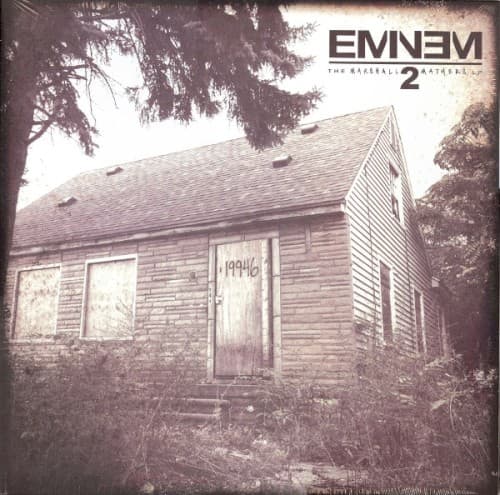
Eminem The Marshall Mathers LP 2: A Sequel Built Like a Campaign
The Marshall Mathers LP 2 is a career decision that happens to contain some of the best rapping of its author's later years, and the interesting part is how little the two things have to do with each other. Eminem's eighth album borrows the title of the record that made him dangerous, wraps its rollout around college football broadcasts and a video-game trailer, and then fills the verses with the most technically dense rapping he had delivered in more than a decade. As strategy it is excellent. As an album it is only partly so, and the gap between those two judgments is the story.
The strategic logic is easy to read. By the time this record arrived, Eminem had spent three albums chasing either redemption or crossover, and critics had stopped treating each new release as an event. Calling the follow-up a sequel to his third album solved the problem in one move, since the name told listeners what to expect before a single song played. According to the fact sheet, the idea grew out of early recordings that reminded Eminem and his circle of his older work, and he paired that impulse with a deliberate interest in vintage turntablist sounds, bringing in Rick Rubin to help. Dr. Dre sits alongside Rubin as executive producer, which gave the project the senior-statesman branding it needed.
The market agreed. The album topped the Billboard 200 with more than 792,000 copies in its first week, it later went quadruple platinum, and it won him a record sixth Grammy for Best Rap Album. Critics were warmer than they had been in years, though the praise concentrated on the rapping rather than on the record as a whole. That distinction is the right way into it: a brilliant performance in service of a plan that is not always as good as the performer.
Rubin's Throwback Gamble and a Voice That Outruns Its Beats
The production plan is a pivot, and it works unevenly. Rick Rubin, executive producer alongside Dr. Dre, anchors the old-school side of the album with a guitar-and-breakbeat single that samples the Beastie Boys and Billy Squier, an explicit nod to the Licensed to Ill era that the fact sheet names as a reference point. That single is the most coherent statement of the album's concept: a rapper in his forties who wants to hear what it sounded like when rap and rock shared a room. Elsewhere the sound spreads out. Arena-rock guitars on the video-game single, an EDM-leaning bed for the showpiece, and a dark pop collaboration with Rihanna written partly by an outside songwriter all sit under the same title, and they do not share a sound.
The common thread is minimalism. The fact sheet notes the production is more stripped-back than on his previous records, and that is audible: drums are loud and dry, the samples are clearly identifiable, and the arrangements leave room for him to run. That works well when the beat is a platform for his voice and badly when the beat is trying to be a song in its own right, because the hooks are largely handed to guest singers who bring polish but not personality.
Where the album earns its reputation is in delivery and craft. His flows change shape from verse to verse, XXL singled out the diversity of his cadences, and the internal rhyme work holds up when you slow it down. Paul MacInnes of The Guardian awarded the record five stars for exactly this reason, and the New York Times, while more reserved, agreed that his lyrics reward close examination. The performance is athletic in a way few of his peers manage at any age, and it is the reason the album can be recommended even by people who dislike its structure.
The concrete weakness is the writing's habit of recycling its own targets. The same critics who praised the technique also noted that he still reaches for homophobic slurs and shock lines, as if he had few new experiences to draw from. The nostalgic frame makes the problem worse rather than better: when the album is explicitly a sequel, the old routines feel like obligations rather than provocations. The result is a record that is dazzling at the sentence level and tired at the idea level. It also means the best moments feel like individual performances rather than parts of a single argument, which is exactly the opposite of what a sequel titled after a landmark album should promise.
Eighty Minutes, Three Albums: Where the Sequence Loses Its Spine
The sequencing is the clearest sign that this was built as a campaign rather than composed as a record. At 16 tracks and close to 80 minutes, it plays like a best-of programmed by a committee that could not agree what to cut. The opening is strong: a long, narrative-driven sequel to an earlier story song sets a dark, theatrical mood, and the first stretch alternates between aggressive rap and big guitar singles in a way that keeps the energy up.
The middle is where the shape starts to wobble. Singles arrive at the pace that suited their release schedule rather than the pace that suits a listener, and the guest-hook songs cluster together so tightly that they flatten each other. A rap showpiece, a chart-topping collaboration and a pop ballad can all be good songs and still make a poor sequence, because each one asks for a different mood, and the transitions between them are abrupt. The effect is a record that keeps resetting rather than building.
The closing stretch recovers some ground. The final track runs past seven minutes and returns to the persona that built the original, which gives the album a sense of coming full circle, even if the circle is a little neat. It is a satisfying ending to a record that does not always earn its length. The deluxe edition adds five more songs, and none of them changes the picture; they make the sprawl more obvious rather than more interesting.
Trimmed to ten or eleven tracks, this would have been a tighter and better record, with the best verses doing more work against fewer distractions. As released, it reads as a compromise between the album Eminem wanted to make and the album the rollout required. The length is not earned, and the best case for it is that the rapping is good enough to make a long sit feel shorter than it is.
Better Than the Reviews of the Era, Smaller Than the Title Promises
Within Eminem's catalog, The Marshall Mathers LP 2 ranks as a strong later-career record that sits well behind the three albums that made his reputation and clearly ahead of the albums that preceded it in the 2000s and early 2010s. It is better than Relapse and Recovery because its best verses are sharper and its ambition is clearer, and it falls short of The Marshall Mathers LP because it never matches that record's sense of danger or its sequencing. The title invites that comparison, and the sequel does not win it.
The album is for listeners who value technique above everything else, who want to hear a veteran rapper stress-test his flow, and who care about how a major-label artist reinvented himself at middle age. It is also a good fit for anyone curious about how Eminem used a sequel brand and a gaming tie-in to re-open a conversation. Skip it if you want the focused, personal writing of his best records or a front-to-back listen without detours. The three tracks to start with are Rap God, Berzerk and Bad Guy, because between them they cover the technical showpiece, the old-school pivot and the long-form storytelling.
It has aged in two directions. The rapping has held up, and the best verses still sound startling, while the arena-rock and EDM-leaning production choices place the album firmly in 2013. The singles have outlived the sequencing, which says something about how the album was built.
For the next step, hear The Marshall Mathers LP to measure the sequel against its source, and then Recovery to hear the pop-minded record this one was reacting against. The sequel is the version of Eminem that knows exactly how good he is at rapping, and the difference between knowing it and showing it is the distance between this album and the one it is named after.
Track by track
Track Listing
Bad Guy
StandoutThe opener runs more than seven minutes and has been described as a sequel to the story told in Stan, with a chorus sung by Sarah Jaffe and production from S1, M-Phazes and Streetrunner. It is the album's most ambitious piece of narrative writing, and it sets the sequel's terms immediately by flipping a familiar perspective. It builds tension patiently and keeps the storytelling front and center. It is slightly overlong and the sample choices (a novelty record, an Italian film-score piece and a jazz cover) are an odd mix, but as a statement that this is a real sequel, it works.
Parking Lot (skit)
WeakA short skit that sets up the next song. It is filler and does little more than pad the running order.
Rhyme or Reason
StandoutRick Rubin and Eminem build a loop around a sample of a Zombies record, and the result is the smoothest of the old-school moves on the album. The verses are nimble and nostalgic, and the sample gives the song a laid-back warmth that the louder singles lack. It is a pleasant, lower-stakes track that shows the retro idea working at a smaller scale.
So Much Better
SolidA brisk, bitter kiss-off produced by Eminem and Resto. It is built for the vocal acrobatics, and the delivery is crisp, but the bitter relationship rhymes retread ground the earlier records covered better.
Survival
SolidThe Call of Duty: Ghosts trailer song, with DJ Khalil's production and a chorus by Liz Rodrigues. According to the fact sheet Eminem turned in five successive versions, each bigger than the last, and the final one sounds like it: breakneck arena-rock guitars and trashy drums under a verse built to be shouted along with. It peaked at number 16 on the Hot 100 and is a good example of the album at its most calculated. As a piece of rap it is strong, as a listening experience it is exhausting, and the chorus does most of the heavy lifting.
Legacy
SolidA big, soaring pop-rap production by Emile, with vocals from Polina that Eminem left untouched. The hook is big enough to be a single and the verses stay in a reflective register. It also feels more like a radio song with a rapper added than a rap song with a hook.
Asshole
SolidAlex da Kid and Eminem produce a sneering, bounce-heavy cut with a chorus by Skylar Grey. The beat is moody and the hook is catchy, but the song is thin on ideas and leans on the shock value of its title.
Berzerk
StandoutThe lead single, produced by Rick Rubin, and the album's clearest statement of purpose. Samples of the Beastie Boys and Billy Squier give it a punchy guitar-and-beats drive that channels the Licensed to Ill era, and Naughty by Nature gets a sample credit as well. It debuted at number three on the Hot 100, and the football broadcast tie-in helped it spread. The verses are bouncy, the hook is simple, and the whole thing is built to be shouted back. The old-school homage is slightly cartoonish, yet that is the charm: it is rap as pure fun, rare on a record that otherwise takes itself very seriously.
Rap God
StandoutThe showpiece. DVLP and Filthy supply an EDM-inspired bed, and Eminem uses it for an extended display of shifting flows, name-checks of the people who built the form, and a final claim to godhood. It debuted at number seven on the Hot 100 and is the best argument for the album's technical reputation. The fastest passage is a genuine feat of breath control, and the track works as both entertainment and a lesson in cadence. The weaknesses are conceptual: it is rap about rap, and the self-regard can be wearing. As a performance, it is outstanding.
Brainless
SolidAnother Eminem and Resto production, in a hard-edged, self-mythologizing mode. The rhymes are dense and the flow is fluid, but nothing about the song suggests it needed to exist beyond demonstrating that the technique is intact.
Stronger Than I Was
SolidA slow, melancholy ballad about the end of a relationship, produced by Eminem and Resto. The vulnerability is sincere, and it is a welcome shift in tone, but it arrives at a point where the sequence has already sagged, and it does not do enough to pull it back.
The Monster
StandoutThe chart-topping collaboration with Rihanna, produced by Frequency, and the fifth Eminem single to reach number one on the Hot 100. The song is built around a dark battle with his own demons, with Bebe Rexha's backing vocals underneath Rihanna's chorus. It is a more calculated version of the formula that made their earlier collaboration a hit, and the formula is still effective: the hook is huge, the verses are tidy and the mood is dark enough to avoid cliche. It is a pop-rap triumph, and the least risky track on the record.
So Far…
StandoutA loose, comic Rick Rubin production built on a Joe Walsh sample and a Schoolly D reference, with Eminem rapping about the indignities of everyday life. It is the funniest track on the album and a welcome break in tone, even if the joke goes on a little long.
Love Game
StandoutKendrick Lamar guests on a Rick Rubin production with a sample of an old pop record and vocals by Keira Marie. The two rappers trade verses in a playful, flirtatious duet, and Lamar's contribution is the sharpest guest verse on the record. It is a fun detour, and a useful reminder of how much of the album's energy comes from other voices.
Headlights
StandoutNate Ruess sings the hook on a warm, mid-tempo production by Emile, Jeff Bhasker and Eminem. It was released as a single in Australia and peaked at number 45 on the Hot 100. The song is a conciliatory letter to his mother, and its sincerity is moving, though the polished hook softens what should be an uncomfortable subject.
Evil Twin
SolidThe closer runs more than seven minutes and returns to the split-persona theme that defined the original album. Sid Roams and Eminem produce, and the track samples the Bad Meets Evil reunion, tying the project back to earlier work. It is more a summary than a statement, but it ends the record with a sense of closure.
Frequently Asked Questions
Is The Marshall Mathers LP 2 as good as the original?
How well did The Marshall Mathers LP 2 sell?
What are the best songs on The Marshall Mathers LP 2?
Genres
Styles