
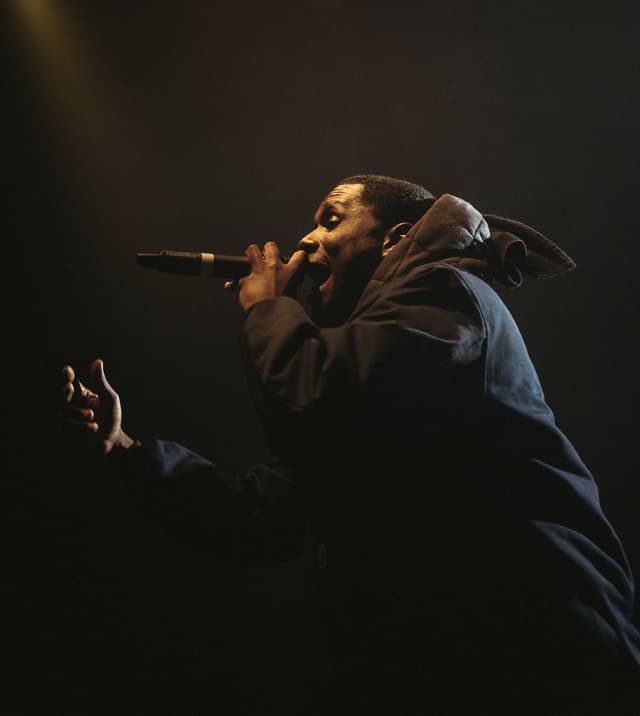
The Phantom Architect of Hip-Hop's Digital Age
Jay Electronica became hip-hop's most compelling mystery through deliberate absence. Born Elpadaro F. Electronica Allah in New Orleans, he emerged in the late 2000s with a sound that felt ancient and futuristic simultaneously — dense with religious symbolism, cosmic imagery, and production that stripped boom-bap to its spiritual essence. What made him singular wasn't just the music but the mythology: leaked tracks circulating like scripture, a debut album promised for over a decade, and features so rare they became events. He treated scarcity as artistic statement when the industry demanded constant content.
His legend rests largely on "Act I: Eternal Sunshine (The Pledge)," a 15-minute suite released in 2007 that sampled Jon Brion's score for the film Eternal Sunshine of the Spotless Mind. The project circulated as an unofficial download, never commercially released, yet it established him as someone operating on a different frequency. Tracks like "Exhibit C" became underground anthems without radio play or major label push. His signing to Roc Nation in 2010 suggested imminent arrival, but the years stretched on with only scattered verses and guest appearances sustaining his presence.
When A Written Testimony finally materialized in 2020, it arrived not as career capstone but confirmation of what the whispers suggested: that Jay Electronica had been refining a specific artistic vision incompatible with industry timelines. The album, heavy with Jay-Z features and religious meditation, polarized listeners who had built their own mythologies around his unreleased catalog. But it clarified his position as someone for whom hip-hop serves primarily as spiritual transmission rather than entertainment vehicle.
Metaphysical Lyricism Over Just Blaze's Cinematic Soul
Jay Electronica writes like someone searching religious texts for hip-hop's original purpose. His verses layer references to the Nation of Gods and Earths, Kabbalah, Islamic theology, and conspiracy theories into narratives that feel less like storytelling and more like testimony. He operates in the tradition of conscious rap but without the didacticism — his bars assume the listener will meet him at a certain intellectual altitude. Lines arrive dense with double meanings, numerology, and historical allusion, demanding repeated listens to unpack their architecture. Where many lyricists use metaphor as decoration, he uses it as primary language.
His flow exists outside contemporary trends. No melodic sing-rap, no triplet flows, no concessions to streaming-era attention spans. He raps with the deliberate pacing of someone who believes every word carries weight, often adopting a near-conversational cadence that makes sudden bursts of technical prowess feel earned rather than performed. His voice carries the warmth of Southern roots but the precision of East Coast lyrical tradition, a hybrid that made him difficult to regionalize.
Production-wise, he gravitated toward Just Blaze's orchestral soul during his most celebrated period, crafting over beats that sounded like triumph and tragedy compressed into the same moment. "Exhibit C" remains the definitive example: booming drums, soaring strings, and enough empty space for every syllable to land with sermon-like authority. Later work incorporated more austere soundscapes, sometimes just a looped sample and minimal percussion, as if stripping away anything that might distract from the message. He treats beats as canvases for ideas rather than backdrops for performance.
From New Orleans Streets to Roc Nation's Most Patient Investment
Jay Electronica's early years remain deliberately obscure, part of the mystique he cultivated. Growing up in New Orleans' Magnolia Projects, he absorbed the city's musical heritage but left before establishing himself locally, spending years traveling and recording in various cities. By the time he surfaced online in the mid-2000s, he had already developed a fully formed aesthetic — no visible evolution from amateur to professional, just arrival. "Act I" dropped as a complete artistic statement, suggesting years of refinement behind closed doors.
The response was immediate within underground circles. Blogs and forums circulated his music like contraband, and the lack of official release channels intensified interest. "Exhibit C" in particular became a calling card, its apocalyptic tone and lyrical density marking him as someone concerned with hip-hop as art form rather than commerce. Features began appearing: a verse here, a leaked collaboration there, each one meticulously crafted and spaced months apart. His approach inverted the typical artist trajectory — rather than flooding the market to build momentum, he created demand through strategic withholding.
The Roc Nation signing in 2010 felt like validation, Jay-Z himself calling Electronica one of the best rappers alive. But the promised album never came. Years passed. Frustration built. He released singles sporadically — "Shiny Suit Theory" with Jay-Z in 2010, "Better in Tune with the Infinite" in 2014 — each one reinforcing his skills while deepening confusion about the delay. Rumors circulated about perfectionism, label politics, personal issues, religious study periods, but no official explanation arrived. The wait itself became part of his narrative, fans debating whether the silence represented artistic integrity or self-sabotage.
A Written Testimony finally dropped in March 2020 with minimal warning, just days before global pandemic lockdowns reshaped reality. The timing felt either perfectly aligned with its apocalyptic themes or cruelly mistimed for an album that needed proper rollout. Jay-Z appeared on eight of ten tracks, a collaboration that read as both blessing and complication — some heard mentorship and creative partnership, others heard the elder statesman overshadowing the long-awaited debut. The production leaned heavily on The-Dream and Jay Electronica himself, with sample choices drawn from religious music and film scores. Tracks like "The Neverending Story" and "A.P.I.D.T.A." delivered the metaphysical bars his core audience craved, but the album's heavy religious focus alienated listeners expecting broader themes.
Critical response recognized the craftsmanship while questioning whether any album could justify the decade-plus wait. It debated whether Jay Electronica had built an impossible standard through absence, creating expectations no single project could satisfy. The album exists now less as career-defining statement and more as data point in a larger artistic philosophy that rejects conventional music industry logic. His post-album activity returned to sporadic mode: occasional features, rare public appearances, social media posts that range from spiritual wisdom to inflammatory political commentary.
The Prophet Who Chose Silence in Hip-Hop's Loudest Era
Jay Electronica's influence operates in paradox. He proved an artist could achieve iconic status while releasing almost no official music, reversing every rule about visibility and momentum. His model — quality over quantity, mystique over accessibility, spiritual over commercial — inspired artists who felt suffocated by content demands. You hear his fingerprints in how certain rappers treat album rollouts as spiritual events rather than product launches, in the renewed interest in esoteric lyricism, in the idea that withholding can generate as much power as releasing.
He exists as hip-hop's great what-if. Fans debate endlessly what his career might have looked like with different choices: earlier album release, more consistent output, less controversy. The unreleased music that circulates online — "The Pledge," "Road to perdition," loosies and freestyles — gets held up as proof of squandered potential. But that reading misses how his approach itself constitutes artistic statement. He demonstrated that an artist could operate entirely outside industry expectations and still command respect, still influence conversations, still matter.
His connection to artists like Mos Def and Common in the conscious rap lineage is obvious, but his real kinship might be with someone like MF DOOM — another artist who treated scarcity as strategy, who built mythology through absence, who refused to play the game on anyone's terms but their own. The difference: DOOM released prolifically under various aliases while Electronica simply went silent. Both approaches challenged what it means to have a rap career in the modern era, suggesting alternatives to the constant churn.
Whether future releases arrive remains uncertain. Jay Electronica has never operated on schedules or responded to pressure. His catalog, sparse as it is, remains a touchstone for listeners who want hip-hop to reach toward transcendence, who believe the genre can carry philosophical weight without sacrificing artistic credibility. He turned limitation into legend, proving sometimes the most powerful thing an artist can do is leave you wanting more.